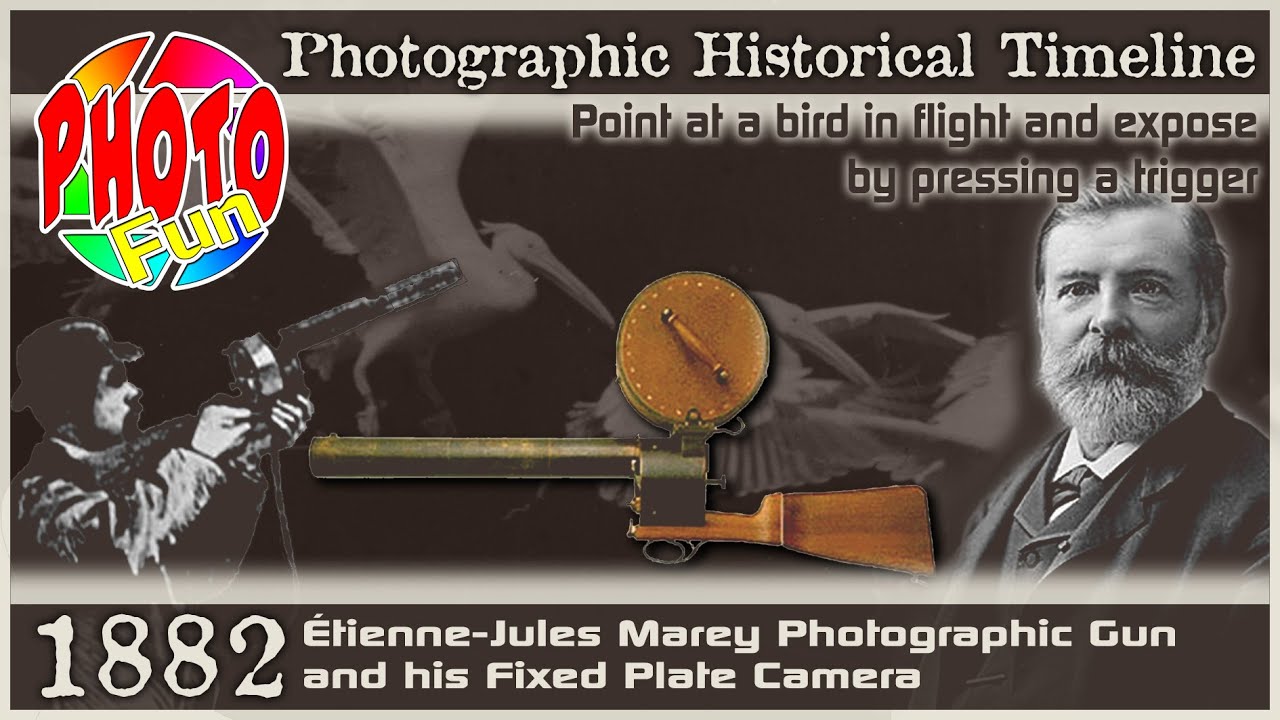
Photographic Historical Timeline 1882 Étiene-Jules Marey Photographic Gun and his Fixed Plate Camera
Автор: Photo Fun
Загружено: 2023-09-03
Просмотров: 422
Описание:
Photographic Historical Timeline 1882 Étienne-Jules Marey Photographic Gun and his Fixed Plate Camera Point at a bird in flight and expose by pressing a trigger
During his visit to Europe in 1881-82, Eadweard J. Muybridge had a significant encounter with the renowned French physiologist, Professor Étienne-Jules Marey. Marey had already established himself as a leading figure in the study of animal movement, with a particular focus on understanding the flight of birds.
Impressed by Muybridge's pioneering work and the methods he employed to capture and analyze motion, Marey recognized the immense potential of these techniques for his own research. Muybridge's use of multiple cameras to capture consecutive frames of motion and his innovations in projection technology had revolutionized the study of motion.
Marey saw an opportunity to apply Muybridge's methods to his investigations of animal movement, seeking to gain deeper insights into the intricacies of flight and motion in birds. He decided to adopt and adapt Muybridge's approach to suit his own scientific inquiries.
In 1882, Professor Étienne-Jules Marey faced the challenge of capturing the intricacies of bird flight using a single camera that could be triggered on-demand. To fulfill this requirement, Marey designed a revolutionary camera known as the chronophotographic gun.
The chronophotographic gun was a remarkable invention that combined the precision of scientific photography with the functionality of a handheld trigger mechanism. With this camera, Marey could point it at a bird in flight and expose the photographic plate by simply pressing a trigger. This innovative approach allowed him to capture a sequence of images in rapid succession, effectively studying the flight motion of birds.
It's worth noting that eight years prior to Marey's invention, the French astronomer P.J.C. Janssen had employed a similar concept in his work. Janssen had utilized a revolver camera to photograph the transit of Venus. The revolver camera incorporated a clockwork mechanism, which utilized a Maltese cross, to rotate the photographic plate intermittently.
Marey's chronophotographic gun marked a significant advancement in the field of motion analysis and scientific photography. By allowing him to capture the nuances of bird flight with a single handheld camera, Marey was able to conduct detailed studies of animal locomotion.
Marey's photographic gun represented a significant evolution of the camera design used by the French astronomer P.J.C. Janssen. Instead of employing a Maltese cross mechanism, Marey utilized an eccentric cam to achieve intermittent motion, allowing for precise and rapid exposures.
The photographic gun was ingeniously engineered to capture twelve exposures on a single photographic plate, with each exposure roughly the size of a postage stamp.
This rapid and precise succession of exposures was crucial for Marey's studies of animal locomotion, particularly in the case of bird flight. By capturing multiple frames in such a short span, Marey could analyze the subtle movements and wing positions of birds during their flight, providing invaluable insights into the mechanics of avian motion.
In February 1882, Étienne-Jules Marey employed his newly developed photographic gun for the first time to capture the motion of a seagull in flight. The bird was photographed against the backdrop of the sky, resulting in a striking silhouette of the graceful creature in motion.
Inspired by the photographic sequences obtained from the seagull's flight, Marey proceeded to create life-size wax models of the bird in various positions and attitudes, as depicted in the photographs. These wax models were meticulously crafted to accurately represent the bird's movement and postures.
The second camera boasted impressive capabilities, enabling it to take ten exposures per second, with each exposure lasting an astonishingly short duration of 1/5000th of a second. This breakthrough allowed Marey to capture rapid motion with unprecedented precision and detail, offering invaluable insights into the complexities of movement.
Marey's newly designed cameras had the ability to capture photographs on a continuous roll of sensitive film. Initially, these rolls were made of paper, but he later transitioned to using celluloid film when this revolutionary material became available.
One challenge Marey faced was the limited length of available film rolls. At that time, rolls of film longer than four meters (approximately 13 feet) were not yet available. As a result, each roll of film was constrained to approximately forty exposures.
These cameras were remarkably advanced for their time, capable of capturing up to fifty pictures per second, with each exposure lasting an astonishingly short 1/1000th of a second.
Despite the impressive capabilities of his cameras, the resulting series of photographs, though scientifically significant, was too short for public exhibition.
Повторяем попытку...
Доступные форматы для скачивания:
Скачать видео
-
Информация по загрузке:




![Pink Floyd - The Dark Side Of The Moon (50th Anniversary) [2023 Remaster] {Full Album}](https://imager.clipsaver.ru/k9ynZnEBtvw/max.jpg)