Bioluminescence Explained: The Chemistry of Glowing Animals (Luciferin & Luciferase)
Автор: Tutor Consortium
Загружено: 2025-12-30
Просмотров: 72
Описание:
Welcome to Tutor Consortium! Dive into the mesmerizing world of Bioluminescence, the phenomenal ability of living organisms to produce light. This lesson is a perfect fusion of High School Biology and Chemistry, explaining the precise chemical reaction and the diverse biological functions of this "cold light."
The Chemical Spark: Luciferin and Luciferase We start with the core chemistry. Bioluminescence is a form of chemiluminescence—light produced by a chemical reaction. You will learn the roles of the three essential players:
Luciferin: The light-emitting substrate molecule.
Luciferase: The enzyme that acts as the catalyst, speeding up the reaction.
Oxygen: The necessary reactant that oxidizes the luciferin. We explain why this process is considered "cold light," achieving near-perfect energy efficiency with almost no heat loss, unlike artificial light sources. We will also touch on how the structure of the luciferase enzyme determines the specific color of the light, explaining why deep-sea creatures mostly glow blue, while fireflies glow green or yellow.
The Anatomy of Light Production We explore the structures that facilitate this glow:
Photophores: Specialized light organs found in marine life, often equipped with reflectors and lenses for precision.
Intrinsic vs. Symbiotic: We distinguish between organisms that produce their own chemicals (like the firefly) and those that host light-producing bacteria (like the anglerfish).
Evolutionary Functions: Why Glow? Bioluminescence is not just beautiful; it is a critical tool for survival across countless ecosystems. We break down its four major evolutionary roles:
Communication and Mating: We use the classic example of the firefly, whose specific flash patterns act as a species-specific courtship signal.
Offense (Luring Prey): From the anglerfish’s tempting bacterial lure to the predatory firefly that mimics other species’ signals, light is used as a lethal trap.
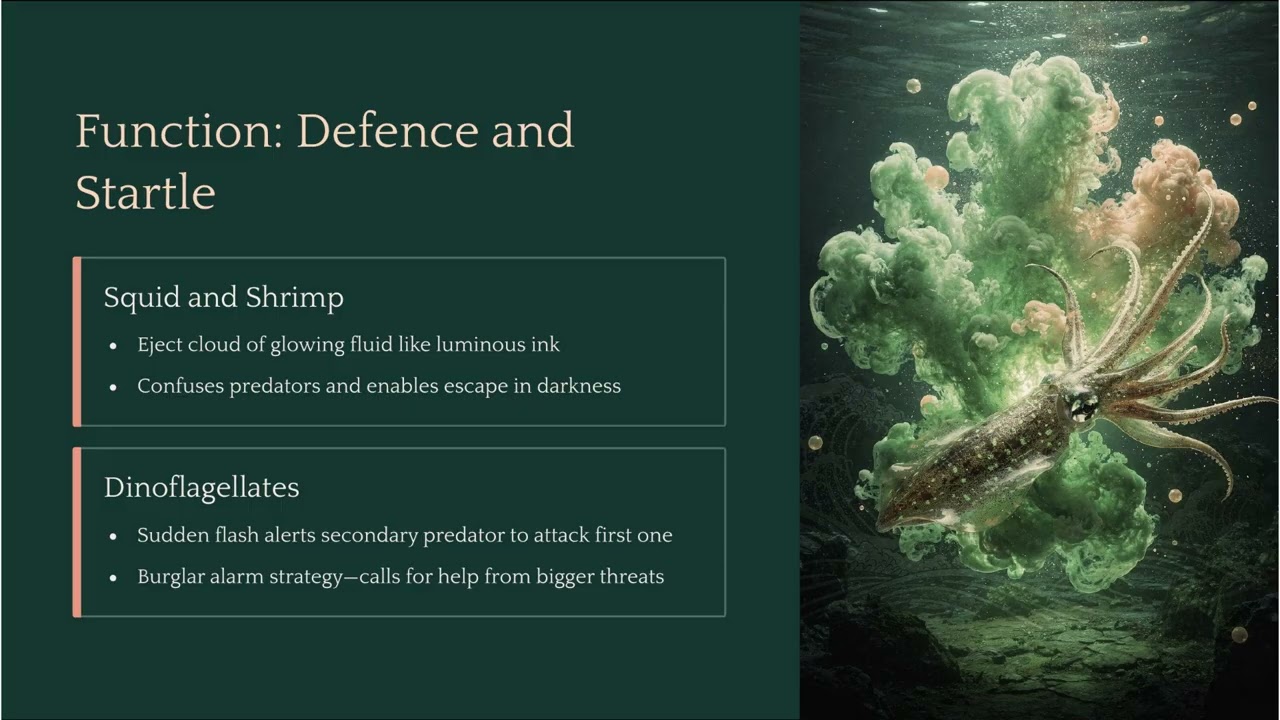
Defense (Startle and Evasion): We look at organisms that deploy a sudden flash of light to startle or distract a predator, and the "Green Bomber" worm that detaches a glowing decoy.
Camouflage (Counterillumination): In the dim, deep ocean, many animals subtly adjust their glow to match the faint light from above, eliminating their silhouette from predators below.
Beyond Nature: Applications in Science Finally, we highlight the incredible utility of these natural chemicals in modern biotechnology. Luciferase is commonly used in labs as a "reporter gene." By attaching the luciferase gene to a target gene, scientists can instantly tell if that gene is active because the cell will begin to glow, providing a powerful, visible marker for tracking disease progression or testing drug effectiveness.
This lesson is essential for high school students studying biochemistry, ecology, and biological adaptations.
Visit our website for more resources: For detailed biochemistry diagrams, ecological analysis worksheets, and study guides, visit us at: www.tutorconsortium.com
Повторяем попытку...
Доступные форматы для скачивания:
Скачать видео
-
Информация по загрузке: