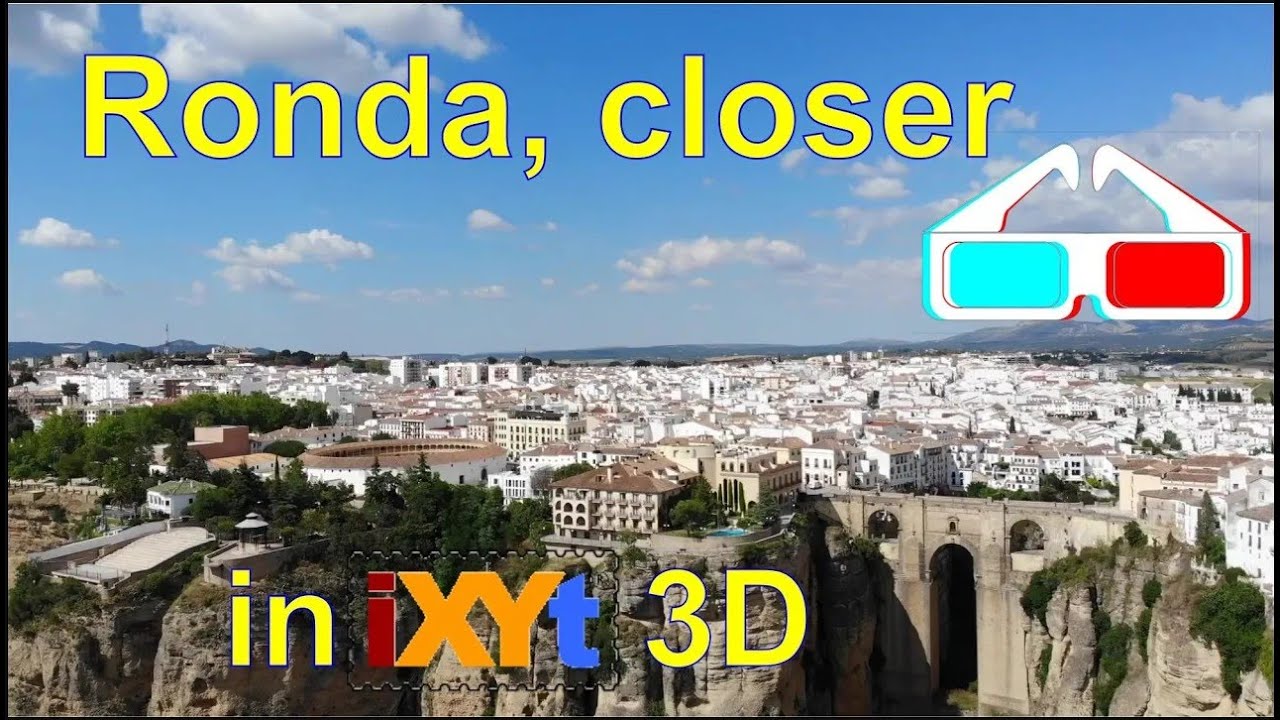
Ronda closer view, Málaga, Andalusia, Spain in relax red-cyan anaglyph iXYt 3D video
Автор: iXYt
Загружено: 2025-11-21
Просмотров: 5
Описание:
Closer Ronda like a toy, as if you were a giant 100 meters tall, in red-blue anaglyph iXYt 3D video.
The places of Arunda and Acinipo mentioned by Pliny have been traditionally identified with the current Ronda.
"Its population is about 35,000. Ronda is known for its cliffside location and a deep canyon that carries the Guadalevín River and divides the town. It is one of the towns and villages that are included in the Sierra de las Nieves National Park.
History
Around the city are remains of prehistoric settlements dating to the Neolithic, including the rock art of Cueva de la Pileta.
The places of Arunda and Acinipo mentioned by Pliny have been traditionally identified with current Ronda.
In the fifth century AD, Ronda was conquered by the Suebi, led by Rechila, being reconquered in the following century by the Eastern Roman Empire, under whose rule Acinipo was abandoned. Later, the Visigothic king Liuvigild captured the city. Ronda was part of the Visigoth realm until 713, when it fell to the Umayyad troops, who named it Hisn al-Rundah ("Castle of Rundah") and made it the capital of the Takurunna province.
It was the hometown of the polymath Abbas ibn Firnas (810–887), an inventor, engineer, alleged aviator, chemist, physician, Muslim poet, and Andalusian musician.
After the disintegration of the caliphate of Córdoba, Ronda became the capital of a small kingdom ruled by the Berber Banu Ifran, the taifa of Ronda. During this period, Ronda gained most of its Islamic architectural heritage. In 1065, Ronda was conquered by the taifa of Seville led by Abbad II al-Mu'tadid. Both the poet Abu al-Baqa ar-Rundi (1204–1285) and the Sufi scholar Ibn Abbad al-Rundi (1333–1390) were born in Ronda.
Hitherto part of the Nasrid Kingdom of Granada, Ronda was seized by the Crown of Castile in 1485. The city was granted a fuero copying Seville's.[3] Upon the Christian conquest, a policy favouring the settlement of Christians in the cities while leaving Muslim majorities in the rural communities was pursued, configurating a 70%–30% balance between mudéjares and Christians settlers in the Serranía de Ronda.
In the early 16th century, a series of edicts enacted that mudéjares from the Crown of Castile must either leave or convert. The practice of Taqiyya was nonetheless common among converts from Islam (Moriscos) and cultural and religious continuity was prevalent in the area until the Alpujarras revolt. Upon the 1570 decision to resettle the so-called moriscos de paces (Moriscos uninvolved in the uprising) away from the Kingdom of Granada and the fateful actions of municipal Christian militias helmed by Antonio de Luna [es] involving theft and enslaving, the hitherto largely peaceful morisco community in the Serranía de Ronda radicalised.[6] Moriscos engaged in guerrilla warfare and banditry, taking advantage of their superior knowledge of the area.
In the early 19th century, the Napoleonic invasion and the subsequent Peninsular War caused much suffering in Ronda, whose inhabitants were reduced from 15,600 to 5,000 in three years. Ronda's area became the base first of guerrilla warriors, then of numerous bandits, whose deeds inspired artists such as Washington Irving, Prosper Mérimée, and Gustave Doré. In the 19th century, the economy of Ronda was mainly based on agricultural activities. ...
Ronda was heavily affected by the Spanish Civil War, which led to emigration and depopulation.[citation needed] The scene in chapter 10 of Hemingway's For Whom the Bell Tolls, describing the 1936 execution of Fascist sympathisers in a (fictional) village who are thrown off a cliff, is considered to be modeled on actual events of the time in Ronda"
More about it: https://en.wikipedia.org/wiki/Ronda
2D original footage for 3D transformation was taken from YouTube, many thanks to Stefan Katafai President Agent4star.
Do you like this kind of virtual reality (VR) or TR?
What other interesting objects do you want to see "by angel's eyes - iXYt"? - please write a comment
iXYt 3D is a method (patent pending, i- Info from 2D - XY thanks to Time - movement) of writing 3D videos for VR (or more precisely - TR, transformed reality - more natural looking than common "plastic" VR, but never seen by the naked eye). For details please visit syla.top/by-angels-eyes/. The worldwide affiche-map-calendar ixit.info inspired the method creation.
Be my patron - www.patreon.com/anatlaz.
Contacts: Telegram, Viber WhatsApp +38 099 437 2436
iXYt 3D is a method (patent pending, i- Info from 2D - XY thanks to Time - movement) of writing 3D videos for VR (or more precisely - TR, transformed reality - more natural looking than common "plastic" VR, but never seen by the naked eye). For details please visit syla.top/by-angels-eyes/. The worldwide affiche-map-calendar ixit.info inspired the method creation.
Be my patron - www.patreon.com/anatlaz.
Contacts: Telegram, Viber or WhatsApp +38 099 437 2436
Повторяем попытку...
Доступные форматы для скачивания:
Скачать видео
-
Информация по загрузке:


![[4K]🇺🇸Зимняя прогулка по Нью-Йорку | Верхний Вест-Сайд Манхэттена | Ужин в Song’e Napule🍕 (2026)](https://image.4k-video.ru/id-video/PS4hdPPioQw)