EXTENSIVE READING AND SECOND LANGUAGE ACQUISITION
Автор: Siti Nur rohmah
Загружено: 2025-11-15
Просмотров: 1
Описание:
Extensive Reading to Second Language Acquisition.
Extensive reading, as a pedagogical approach, emphasizes the consumption of large quantities of material for pleasure and general comprehension, contrasting sharply with intensive reading, which focuses on detailed analysis of complex texts under teacher guidance. This method, often student-led and low-pressure, allows language skills to develop naturally through immersive exposure, akin to "osmosis," without frequent interruptions for vocabulary drills. According to the material, extensive reading yields significant benefits, including contextual vocabulary growth, enhanced reading fluency and speed, increased motivation via personal choice, and broader cultural knowledge. Studies cited demonstrate improvements in reading proficiency, grammar, and overall language skills. However, challenges such as resource demands and initial student resistance exist, though these can be mitigated with supportive strategies.
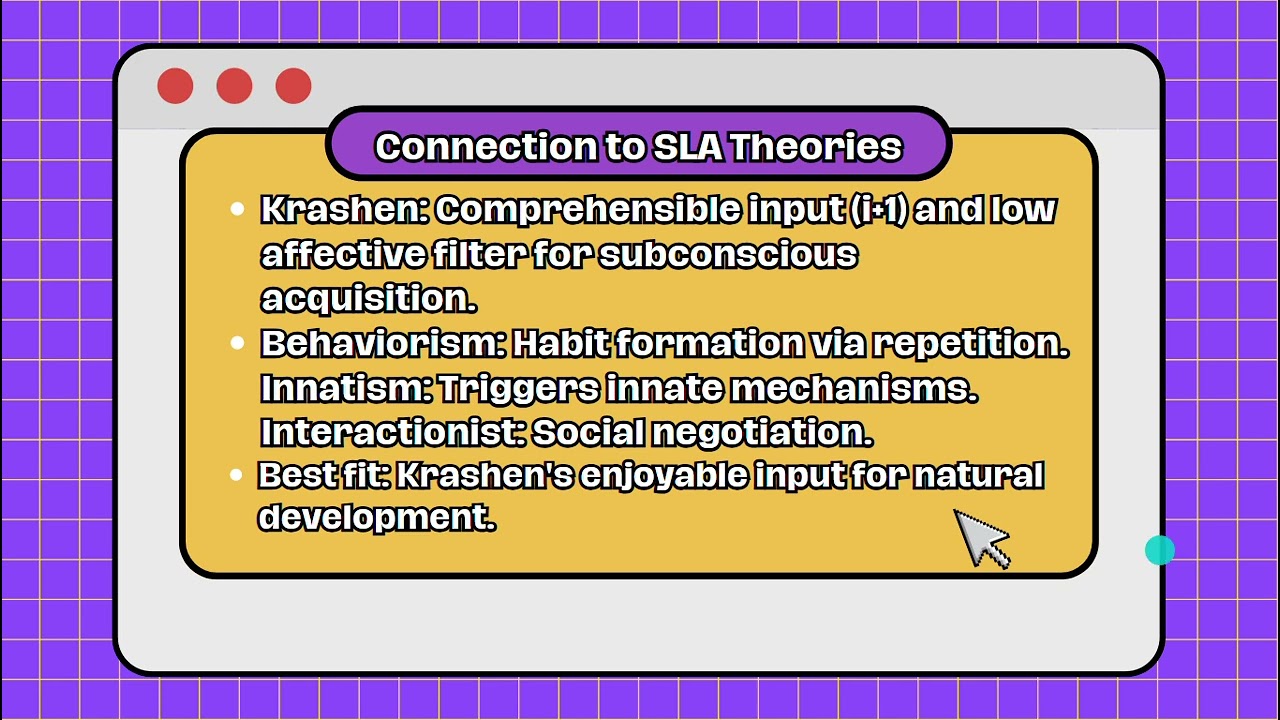
The approach aligns closely with key Second Language Acquisition (SLA) theories. Krashen's Input Hypothesis posits that comprehensible input slightly beyond the learner's level (i+1) facilitates subconscious acquisition, while a low affective filter—promoted by enjoyment and reduced pressure—ensures language "sticks" naturally. Behaviorism supports habit formation through repeated exposure to linguistic structures, aiding vocabulary retention. Innatism, or Universal Grammar, views extensive reading as a trigger for innate language mechanisms via implicit input, fostering grammar acquisition. Krashen's framework best encapsulates the material, emphasizing massive, enjoyable input over conscious correction, making it practical for real classrooms.
Real-life examples. In one learner's essay, English acquisition occurs through gameplay videos, where phrases like "bearer of bad news" and "ravishing" are absorbed contextually, driven by passion and low pressure. Another essay highlights strategies like self-conversation, AI-assisted storytelling, voice acting, and video games, enabling global interactions for natural conversations. These align with Behaviorist repetition in voice acting, Innatist subconscious input in videos, and Interactionist negotiation in multiplayer games. Such stories reveal that SLA is dynamic and interest-driven, blending exposure, habits, and social elements, outperforming rigid classroom methods and promoting holistic skills like fluency and cultural awareness.
Weekly activities included listening to an English podcast for spoken vocabulary and tones, reading an article on mental health with idioms like "runaway bestseller," and watching a movie clip followed by shadowing for grammar and accent practice. This immersive input, prioritizing comprehension, mirrors Krashen's hypotheses: comprehensible content (i+1) inspired subconscious growth, while low anxiety fostered absorption. Elements of monitoring (repeating quotes), habit formation (shadowing), and natural order (simple to complex structures) were evident.
Ultimately, extensive reading and massive input underscore that SLA thrives on motivation and context, normalizing tough topics while building resilience. This approach highlights SLA's real-world messiness, where enjoyment-driven methods yield profound, natural development.
Повторяем попытку...
Доступные форматы для скачивания:
Скачать видео
-
Информация по загрузке: