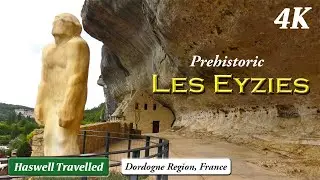
Les Eyzies, (Abri Cro-Magnon & Musée de Préhistoire / Cro-Magnon Rock Shelter & Pre-history Museum)
Автор: A Miscellany of Marvels.
Загружено: 2026-01-10
Просмотров: 9
Описание:
Les Eyzies (Las Aisiás in Occitan) is a commune in the Dordogne department in Nouvelle-Aquitaine in southwestern France. The village is home of a Rock Shelter which is an Aurignacian (Pre-history Museum) site.
Most notably, it is the site of the discovery of anatomically modern human remains, apparently buried at the site, dated to about 28,000 years ago. The find is also called Cro-Magnon after the name of the rock shelter. Because of its archeological importance, Abri de Cro-Magnon was inscribed on the UNESCO World Heritage List as part of the Prehistoric Sites and Decorated Caves of the Vézère Valley site.
In 1868, workmen found animal bones, flint tools, and human skulls in the rock shelter. French geologist Louis Lartet was called for excavations, and found the partial skeletons of four prehistoric adults and one infant, along with perforated shells used as ornaments, an object made from ivory, and worked reindeer antler.
These "Cro-Magnon men" were identified as the prehistoric human species of Europe, as distinct from Neanderthal Man, described a few years earlier by William King based on the Neanderthal 1 fossil discovered in Germany in 1856. Lartet proposed the subspecies name Homo sapiens fossilis in 1869. The term "Cro-Magnon Man" soon came to be used in a general sense to describe the oldest modern people in Europe. By the 1970s, the term was used for any early modern human wherever found, as was the case with the far-flung Jebel Qafzeh remains in Israel and various Paleo-Indians in the Americas.
The remains featured in these video are thought to represent adults who died at an advanced age, who were placed at the site, along with pieces of shell and animal teeth in what appear to have been pendants or necklaces, in an apparent intentional burial. The presence of necklaces and tools suggests the concept of grave goods.
The National Museum of Prehistory is a French institution founded in 1918 by Denis Peyrony in the commune It was fficially inaugurated on September 30, 1923 and is housed in what was formerly the Château de Tayac, purchased for this purpose by the State in 1913. In 2004, a new museum, designed by Jean-Pierre Buffi, was inaugurated on the emblematic cliff face of Les Eyzies.
The Museum presents an exceptionally rich prehistoric past in situ, and conserves some 6 million objects. A site museum avant la lettre, at the heart of the Vézère Valley "museum site". It now houses one of France's most important Paleolithic collections: lithic and bone industry, art furniture, burials, fauna and the world's first collection of Paleolithic art on engraved or sculpted blocks.
The museum reveals the ancient traces left by man in France. In countless display cases, stone tools, bone and ivory artefacts, life-size reconstructions of prehistoric man and extinct animals, and an understanding of human evolution over the last 400,000 years, are all showcased in a contemporary architectural setting.
--------------------------------------------------
Les Eyzies (Las Aisiás en occitan) est une commune du département de la Dordogne en Nouvelle-Aquitaine, dans le sud-ouest de la France. Le village abrite un abri sous roche qui est un site aurignacien (Paléolithique supérieur).
C'est notamment le site de la découverte de restes d'humains anatomiquement modernes, apparemment enterrés sur place, datant d'environ 28 000 ans. La découverte est également appelée Cro-Magnon d'après le nom de l'abri sous roche. En raison de son importance archéologique, l'Abri de Cro-Magnon a été inscrit sur la liste du patrimoine mondial de l'UNESCO dans le cadre du site des Sites préhistoriques et grottes ornées de la vallée de la Vézère.
Le Musée National de Préhistoire est une institution française fondée en 1918 par Denis Peyrony dans la commune. Il a été officiellement inauguré le 30 septembre 1923 et est installé dans ce qui était autrefois le Château de Tayac, acheté à cet effet par l'État en 1913. En 2004, un nouveau musée, conçu par Jean-Pierre Buffi, a été inauguré sur la falaise emblématique des Eyzies. Le musée présente un passé préhistorique exceptionnellement riche in situ, et conserve environ 6 millions d’objets. Un musée de site avant la lettre, au cœur de la vallée de la Vézère « site-musée ». Il abrite désormais l'une des collections paléolithiques les plus importantes de France : industrie lithique et osseuse, mobilier artistique, sépultures, faune et la première collection mondiale d’art paléolithique sur blocs gravés ou sculptés.
Повторяем попытку...

Доступные форматы для скачивания:
Скачать видео
-
Информация по загрузке: