Fan Left for Dead Awaits Resurrection
Автор: Tractorman44
Загружено: 2021-05-06
Просмотров: 903
Описание:
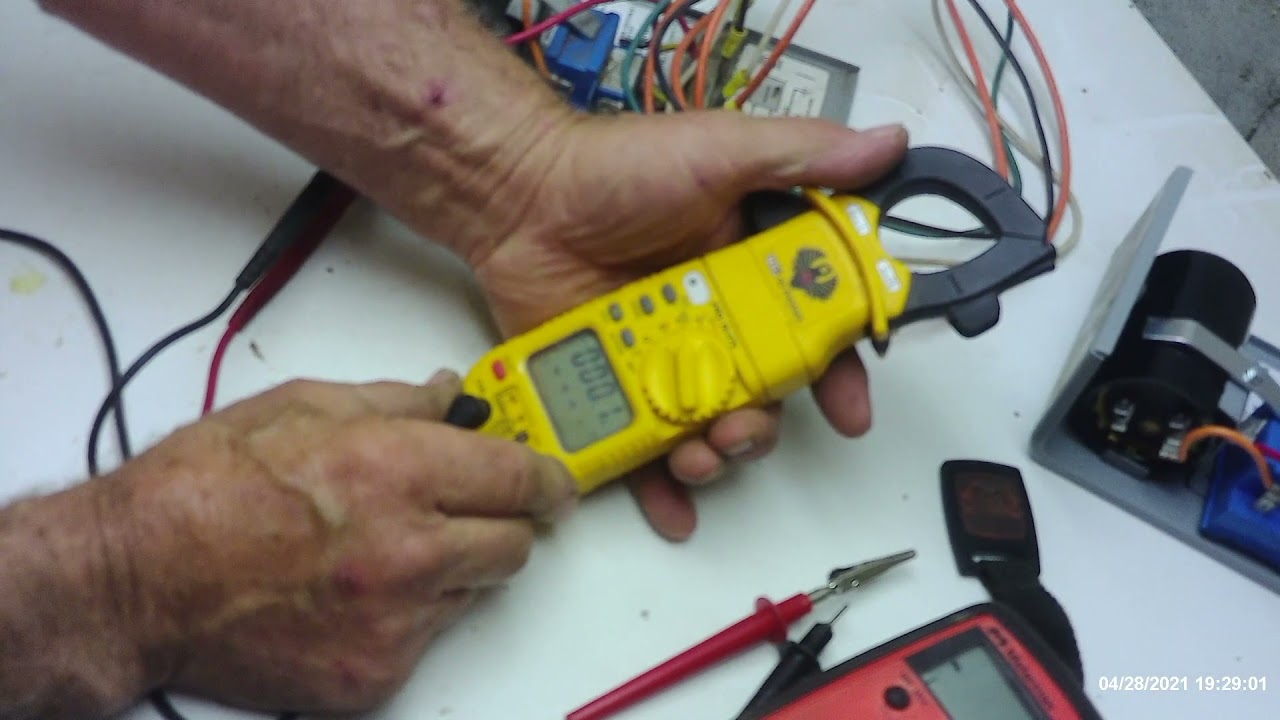
A quick troubleshooting to determine what the wire connections are on a motor with no diagram is the focus of this video. The 'pull-chain' switch would not turn the motor on or even make it hum so we know that is either the problem or there is a wire burnt off somewhere in the circuit. Within a minute or two, we find the capacitor has failed, the switch is in fact defective AND how the wires connect to make the two speed motor run. A bad capacitor cannot always be determined to be defective by sight, but this one can because it is swelled up on the terminal end. THAT's always indicating that its defective. Capacitors can fail 'open' or 'shorted' and in rare cases their capacitance can actually vary way off from their micro-farad rating. It was a rare failure back in the day, but with todays cheaper manufacturing practices it is becoming more common.
For lack of a better description, you can consider the run capacitors job in the circuit of a PSC motor...(Permanent Split Capacitor motor).... is to limit the amount of current passing though the 'start' winding during startup as well as through the 'run' winding after the motor has come to speed. It is a metallic cased capacitor (mostly) and is designed to remain in the circuit anytime the motor is energized. It is connected across the ends of the start and run winding, with one leg of line voltage connected to the run winding and the other leg of the line voltage connected to the 'common' terminal. 'Common' meaning the other ends of both the start and run windings are connected to it.
With an 'open' run capacitor, there will be no current flow through the 'start' winding of the motor, reducing starting torque dramatically and in most cases not even allowing the motor to start. The resultant LRA (Locked Rotor Amps) will be high and it will rapidly overheat the internal thermal over load in the common terminal of the motor and remove incoming voltage at that point.
With a 'shorted' run capacitor, there will be no limit to the current flow through the start winding of the motor causing rapid overheating and a quick shut down on the internal overload as described above. After a number of cycles tripping off on overload, the overload may either fail, or the heat generated and contained within the motor windings and housing will not cool down sufficiently to allow the overload to automatically close for an ever extending amount of time. I've seen motors so hot that their paint was discolored from the heat generated from the windings.
If your motor is humming and you give it a push with a screwdriver and takes off slowly and runs...don't do it. That's almost always an indication of an open capacitor or a capacitor whose micro-farad rating has majically changed to a different rating. Running it in that condition will shorten its life expectancy without a doubt !!
The above description is probably not totally correct because I lack the verbal acuity as well as the engineering background to claim it as a perfect technical description. But its close enough. Now we won't even get into 'start' capacitors in this discussion because this motor doesn't have one and it is a totally different animal !!
I guess the moral of the story is don't throw a electro/mechanical device away without at least digging into it to see if something is obviously burnt up or disconnected. Of course this is not a suggestion for you to actually do it yourself....find a friend or relative that has a bit of knowledge about electricity to do it. Remember that life is short and death is long. You don't want to get there prematurely. It's bad for your health.....literally.
This is not an instructional video at all...it was just a fun time that ended up being recorded for the entertainment value....you did see my Much Older Brother dancing a jig in the background didn't you...?? LOL.
So I repeat the disclaimer: Do not do the things I do in the manner in which I do them and especially when it comes to a procedure like this, because more people die annually working on low voltage electricity than die working on all other high voltages combined. The reason is lack of proper training and a real world understanding of how dangerous low voltage really is. Heck even the Beatles had a song telling all the young rock n rollers to..... "LET IT BE". I think they might have been 'seeking words of wisdom' about playing electric guitars in the rain.....
Повторяем попытку...

Доступные форматы для скачивания:
Скачать видео
-
Информация по загрузке:




![Best of Deep House [2026] | Melodic House & Progressive Flow](https://imager.clipsaver.ru/Il-ZpBuC8tA/max.jpg)