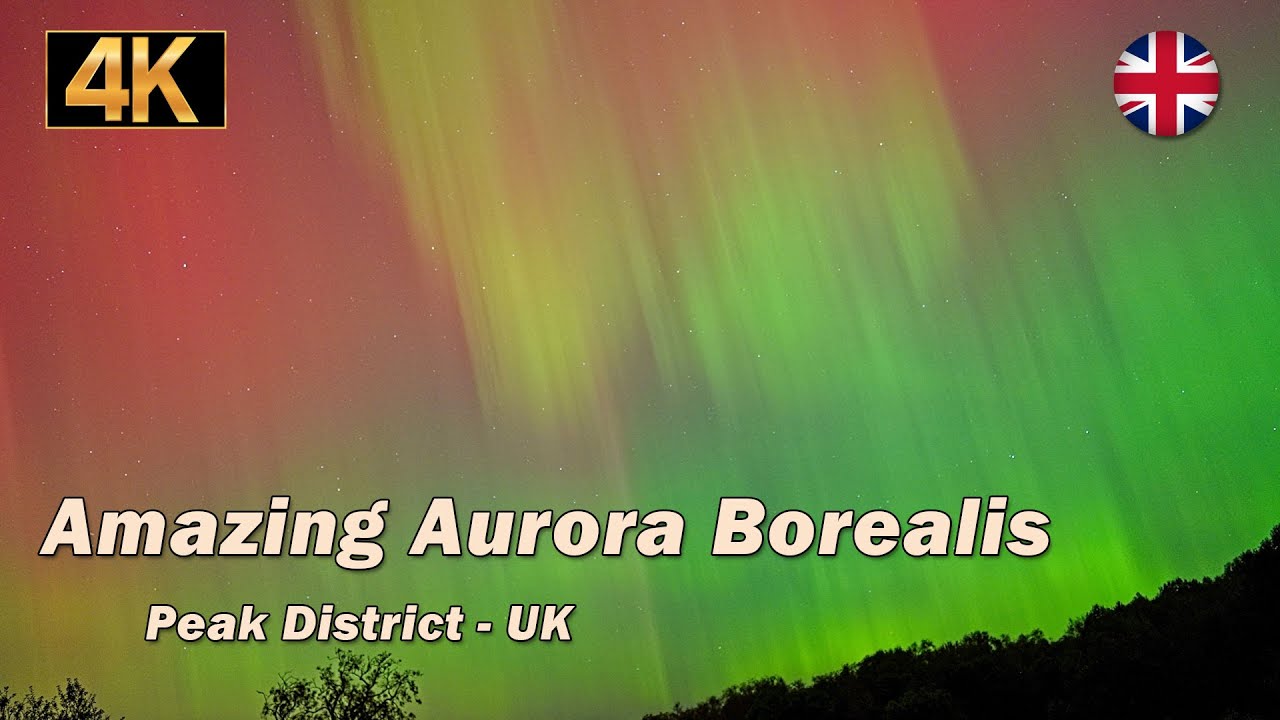
Amazing Aurora Borealis display in the Peak District, UK.
Автор: Barn Owl Live
Загружено: 2024-10-13
Просмотров: 140
Описание:
On the 11th of October, the UK was bathed in a beautiful display of the aurora borealis in the night sky. Mother nature was dancing in the moonlight with a stunning display of charged particles in the sky, creating a light show like no other.
Wanting to record this spectacular sight, I grabbed my camera around 7 p.m. and set it up to create a time-lapse movie of the beauty unfolding in the night sky.
How to photogrpah / video the northen lights -
Most cameras have a built-in “interval shooting mode,” which allows them to take a number of pictures automatically over a period of time. If your camera doesn't have a built-in function, you can use an intervalometer attached to it to trigger it to take pictures. Pretty much all Sony full-frame Alpha cameras have a built-in solution which is easy to use.
I wanted a good-quality image with little noise, so I set the shutter to open for 2 seconds and set the ISO to 640 to reduce noise in the image. The 2-second exposure with the wide aperture f1.4 lens gives good nighttime results. I set the white balance to 4000K, which helps keep the colour natural and brings out the greens, blues, and red hues.
I set the Sony camera's interval shooting to take a picture every 3 seconds, giving the camera a full 1 second after each 2-second shutter opening to process and save the image before taking the next one. If you don't allow some time for the camera to save and process the image, it can clog up the camera's buffer.
With the camera mounted on the tripod and pointing north, I focused the lens to infinity and then taped 2 of the hand-warming bags to the lens. If you don't do this on a cool night, you will almost certainly get condensation on the lens, ruining the whole shoot.
Finally, I plugged in my USB power bank to power the camera through the night, pressed shoot, and the camera started taking almost 10K images over the next 8 hours. I put a camera cover over the body of the camera to keep it dry, but no rain was forecast, so it was the perfect night for the shoot.
I kept an eye on the camera progress with large volumes of tea and eventually brought the camera in around 5 AM, having started it running around 8 PM,
I quickly looked at a few pics, and they looked great! Next, I downloaded all 9930 images to Sony's free “Image Edge Desktop” software. In the “Viewer” app of the software in the menu is a “Create Time Lapse Movie” function. It's easy to do, and you simply select the images you want to use to create the movie, set up the quality and aspect ratio and then press go and let the software do its magic. After an hour or so, I left the software running and out popped the video.
Camera Settings -
ISO 640
Aperture F1.4
Shutter Speed 2s
White Balance 4000K
Interval Timing settings - 1 picture every 3 seconds, maximum 10K images.
KIT
Sony Alpha 7 III
Sony FE24mm F1,4GM lens
USB Power Bank
USB to USB-C lead
Tripod
2 Hand warmers
#AuroraBorealis
#Northernlights
#Northern lights
#Aurora
#Aurora UK
#Aurora Borealis
#Peak District
#asmr
What are the aurora borealis or northern lights?
The Aurora Borealis occurs when charged particles from the sun interact with the Earth’s magnetic field. It's a stunning display of lights that dance across the night sky.
The sun continuously emits a stream of charged particles called the solar wind. These particles travel across the solar system at about 1 million miles per hour. When they reach Earth, they encounter our planet's magnetic field, which acts as a protective shield, deflecting most solar wind particles. However, some particles become trapped in the magnetic field and are guided towards the polar regions, where the magnetic field lines converge.
As these solar particles journey down the magnetic field lines towards the poles, they collide with molecules and atoms in Earth’s atmosphere, mainly oxygen and nitrogen. These collisions transfer energy to the atmospheric particles, exciting them to higher energy states. When the particles return to their normal state, they release this energy through light.
The specific colours of the auroras depend on the type of gas involved in the collisions and their altitude. Oxygen, for example, emits green and red light, while nitrogen produces blue and purple hues. Green is the most common colour observed in auroras, typically appearing at altitudes of around 60 to 150 miles above the Earth’s surface. Red auroras are rarer and occur at even higher altitudes, up to 200 miles, while blue and purple colours are often visible at lower altitudes.
These celestial displays have inspired awe and wonder throughout human history. So, next time you find yourself under a clear, dark sky and have heard rumours, the Aurora Borealis may appear; look up and enjoy the natural light show by Mother Nature.
Enjoy! & please watch more from my channel @BarnOwlLive as I add videos.
Please subscribe and share the video to get this channel started.
Cheers,
Paul
Повторяем попытку...
Доступные форматы для скачивания:
Скачать видео
-
Информация по загрузке:




![Northern Lights | Arctic Norway | Quadrantids Meteor | How many shooting stars do you see? [4K]](https://image.4k-video.ru/id-video/9p7T_1C77jU)


