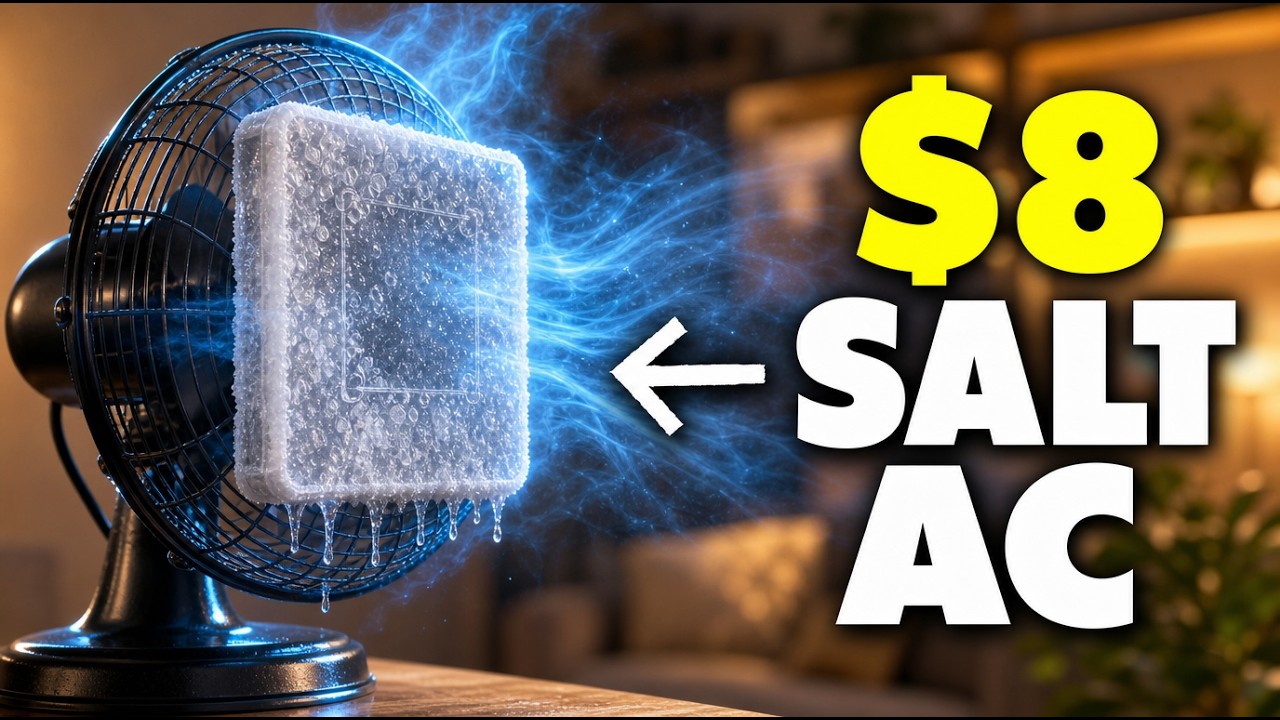
This $8 Salt Block Turns Any Fan Into a Free AC. Why Did We Stop Using It?
Автор: Ray Holton Secrets
Загружено: 2026-07-02
Просмотров: 36355
Описание:
📘 All 60 cooling methods from this channel in one manual — honest numbers, real costs, weekend builds → https://rayholtonsecrets.com/
A regular fan doesn't cool air — it just moves it. But add an eight-dollar salt block to the airflow and something changes. As the fan pushes air across the salt, the salt pulls moisture out of it, and that drier air feels dramatically cooler on your skin. In humid conditions, this simple pairing turns an ordinary fan from something that just circulates warm air into something that actually makes a room feel colder — with no electricity beyond what the fan already uses.
In this video, we explain how salt-and-fan cooling works, where the idea comes from, and why this cheap approach faded once mechanical air conditioning took over.
We start with why a fan alone doesn't cool. A fan makes you feel cooler only by helping sweat evaporate off your skin. But in humid air, sweat can't evaporate efficiently — the air is already saturated with moisture — so the fan just pushes warm, wet air around and you stay uncomfortable. This is the exact problem the salt solves.
Salt is hygroscopic, meaning it attracts and holds water vapor. Place a salt block in the path of the fan's airflow and the salt strips moisture out of the passing air. The air coming off the other side is drier, which means it can once again pull sweat off your skin the way it's supposed to. That restored evaporation is where the real cooling sensation comes from — not a drop in the thermometer, but a dramatic change in how the room feels.
We walk through the setup. Which salt to use and where to buy it cheaply. How to position the block relative to the fan for maximum airflow contact. How much salt you need for a given room size. And how to dry the salt back out using sunlight or low heat so it keeps working instead of saturating and losing its effect.
We trace the history. Pairing airflow with moisture control is an ancient cooling strategy — from wet-screen windows to salt-lined ventilation passages used across hot, humid regions long before electricity. People understood that in a humid climate, drying the air matters as much as moving it. That knowledge faded once air conditioning made it unnecessary for anyone on the grid.
Then we cover the honest limitations. This does not lower the actual air temperature the way an air conditioner does — it lowers the humidity and the perceived temperature. It works best in small, enclosed, humid spaces. In already-dry climates, the effect is minimal because the air doesn't need drying. The salt saturates and needs recharging. And a single block paired with one fan cools a personal space, not a whole house. We break down exactly what to expect so you go in with realistic expectations.
Finally, we explain why this never became mainstream. The HVAC industry sells equipment, refrigerant, and service contracts. A fan and a block of salt generate none of that. There's no compressor to replace, no refrigerant to recharge, no annual maintenance to bill. The approach stayed invisible not because it doesn't work, but because nobody could build a business around something this simple and this cheap.
Disclaimer: This video is for educational and informational purposes only. Cooling and dehumidification performance depends on climate, humidity, room size, and airflow. Salt is hygroscopic and the resulting brine can be corrosive to nearby metal surfaces. This approach supplements but does not replace mechanical cooling in extreme conditions.
#SaltCooling #FanHack #PassiveCooling
Повторяем попытку...
Доступные форматы для скачивания:
Скачать видео
-
Информация по загрузке: