Michaelis-Menten kinetics - giving enzymes a performance review; derivation & Km, kcat measurement
Автор: the bumbling biochemist
Загружено: 2022-03-21
Просмотров: 1615
Описание:
How many sticks could a stick-snapper snap if a stick-snapper could snap sticks? A stick-snapper would snap all the sticks it could snap according to Michaelis-Menten kinetics! full text: https://bit.ly/maudmenten
A reaction’s only as fast as its slowest step, and you can split a reaction up into a few steps: bind (E+S ⇌ ES), change (ES⇌EP), & release (EP⇌E+P). For simplicity’s sake, let’s say that the reaction’s really favorable so it’s really unlikely to go in the reverse direction (you’re not gonna change product into substrate). (Even if the reaction does go backwards, if you measure kinetics at the very beginning, when there isn’t any product to get turned back into substrate you can ignore the reverse). Then we can remove a couple of those backwards arrows so we have
bind (E+S ⇌ ES), change (ES→EP), & release (EP→E+P)
You can see that I didn’t take away that first backwards arrow because the binding step is still reversible - and which way the equilibrium lies (is E + S or ES more favored) depends on the affinity (stickiness) of the 2 for one another. And even though we’re assuming you can only go ES→EP (and not EP→ES) - that doesn’t mean you will make that change. If you think of things chance-wise (probabilistically), each time a substrate collides with an enzyme, it has a chance of sticking and each time it sticks it has a chance of converting to product. How fast the reaction will occur depends on:
how likely E & S are to collide (depends on their concentrations & how much energy they have)
how likely E & S are to stick (depends on their stickiness “affinity” for one another)
how likely S is to convert (depends on how high the activation barrier is & how long the substrate’s stuck there so it can “keep trying”)
You also have the releasing step, but, except for some weird cases, that’s usually not a hold-up, so we’ll combine the change and release steps into ES → E + P. So now we have 2 steps, bind (E+S ⇌ ES) & change/release (ES → E + S) and each of these can happen at different speeds
We can give each step a rate constant, k. It’s “constant” in terms of it not being affected by concentrations because it’s an inherent property of the molecules, but it is affected by differences in the environment (pH, etc.) so it’s specific for a specific reaction under specific conditions.
So, how many sticks could a stick-snapper snap if a stick-snapper could snap sticks? To “answer” this let’s turn to Michaelis-Menten kinetics.
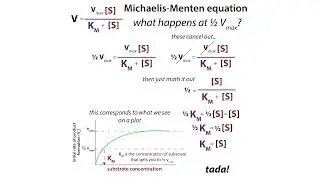
Km is the substrate concentration at which product formation is at 1/2 it’s maximal speed (so 1/2 Vmax).
You usually find it by measuring Vo (that initial rate of product formation) at multiple concentrations of the substrate (another chance to use those serial dilutions!).Then you plot substrate concentration on the horizontal (x) axis & reaction rate on the vertical (y) axis. Do this and (often) you’ll get a ,- like curve, a parabola that starts steep and then plateaus. Enzymes that give curves like this are said to obey Michaelis-Menten kinetics.
The curve starts steep (but slow) because at the beginning there’s more than enough enzyme to quickly change all the substrate into product but then substrate runs out (too many snappers, too few sticks). But as the substrate concentration increases, the enzyme gets saturated - each enzyme is working its hardest, but it can only go so fast - the enzyme becomes limiting (too many sticks, too few snappers). The height at which the curve plateaus is called the maximum velocity (Vmax) and the substrate concentration at which the curve gets halfway to Vmax is called the Km.
This Vmax depends on enzyme concentration (which is why we adjust it to get kcat), but Km doesn’t depend on enzyme concentration, just on how well the enzyme likes the substrate. It’s not quite this simple, but, in general terms & typical cases
lower Km → better binder (higher affinity for substrate)
higher Km → worse binder (lower affinity for substrate)
and
higher kcat → better changer
lower kcat → worse changer
If you want a good idea about how “good” an enzyme is overall for a particular substrate, you need to know how well it binds substrate & how well it changes it. So you combine those 2 measures to get another value, the “specificity constant” (aka “catalytic efficiency”) which = kcat/Km
You can use that to compare the same enzyme with different substrates, but you should not use it to compare different enzymes. This is because You can get the same kcat/Km with different kcats & Kms and the importance of kcat and Km depend on the substrate concentration. At low [S], Km matters more but at high [S] kcat matters more, and an enzyme with a "better" catalytic efficiency could have a lower reaction rate than a "worse" one at certain [S]. More on this here:
Eisenthal et al., Trends Biotechnol. 2007 https://doi.org/10.1016/j.tibtech.200...
Повторяем попытку...

Доступные форматы для скачивания:
Скачать видео
-
Информация по загрузке:

![Enzyme Kinetics with Michaelis-Menten Curve | V, [s], Vmax, and Km Relationships](https://image.4k-video.ru/id-video/kmyR1cYxRL4)