POPULATIONS – Part 2 | Population Interactions Explained with Real Life Examples | Class 12 Biology!
Автор: Knowledge Chronicle
Загружено: 2025-06-30
Просмотров: 418
Описание:
🫁POPULATIONS – Part 2 | Population Interactions Explained with Real Life Examples | Class 12 Biology
✍🏻Yesterday, we explored the fascinating world of Populations in Part 1. And today… get ready to dive into the most dynamic and action-packed part of population ecology — yes, we’re talking about Population Interactions!
Let’s begin Part 2!"
Why Population Interactions Matter
Can you imagine a forest with only tigers? Or an ocean with only whales?
Sounds impossible, right?
Because no species exists in complete isolation.
Even plants, which make their own food, rely on soil microbes for nutrients and insects or animals for pollination.
In nature, every organism interacts — with plants, animals, or even microbes. And these interactions are vital for survival, balance, and evolution.
These are known as Interspecific Interactions – interactions between populations of different species.
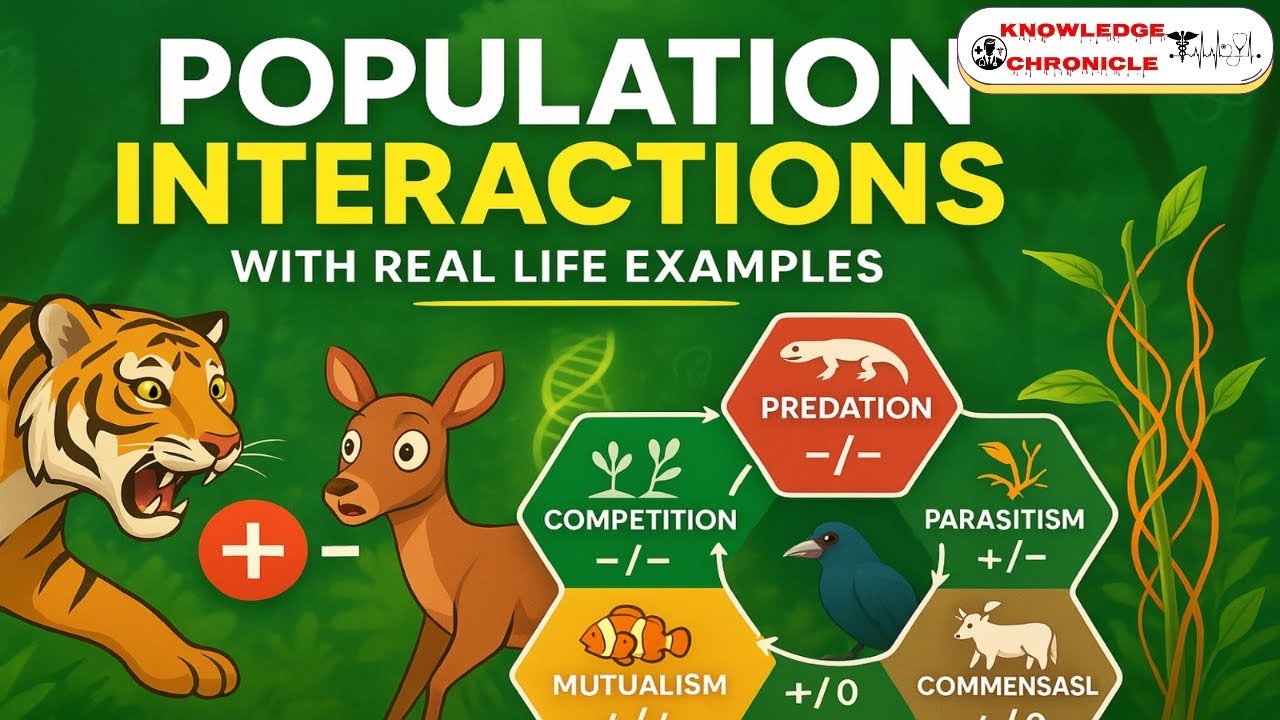
Types of Interactions
To simplify, scientists use symbols to indicate how these interactions affect the species involved:
: Beneficial
– : Harmful
0 : Neutral
Now, let’s break down each type with examples.
1 Predation ( + / – )
One species benefits, the other is harmed.
Predation is not just about lions and deer!
Even a sparrow eating a seed is a predator. Herbivores are also predators for plants!
But predators are not villains — they:
Control prey populations, preventing overpopulation.
Maintain biodiversity by reducing competition.
Example:
The prickly pear cactus invaded Australian lands rapidly.
It was finally controlled by introducing a cactus-feeding moth — its natural predator.
Case Study:
When the starfish Pisaster was removed from American rocky shores, over 10 species of invertebrates disappeared. Why?
Because Pisaster kept their competitors in check.
Interesting Fact:
Some prey evolve defense strategies:
Camouflage: Insects or frogs blend with the environment.
Poison: Monarch butterflies taste horrible due to chemicals from poisonous weeds they eat as caterpillars.
Chemical Warfare in Plants:
Thorns in Cactus,
Cardiac glycosides in Calotropis,
Chemicals like nicotine, caffeine, and opium evolved to repel herbivores.
2. Competition ( – / – )
Both species are harmed as they fight for the same resource.
It’s not always between similar species.
Even flamingoes and fishes in South America compete for zooplankton.
Lab Example:
Gause’s Experiment – Two species of Paramecium competed in a limited space.
The stronger one eliminated the other. This led to the Competitive Exclusion Principle.
Real Example:
On Scotland’s coasts, Balanus a larger barnacle pushes out Chathamalus, the smaller one.
But modern ecology says: Species don’t always eliminate one another — they often coexist by partitioning resources.
Example:
Five warbler bird species live on the same tree but feed in different zones, at different times — avoiding direct conflict.
3. Parasitism ( + / – )
Parasites benefit; hosts are harmed.
Parasites are everywhere — from plants to animals. They’re often host-specific and co-evolve with their hosts.
Adaptations in parasites:
Loss of sensory organs they don’t need to see or move
Suckers or hooks to hold onto hosts
No digestive system — they absorb pre-digested nutrients
High reproduction rates to survive inside hostile hosts
Examples:
Ectoparasites: Lice on humans, ticks on dogs, Cuscuta plant on hedges.
Endoparasites: Malarial parasite needs mosquito vector, liver fluke needs snail & fish.
Cuscuta has no leaves or chlorophyll — it lives entirely off the host.
Brood Parasitism:
The koel lays its eggs in a crow’s nest.
Its eggs look almost identical to the crow’s — a brilliant evolutionary trick!
4. Commensalism ( + / 0 )
One species benefits; the other is unaffected.
Examples:
Orchids on mango trees: Orchids get height and sunlight, mango tree is unaffected.
Barnacles on whales: Travel the oceans for free!
Cattle Egrets and Cattle: Egrets eat insects that cattle stir up while grazing.
Clownfish and Sea Anemone: Clownfish gains protection; sea anemone doesn’t mind.
5. Mutualism ( + / + )
Both species benefit — a win-win!
Examples:
Lichens: Fungus + algae/cyanobacteria.
Mycorrhizae: Fungi + plant roots.
Fungi help absorb minerals; plants provide sugars.
Pollination & Seed Dispersal are fascinating examples: Plants offer nectar or fruits. Animals act as pollinators or dispersertion
#PopulationEcology #PopulationInteractions #biology #trending #Class12Biology #EcologyExplained #neet #trend #BiologyWithExamples #KnowledgeChronicle #NCERTBiology #Predation #Mutualism #Parasitism #Competition #Commensalism #Amensalism #science
⚠️ This video is entirely AI-generated for educational purposes. Both the visuals and the voiceover have been created using artificial intelligence. No real human voice or footage has been used. Content is produced by Knowledge Chronicle for informative and learning purposes only. 📚
Повторяем попытку...
Доступные форматы для скачивания:
Скачать видео
-
Информация по загрузке:


