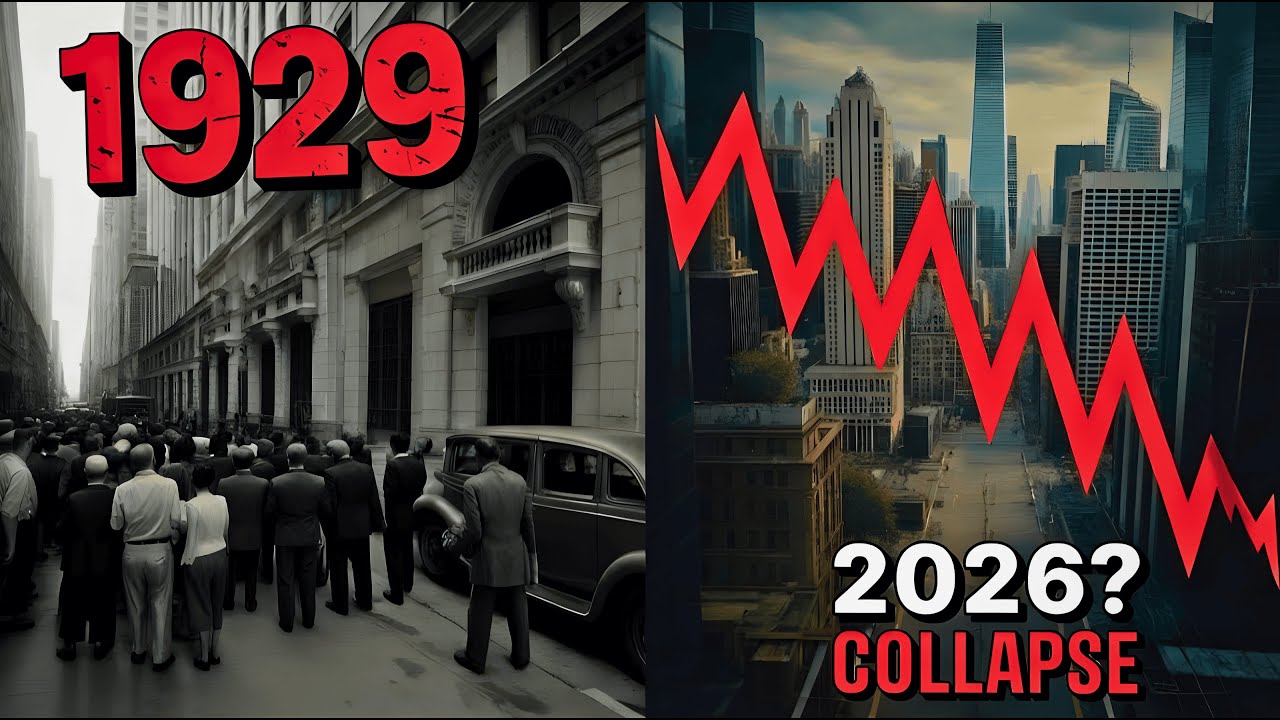
Why the Next CRASH (2026) Will Be WORSE Than 1929 & 2008
Автор: Capital Rewind
Загружено: 2026-01-14
Просмотров: 435
Описание:
Why the Next CRASH (2026) Will Be WORSE Than 1929 & 2008
In the summer of 1929, a Yale economist declared that stock prices had reached "a permanently high plateau."
Fourteen weeks later, $14 billion had vanished. Banks padlocked their doors. Men who had been millionaires sold apples on street corners.
In 2007, the chairman of the Federal Reserve assured Congress that subprime mortgage problems were "likely to be contained."
Eighteen months later, the global financial system stood hours from total collapse. Entire nations went bankrupt. A generation lost their homes, their savings, their futures.
Now, in the mid-2020s, the experts are calm again. They speak of soft landings. Of resilient markets. Of controlled inflation.
But beneath the surface, the numbers tell a different story. A darker story. A story that has played out before — in ancient Rome, in Habsburg Spain, in the fall of the British Empire.
What if the next collapse isn't just another recession?
What if it's the end of an era?
There is a moment, just before every great financial catastrophe, when the world feels impossibly stable.
It happened in the autumn of 1929. The stock market had tripled in less than a decade. Unemployment was low. Consumer confidence was high. Magazines published articles about the "new era" of prosperity — a world where the old rules of boom and bust no longer applied.
It happened again in the summer of 2007. Housing prices had doubled in six years. Wall Street was minting billionaires. The Federal Reserve chairman spoke of a "Great Moderation" — an age when central banks had finally tamed the business cycle.
In both cases, the crash came not despite the confidence, but because of it.
And now, in the mid-2020s, we find ourselves in another moment of eerie calm. The markets have recovered. Inflation, we are told, is under control. The banking system is "well-capitalized." The economy is "resilient."
But something is wrong.
The United States government now owes more than $35 trillion — a sum so vast it has lost all meaning. The interest payments alone will soon exceed the entire defense budget. Commercial real estate sits empty across every major city, a $1.5 trillion time bomb ticking beneath the banking sector. The derivatives market — the same web of financial bets that detonated in 2008 — has grown to over $600 trillion, more than six times the entire global economy.
And yet, the experts remain calm.
This is not a documentary about prediction. Predictions are for fortune tellers and fools. This is a documentary about pattern recognition — about the structural forces that have preceded every great collapse in modern history.
Because here is what the textbooks don't teach you: financial crises are not random. They are not bolts from the blue. They follow a script — a sequence of stages that repeats with disturbing regularity across centuries and continents.
The Dutch Tulip Mania of 1637. The South Sea Bubble of 1720. The Panic of 1873. The Great Depression. The Asian Financial Crisis. The Dot-Com Bust. The Global Financial Crisis of 2008.
Different eras. Different technologies. Different currencies.
The same pattern.
Every cycle begins with a displacement — a new innovation or policy that creates genuine opportunity. Railroads. Electricity. The internet. Cheap credit.
Then comes the boom. Credit expands. Asset prices rise. Early investors make fortunes.
Then euphoria. Taxi drivers give stock tips. Housewives flip condos. Shoeshine boys talk about margins.
Then the quiet exit. The smart money slips out, barely noticed.
Then panic. The herd realizes, all at once, that the music has stopped.
Then contagion. What started in one sector spreads everywhere.
Then despair. Wealth is destroyed. Jobs vanish. Governments fall.
Seven stages. The same seven stages. Over and over again.
The question is not whether the pattern will repeat. The question is where we are in the cycle — and whether what comes next will be worse than anything we've seen before.
The evidence suggests it will be.
Not because of any single cause. Not because of one bad policy or one reckless bank. But because of the compounding effect of decades of choices — the slow accumulation of debt, the hollowing out of productive industry, the transfer of risk from the private sector to the public balance sheet, the quiet erosion of the currency that underpins the entire global order.
1929 destroyed a generation. It took twenty-five years for the stock market to recover its previous highs. It took a world war to pull the economy out of depression.
2008 was contained — but only through the largest intervention in financial history.
Disclaimer:
This video is for educational and informational purposes only. The events, patterns, and scenarios discussed do not guarantee that similar outcomes will occur in the future. Nothing in this documentary should be interpreted as financial advice. Always consult a qualified professional before making financial decisions.
Повторяем попытку...
Доступные форматы для скачивания:
Скачать видео
-
Информация по загрузке: