MATTIA BATTISTINI: “Eri tu?” From “Un Ballo in Maschera”
Автор: Rick Robertson Collection
Загружено: 2025-11-25
Просмотров: 86
Описание:
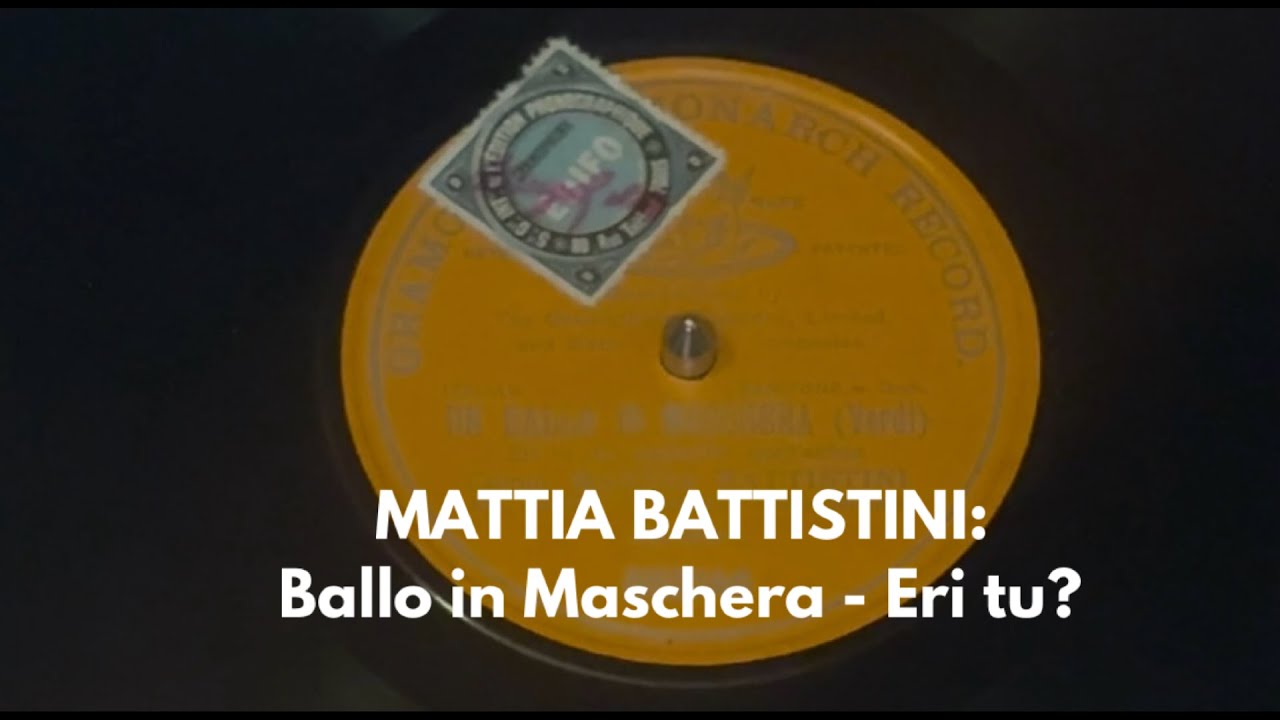
Ballo in Maschera - Eri tu? (Verdi)
MATTIA BATTISTINI, baritone
Gramophone 052146 (mx 886c-1, c. November 1906)
(Wikipedia) Mattia Battistini (2/27/1856 – 11/7/1928) was an Italian operatic baritone, referred to as the "King of Baritones" in multiple publications.
He spent most of his childhood in the Collebaccaro di Contigliano village, near Rieti, where his parents owned an estate.
Battistini dropped out of law school to study music with Emilio Terziani (who taught composition) and with Venceslao Persichini (professor of singing) at the Accademia Nazionale di Santa Cecilia—then the Liceo Musicale of Rome. Battistini worked with conductor Luigi Mancinelli and the composer Augusto Rotoli and consulted with baritone Antonio Cotogni to refine his technique.
From 1892 onwards, Battistini established himself as an immense favorite with audiences at Russia's two imperial theatres in Saint Petersburg and Moscow: the Mariinsky and the Bolshoi respectively. He returned to Russia regularly, appearing there for 23 seasons in total, and touring extensively elsewhere in eastern Europe, using Warsaw as his stepping-stone. He would journey to Warsaw, Saint Petersburg, Moscow, and Odessa like a prince, traveling in his private rail coach with a retinue of servants and innumerable trunks containing a vast stage wardrobe renowned for its elegance and lavishness. The composer Jules Massenet was prepared to adjust the role of Werther for the baritone range when Battistini elected to sing it in Saint Petersburg in 1902, such was the singer's prestige.
Battistini also appeared with some regularity in Milan, Lisbon, Barcelona, Madrid, Berlin, Vienna, Prague, Budapest, and Paris (where he sang for the first time in 1916). But his many social connections in Russia, and the favor that he enjoyed with the imperial family and the nobility, ensured that Russia—more than perhaps even Italy—became his artistic home before the outbreak of the First World War, in 1914. The war led to the destruction, by the Bolsheviks in 1917, of the Tsarist regime. This history-shaping political development, coupled with Battistini's refusal to sing in the Americas, meant that his career after the war's conclusion in 1918 was confined to Western Europe.
From 1892 onwards, Battistini established himself as an immense favorite with audiences at Russia's two imperial theatres in Saint Petersburg and Moscow: the Mariinsky and the Bolshoi respectively. He returned to Russia regularly, appearing there for 23 seasons in total, and touring extensively elsewhere in eastern Europe, using Warsaw as his stepping-stone. He would journey to Warsaw, Saint Petersburg, Moscow, and Odessa. Jules Massenet was prepared to adjust the role of Werther for the baritone range when Battistini elected to sing it in Saint Petersburg in 1902, such was the singer's prestige.
The industrious Battistini also appeared with some regularity in Milan, Lisbon, Barcelona, Madrid, Berlin, Vienna, Prague, Budapest, and Paris (where he sang for the first time in 1916[5]). But his many social connections in Russia, and the favor that he enjoyed with the imperial family and the nobility, ensured that Russia—more than perhaps even Italy—became his artistic home before the outbreak of the First World War, in 1914. The war led to the destruction, by the Bolsheviks in 1917, of the Tsarist regime and the aristocratic society that had enriched touring Italian opera stars like Battistini and his tenor compatriots Francesco Tamagno, Francesco Marconi, and Angelo Masini. This history-shaping political development, coupled with Battistini's refusal to sing in the Americas, meant that his career after the war's conclusion in 1918 was confined to Western Europe.
Battistini was esteemed as one of the greatest of singers and even a cursory acquaintance with his many discs will make it clear why he was so celebrated by his contemporaries. Amongst the arsenal of vocal weapons that he displays on record was the perfect blending of his registers coupled with the sophisticated use of ornamentation, portamento, and fil di voce, as well as an array of rubato and legato effects. His art was perfected before the advent of "passion-torn-to-tatters" verismo opera in the 1890s, and together with the likes of Pol Plançon and Mario Ancona (and, to a lesser extent, Alessandro Bonci), he represented the twilight of the art of male bel canto singing on disc.
Fortunately, the sound of Battistini's clear, high-placed, and open-throated baritone voice took well to the primitive acoustic recording process with only his very lowest notes sounding pallid. He also handled the trying conditions of the early sound 'studios', with their boxy confines and wall-mounted recording funnel, much better than did many of his contemporaries.
Повторяем попытку...
Доступные форматы для скачивания:
Скачать видео
-
Информация по загрузке: