Delete This Mental Escape and Watch Discipline Stabilize
Автор: Mental Warfare
Загружено: 2026-02-28
Просмотров: 8
Описание:
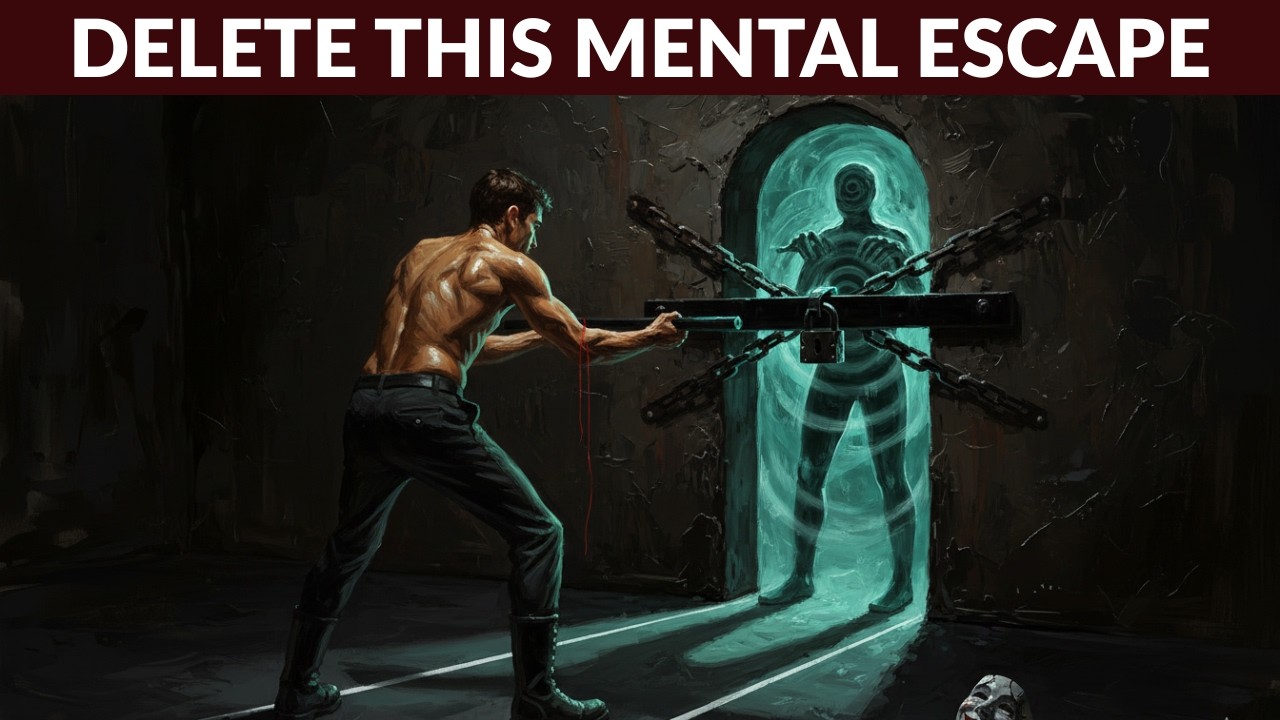
What if your secret enemy is not temptation but the quiet, comforting daydream you use to avoid it? You tell yourself you will tomorrow, you rehearse grand plans in your head, you imagine progress—while real discipline withers. That mental escape is not harmless. It is a small theft that compounds into chronic distraction, depleted willpower, and a life hollowed by intention without action.
This video argues a counter-intuitive truth that most teachers never mention: deleting the habit of mentally escaping into strategy, rehearsal, or rumination actually stabilizes discipline far more reliably than "trying harder." Stop treating imagination as practice and start treating it as what it often is: an avoidance tactic. When you remove the safety valve that lets you feel like you did something without doing it, your nervous system stops oscillating between guilt and numbing, and your capacity for steady, repeatable action rises.
In this video, you’ll learn:
→ How to recognize the subtle forms of mental escape that masquerade as planning, moralizing, or future-self bargaining
→ Why mental rehearsal can sabotage execution: the neuroscience behind habit loops, reward cues, and basal ganglia automation
→ The paradox of willpower: why eliminating the escape route conserves cognitive energy more than ego-strength exercises
→ Practical tactics to delete mental escape: precommitment, micro-rituals, friction insertion, and environment redesign
→ How to measure if discipline is stabilizing: simple behavioral metrics that reveal sustained change
→ When mental simulation helps and when it harms: calibrating imagination as a tool instead of a refuge
→ A short experiment you can run this week to break the habit and watch your consistency climb
Subscribe for more dark, practical psychology and hit the bell to be warned when the next lesson drops. If you want brutal clarity about your mind, this channel is where fewer comforts, more results live.
References & Research
Mischel, W. (2014). The Marshmallow Test: Mastering Self-Control. Little, Brown and Company.
Baumeister, R. F., Vohs, K. D., & Tice, D. M. (2007). The Strength Model of Self-Control. Current Directions in Psychological Science.
Hagger, M. S., Wood, C., Stiff, C., & Chatzisarantis, N. L. D. (2010). Ego Depletion and the Strength Model of Self-Control: A Meta-Analysis. Psychological Bulletin.
Kahneman, D. (2011). Thinking, Fast and Slow. Farrar, Straus and Giroux.
Clear, J. (2018). Atomic Habits. Avery.
Fogg, B. J. (2019). Tiny Habits: The Small Changes That Change Everything. Houghton Mifflin Harcourt.
Graybiel, A. M. (2008). Habits, Rituals, and the Evaluative Brain. Annual Review of Neuroscience.
Tierney, J. (2011). Willpower and Decision Fatigue. The New York Times (coverage of Baumeister’s work).
Risko, E. F., & Gilbert, S. J. (2016). Cognitive Offloading: How and Why We Use External Aids. Trends in Cognitive Sciences.
Disclaimer
This video is for educational and entertainment purposes only. It presents research summaries, philosophical framing, and practical frameworks based on human-created scripts and original research. Visuals are generated with AI tools and voiceovers may be synthesized, but the analysis and script are original human work. Use what fits your situation and consult qualified professionals for personal or clinical advice.
#DarkPsychology #Discipline #Willpower #Habits #SelfControl #MentalModels #Philosophy #Stoicism #DecisionFatigue #EgoDepletion #AtomicHabits #DelayDiscounting #CognitiveOffloading #Focus #Productivity #Mindfulness #BehavioralScience #Neuroscience #SelfImprovement #Consistency
Повторяем попытку...
Доступные форматы для скачивания:
Скачать видео
-
Информация по загрузке: