Namaqua Sandgrouse (Bird Carry Water in Its Feathers)
Автор: 3 Minutes Nature
Загружено: 2021-10-25
Просмотров: 65172
Описание:
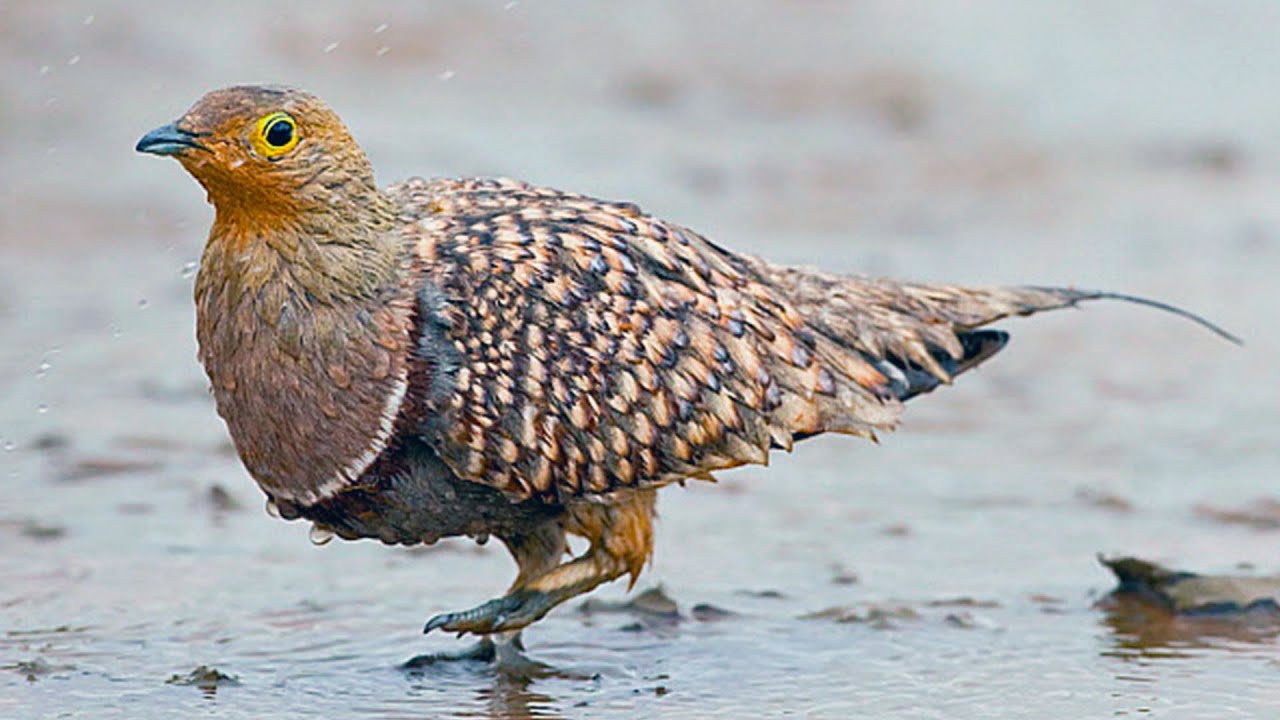
The Namaqua sandgrouse (Pterocles namaqua), is a species of ground-dwelling bird in the sandgrouse family. The Namaqua sandgrouse can be found in various arid parts of South Africa and its neighbouring lands. Namaqua Sandgrouse is nomadic in the desert, semi-desert, and arid savanna.
Seeds are the main staple of the Namaqua sandgrouse, which forages over large areas. The bird prefers seeds high in protein, like legumes, picking them off the ground with its short bill. It feeds in the daylight hours and rests in the shade of a bush during the extreme heat of midday. The bird will sometimes eat plant material and insects or molluscs that happen to be on plants, and occasionally grit to help grind down seeds in the gizzard.
A dumpy, short-legged, pigeon-like bird that shuffles awkwardly on the ground and flies in a fast and direct manner, singly or in groups. It has a long, pointed tail and sharply-pointed wings. The male has a pair of black-and-white bands across the chest and has a plain buffy face and head; the female is mottled with black, brown, and white. There is a dense layer of under down which helps insulate the bird from extremes of heat and cold.
The feathers of the belly are specially adapted for absorbing water, retaining it and acting like a sponge. On very hot days, parents fly to water bodies that may be many miles away from watering holes. After drinking, soak their belly, and quickly return to the nest to cool the eggs or provide water to waiting chicks. The chicks suck up water like a goat kid drinks milk from mother’s udders. The amount of water that can be carried in this way is 15 to 20 millilitres.
Sandgrouses are gregarious, feeding in flocks of up to 100 birds. As a consequence of their dry diet, they need to visit water sources regularly. When drinking, water is sucked into the beak, which is then raised to let the water flow down into the crop. By repeating this procedure rapidly, enough water to last twenty-four hours can be swallowed in a few seconds. As they travel to water holes, they call to members of their own species and many hundreds or thousands synchronize their arrival at the drinking site despite converging from many different locations scattered over hundreds of square miles of territory. Namaqua sandgrouse birds communicate through a far-carrying call which is a musical 'kelkiw-wyn'.
Sandgrouse travels tens of miles to their traditional water holes and tends to disregard temporary water sources which may appear periodically. This clearly has a survival value, because a dried-up water source in an arid region could result in dehydration and death.
They are vulnerable to attack while watering but with a large number of birds milling about, predators find it difficult to select a target bird and are likely to have been spotted before they can get close to the flock. The sandgrouse tends to avoid sites with cover for mammalian predators and their greatest risk is usually from predatory birds. When faced with danger, this bird escapes by jumping from the ground directly into the flight.
Breeding takes place at any time of the year and is dependent on rainfall. Usually, the nests are solitary but sometimes several pairs of birds choose sites near each other. The nest is a scrape in the earth, scantily lined with dried plant material. Two or three pinkish-grey eggs with brown markings are laid over the course of a few days. Incubation starts after the last egg has been laid and lasts about 22 days. The female does the incubation by day and the male does a longer shift at night, starting about two hours before sunset and finishing two hours after dawn. The chicks are precocial and able to leave the nest on the day they are hatched. The male brings them water absorbed on the specially adapted feathers of his breast. The chicks grow rapidly, they are fully feathered at three weeks and able to fly at six.
The species is common within its range and is considered to be of Least Concern by the IUCN Red List of Threatened Species. The birds are at risk of predation by mongooses while they are young. Sheep farmers kill birds of prey and jackals to protect their flocks and this may have resulted in an increase in the mongoose population and consequently a diminution in the number of sandgrouse chicks that survive. Other predators that prey on the Namaqua sandgrouse include eagle and falcon.
#Wildlife #Bird #NamibDesert
Повторяем попытку...
Доступные форматы для скачивания:
Скачать видео
-
Информация по загрузке:


![Amazing SAHARA: Tassili n'Ajjer, Algeria [Amazing Places 4K]](https://image.4k-video.ru/id-video/OpFdLHl7Mgs)