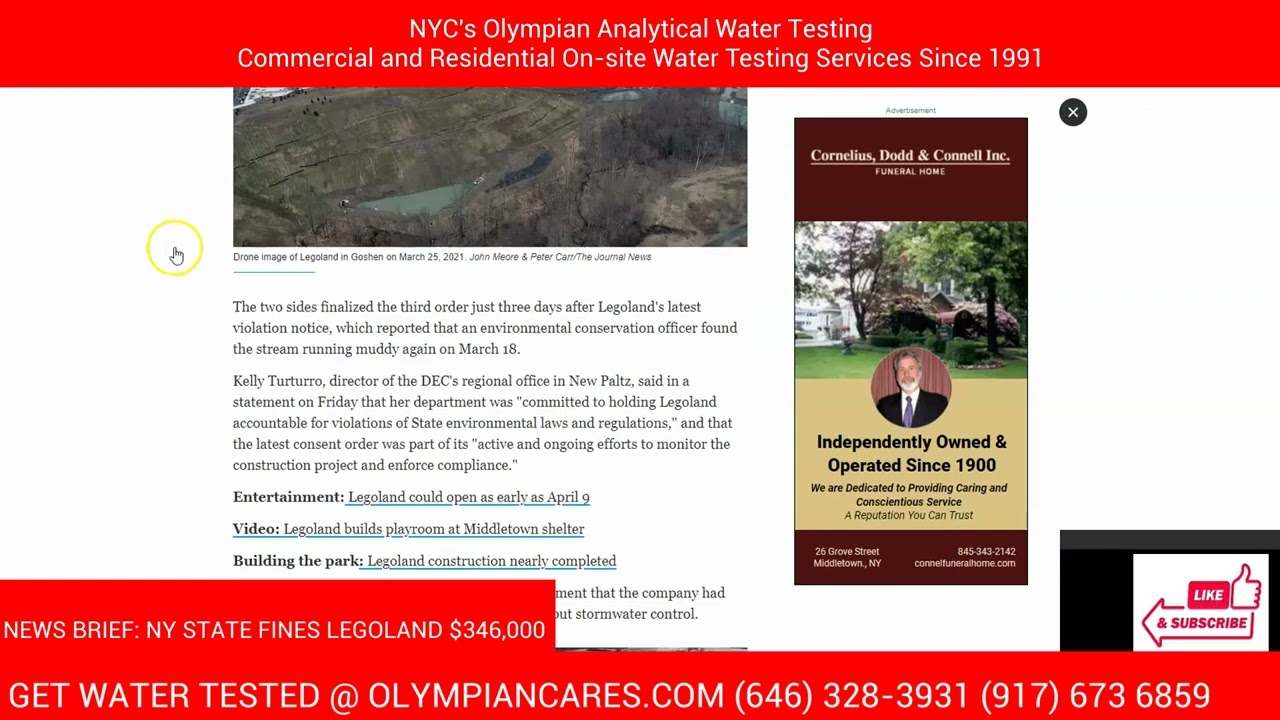
Water Testing for Mercury - NY state fines Legoland $346,000 for Environmental Violations
Автор: Olympian Water Testing
Загружено: 2022-12-08
Просмотров: 152
Описание:
Water Testing for Mercury
Olympian Water Testing Services is the company you can rely on for your required lead in water testing. Established 1991
https://olympiancares.com
https://olympiancares.com/nyc-environ...
/ @olympianwatertesting
NYC oldest and most reliable drinking water laboratory testing service for lead.
We serve schools, Pre k - 12, Charter schools, Public schools, Private Schools, Day Care as well as office space and residential water testing projects within NYC, the five boroughs, Brooklyn NY, Queens NY, the Bronx, NY, Staten Island NY, Yonkers NY, Nassau County NY, Manhattan NY, Water Testing for Mercury
We test for all chemicals, heavy metals, bacteria and contaminants through our ELAP certified labs.
Olympian Water Testing of Brooklyn NY
665 88th St, Brooklyn, NY 11228
Call 7 days 646-328-3931
Olympian Water Testing of Queens NY
47-1 Greenpoint Ave, Sunnyside, NY 11104
Call 7 days 646-328-3931
Olympian Water Testing of Staten Island NY
1365 N Railroad Ave, Staten Island, NY 10306
Call 7 days 646-328-3931
Olympian Water Testing of Manhattan NY - NYC
461 Columbus Ave, New York, NY 10024
Call 7 days 646-328-3931
#WaterTestingforMercury
#NYC
#brooklyn
#queens
#statenisland
#yonkersnewyork
#nassaucounty
#manhattan
#nyc
#bronx
#olympianwatertesting
Water Testing for Mercury NYC Since 1991
Olympian Water Testing
https://olympiancares.com
https://olympiancares.com/nyc-environ...
/ @olympianwatertesting
Mercury is a toxic heavy metal that can be harmful to human health and the environment. It can enter the water supply through industrial waste, agricultural runoff, and other sources. Therefore, it is important to regularly test water for mercury to ensure that it is safe for consumption.
There are several methods that can be used to test water for mercury, including atomic absorption spectroscopy, inductively coupled plasma mass spectrometry (ICP-MS), and cold vapor atomic absorption spectroscopy. These methods involve collecting a water sample and subjecting it to various chemical and physical processes to extract and analyze the mercury.
In the United States, the Environmental Protection Agency (EPA) has established a maximum contaminant level (MCL) for mercury in drinking water of 2 parts per billion (ppb). This means that water that is intended for human consumption should not contain more than 2 ppb of mercury. If the water sample is found to contain levels of mercury above the MCL, steps should be taken to remove the contaminant and make the water safe for consumption.
Exposure to high levels of mercury can cause serious health problems, including neurological damage, kidney damage, and tremors. Children and fetuses are especially vulnerable to the effects of mercury, as it can interfere with the development of the brain and nervous system. Therefore, it is important to ensure that the water supply is free of mercury to protect public health.
There are several ways to remove mercury from water, including using activated carbon filters, reverse osmosis, and other methods. It is important to choose the most appropriate method for the specific water supply and the level of contamination.
In addition to testing the water for mercury, it is also important to educate the public about the potential risks of mercury exposure and how to reduce their risk. This can include advising people to limit their consumption of certain types of fish that may be contaminated with mercury, such as shark, swordfish, and king mackerel.
It is also important to reduce the sources of mercury pollution in order to prevent it from entering the water supply. This can include regulating industrial and agricultural practices, such as reducing the use of mercury-containing pesticides and limiting the release of mercury from factories.
In conclusion, water analysis for mercury is an important process that helps to ensure the safety of the water supply. By regularly testing for this toxic metal, we can protect ourselves and our communities from the harmful effects of mercury exposure. In addition to testing the water, it is also important to educate the public about the risks of mercury exposure and to take steps to reduce the sources of mercury pollution.
Повторяем попытку...
Доступные форматы для скачивания:
Скачать видео
-
Информация по загрузке:


