applied microbiology: brewing kombucha
Автор: Lab Lulz
Загружено: 2020-02-18
Просмотров: 1499
Описание:
SAFETY
Discard batches contaminated with mold; do not consume!
Live cultures may be dangerous to the immunocompromised
Many people make dubious claims of health benefits from kombucha which are probably best disregarded
This is kombucha, a fermented sweet tea containing live culture. Here's what we'll need to get a batch going:
First of all, we need a culture of the digestive microbes. Often this is provided as a "SCOBY", which looks like a slimy pancake. Kombucha from a previous batch can also provide the necessary yeast and bacteria.
We'll need a container. This jar has a convenient spout, but pretty much anything will work.
Two tablespoons of black tea (two large tea bags) and one cup sugar will be fermented. Freshly boiled water will lower the risk of contamination. The tea is steeped in 4 cups hot water for 10 minutes. Then, the sugar is added.
Once cool, the tea is added to the jar, and diluted to 1 gallon. The liquid culture and the SCOBY are added. Finally, the container is covered with something breathable, like a clean cloth or a coffee filter.
We don't have to wait long.
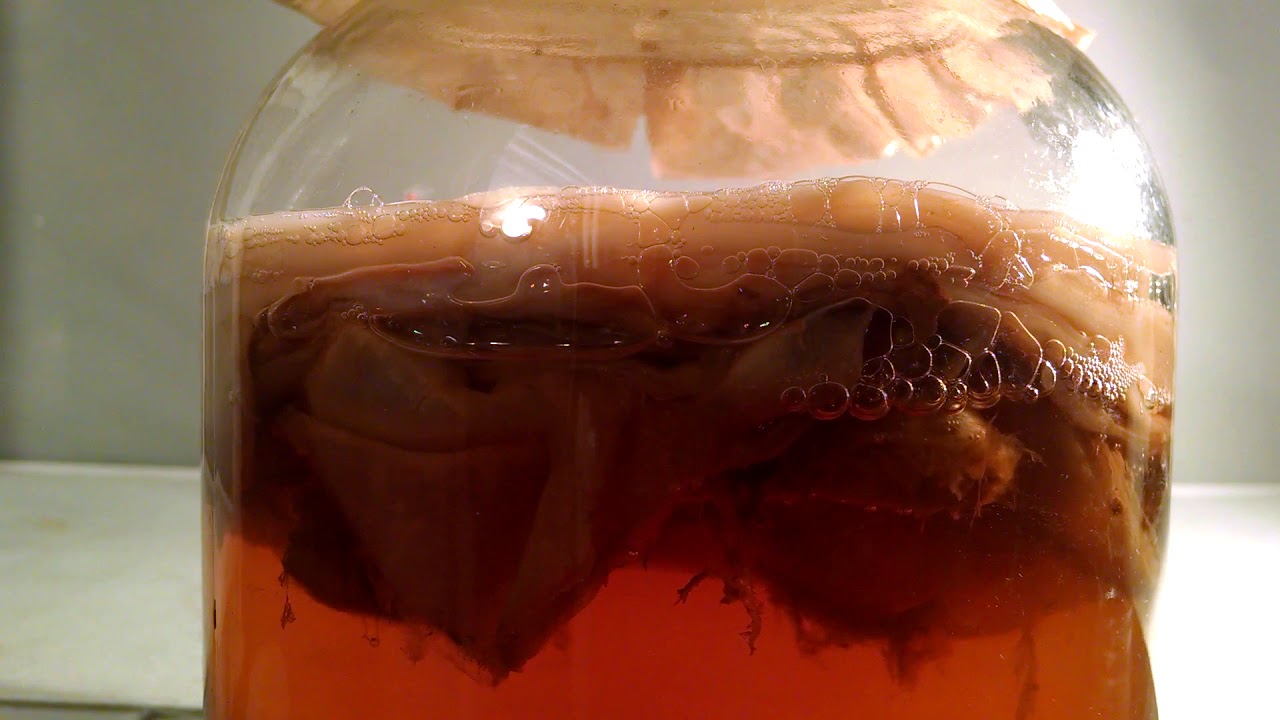
By day 3, a thin layer is forming on the tea's surface. This is the new SCOBY!
After 4 days, it's strong enough to hold bubbles down. The bubbles are carbon dioxide, generated as the yeasts digest the sugar into alcohol.
When alcohol is the intended product, as with beer or wine, air is excluded from the fermentation. In the case of kombucha, dust is excluded but gas can diffuse freely. As the yeasts produce alcohol, bacteria like Komatgataeibacter xylinus use oxygen to metabolize it into acetic acid. This makes the tea acidic, with very little alcohol content overall.
Kombucha isn't a single organism but a collection of yeasts and bacteria, one feeding off and removing the other's waste. This mutually beneficial arrangement is called a symbiosis. S.C.O.B.Y stands for Symbiotic Culture Of Bacteria and Yeast.
The SCOBY is also an example of a biofilm. A biofilm is a collection of microbes living stuck to one another. They often include an extracellular biopolymer matrix in which the microbes are embedded. In the case of kombucha, the polymer is cellulose produced by bacteria like K. xylinus.
The tea becomes slightly fizzy with fermentation. Depending on when it is sampled, it may be sweet, tart, or a sipping vinegar.
It can take a few weeks to ferment to taste, so I keep several batches in rotation, topping off fresh tea as needed.
Here's a recipe I use to stay cool over the summer: Take a watermelon from the fridge, and scoop out a few chunks into a glass. Cover it with chilled kombucha.
Thanks for watching, and stay tuned!
Повторяем попытку...
Доступные форматы для скачивания:
Скачать видео
-
Информация по загрузке:
![Что такое спин? [Veritasium]](https://image.4k-video.ru/id-video/gVFjBXyo7Ls)