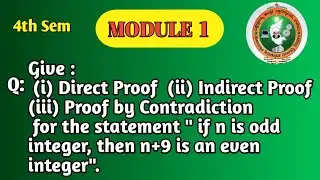
VTU 4th Sem Maths | Logical Equivalence Proof | Module 1 – Mathematical Logic | BCS405A
Автор: Express VTU 4 All
Загружено: 2025-07-10
Просмотров: 2722
Описание:
In this video, we solve an important logical equivalence problem from Module 1 – Mathematical Logic 1 of the VTU 4th Semester Mathematics syllabus (Subject Code: BCS405A).
📌 Question:
Show that the compound proposition
[(p ↔ q) ∧ (q ↔ r) ∧ (r ↔ p)] ⇔ [(p → q) ∧ (q → r) ∧ (r → p)]
is logically equivalent,
where p, q, and r are primitive statements.
We break down both compound propositions and use truth tables to verify their logical equivalence. This problem strengthens your understanding of biconditional (↔), implication (→), and compound propositions — a key area in discrete mathematics and logic.
VTU mathematical logic questions
Logical equivalence VTU BCS405A
Compound proposition truth table
VTU 4th sem maths module 1
Mathematical logic module 1 VTU
Logical equivalence truth table VTU
Prove [(p↔q) ∧ (q↔r) ∧ (r↔p)] ⇔ [(p→q) ∧ (q→r) ∧ (r→p)]
VTU discrete mathematics logic
BCS405A logic equivalence problems
VTU module 1 maths logical reasoning
In this video from Module 1 – Mathematical Logic 1 (Subject Code: BCS405A), we’ll solve a very interesting logical equivalence problem involving compound propositions.
We’re given two compound expressions:
[(p ↔ q) ∧ (q ↔ r) ∧ (r ↔ p)] and [(p → q) ∧ (q → r) ∧ (r → p)]
and we have to show that they are logically equivalent.
We’ll solve it step-by-step using a truth table, which is a very important concept for exams and understanding logical reasoning.
Повторяем попытку...

Доступные форматы для скачивания:
Скачать видео
-
Информация по загрузке: