How to Properly Pass Command Line Arguments in Self-Invoking Bash Scripts
Автор: vlogize
Загружено: 2025-09-07
Просмотров: 1
Описание:
Learn how to correctly pass all command line arguments to a self-invoking bash script within a Docker container using simple quoting methods.
---
This video is based on the question https://stackoverflow.com/q/63294130/ asked by the user 'hallvors' ( https://stackoverflow.com/u/163549/ ) and on the answer https://stackoverflow.com/a/63297640/ provided by the user 'Philippe' ( https://stackoverflow.com/u/2125671/ ) at 'Stack Overflow' website. Thanks to these great users and Stackexchange community for their contributions.
Visit these links for original content and any more details, such as alternate solutions, latest updates/developments on topic, comments, revision history etc. For example, the original title of the Question was: Including $@ to pass on all command line arguments when a shell script invokes itself with bash -c
Also, Content (except music) licensed under CC BY-SA https://meta.stackexchange.com/help/l...
The original Question post is licensed under the 'CC BY-SA 4.0' ( https://creativecommons.org/licenses/... ) license, and the original Answer post is licensed under the 'CC BY-SA 4.0' ( https://creativecommons.org/licenses/... ) license.
If anything seems off to you, please feel free to write me at vlogize [AT] gmail [DOT] com.
---
Mastering Command Line Arguments in Bash: Self-Invoking Scripts
When working with bash scripts, especially for those looking to run scripts in a containerized environment like Docker, you might face challenges in passing command line arguments correctly. One common issue arises when invoking a script that calls itself while attempting to forward any provided arguments, particularly with different quoting mechanics. This guide will walk you through the correct way to handle passing command line arguments in a self-invoking bash script, ensuring that everything functions smoothly.
The Problem
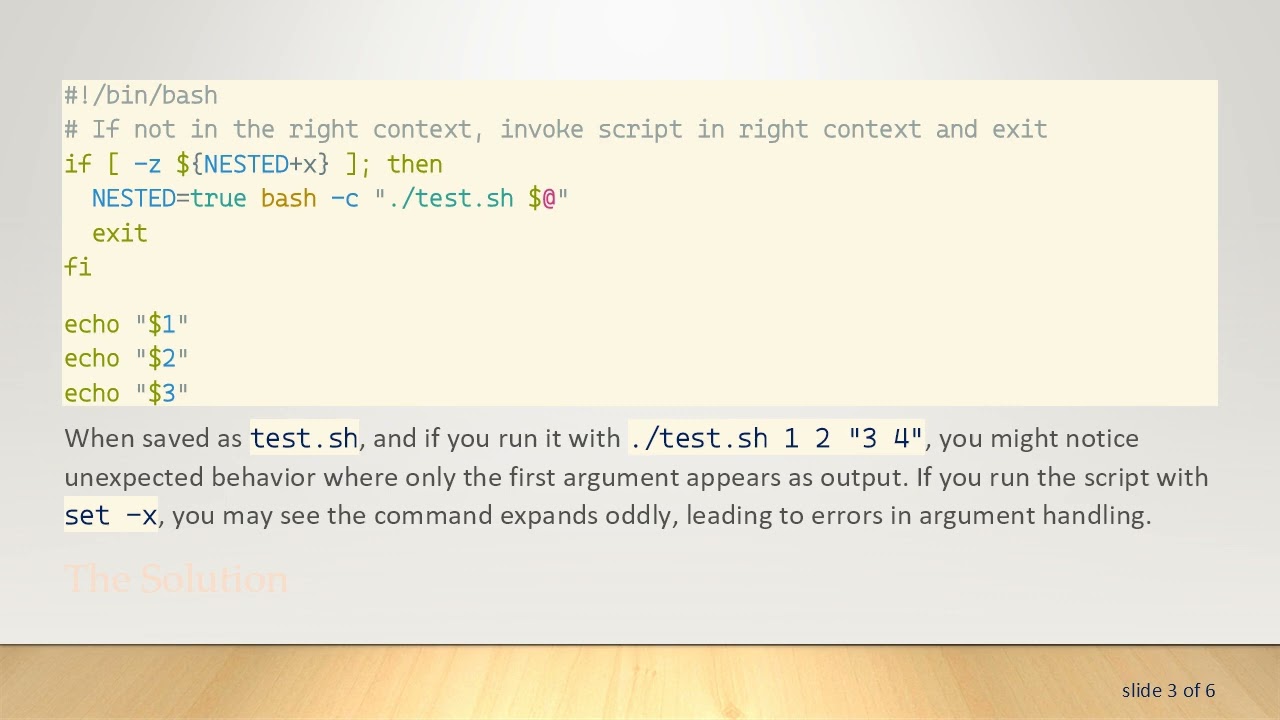
Suppose you have a bash script like the one below, intended to invoke itself in a new context. For example, you may need it to be run inside a Docker container. You attempt to pass all command line arguments as follows:
[[See Video to Reveal this Text or Code Snippet]]
When saved as test.sh, and if you run it with ./test.sh 1 2 "3 4", you might notice unexpected behavior where only the first argument appears as output. If you run the script with set -x, you may see the command expands oddly, leading to errors in argument handling.
The Solution
To correctly pass all command line arguments while self-invoking, one should avoid using bash -c due to its poor handling of arguments with spaces or special characters. Instead, the key is to directly call the script with ./test.sh "$@ ". Below is the revised code:
[[See Video to Reveal this Text or Code Snippet]]
Key Changes Made
Use of ./test.sh "$@ ": This modification will ensure all arguments, including those with spaces, are passed correctly.
Elimination of bash -c: This is essential, as bash -c can insert unwanted quoting that disrupts the expected behavior.
Benefits of the Revised Script
Simpler Logic: The script is now more straightforward without complexities introduced by the bash -c command.
Proper Handling of Arguments: Using "$@ " ensures all variations of input arguments are respected and echoed as intended.
Conclusion
When dealing with self-invoking bash scripts, especially in complex environments like Docker, remember to handle your command line arguments with care. Avoid unnecessary complexities by using straightforward solutions that respect bash's handling of arguments. By implementing the suggested changes, you’ll ensure your script invocations work flawlessly, allowing you to focus on developing robust applications without hiccups caused by command line issues.
If you follow the recommendations in this post, you’ll be well on your way to mastering command line argument handling in bash scripts. Happy scripting!
Повторяем попытку...
Доступные форматы для скачивания:
Скачать видео
-
Информация по загрузке: