The Real Reason Singapore Won't Cut Down This Large Forest
Автор: The Blue Cats
Загружено: 2026-06-14
Просмотров: 83251
Описание:
The Blue Cats’ website: https://www.thebluecats.com.sg/
The Blue Cats' Instagram: / singaporethebluecats
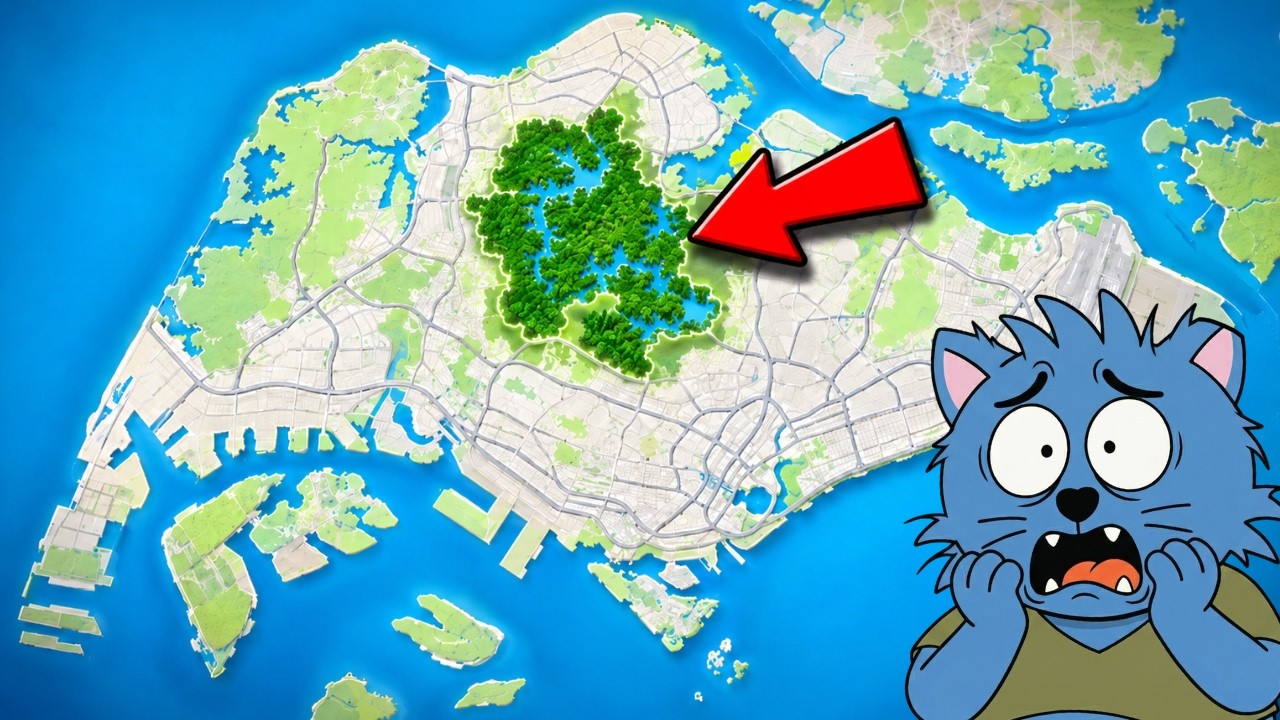
The Central Catchment Nature Reserve is Singapore's largest nature reserve, covering more than 2,000 hectares of forest with over 20km of trails, including the popular TreeTop Walk around MacRitchie Reservoir. It functions as a catchment area for four of Singapore's main reservoirs: MacRitchie, Upper Peirce, Lower Peirce, and Upper Seletar, all located within the reserve. Rainwater falls on the surrounding land and flows downhill into the reservoirs, and the trees and soil of the forest filter the water clean before it arrives. For this reason the forest is kept wild deliberately, and it is co-managed by NParks and PUB, the national water agency.
Singapore has no natural water resources such as large lakes or rivers, relying instead on rain. The country has progressively created surface water reservoirs, growing from the first three at MacRitchie, Seletar and Peirce to 17 reservoirs today, making it one of the few countries in the world to harvest urban stormwater on a large scale for drinking water. Water is drawn from four sources known as the Four National Taps: local catchment water, imported water from Malaysia, NEWater, and desalinated seawater. Desalination requires forcing seawater through membranes to remove salt, which consumes significant energy and money, so catching rainwater remains far more efficient because rain is already nearly fresh. Spreading supply across all four taps prevents dependence on any single source.
The reserve sits in the centre of the island due to history and geography. MacRitchie was completed in the late 1860s as Singapore's first water supply system, originally called the Impounding Reservoir or Thomson Road Reservoir. The middle of the island is high, hilly ground, with the TreeTop Walk connecting Bukit Peirce and Bukit Kalang, the two highest points in MacRitchie. High ground is ideal because a valley can be dammed and rain flows naturally downhill into it. The inland location also kept the water supply away from the crowded, dirty colonial port that was packed along the southern coast, keeping it cleaner and safer. The modern city later grew around this 150-year-old water decision.
Beyond catching rainwater, the reserve acts as a large green lung in the geographical centre of the island, cooling and cleaning the surrounding air. It is also a biodiversity ark, containing scattered patches of primary lowland dipterocarp forest and the last remaining primary freshwater swamp forest in Singapore at the Nee Soon Swamp Forest, with some of the country's rarest plants and animals found nowhere else. It serves as a recreation space featuring MacRitchie, boardwalks, the TreeTop Walk, and the nearby Mandai wildlife reserve. The Central Catchment and Bukit Timah Nature Reserves once formed one contiguous forest until the Bukit Timah Expressway, built in 1986, split it in two and prevented animals from crossing. To address this, the authorities built Eco-Link@BKE in 2013, a forest-covered overpass that reconnects the two reserves to allow animal movement and the dispersal of forest plant seeds, which NParks calls Southeast Asia's first ecological bridge.
Повторяем попытку...
Доступные форматы для скачивания:
Скачать видео
-
Информация по загрузке: