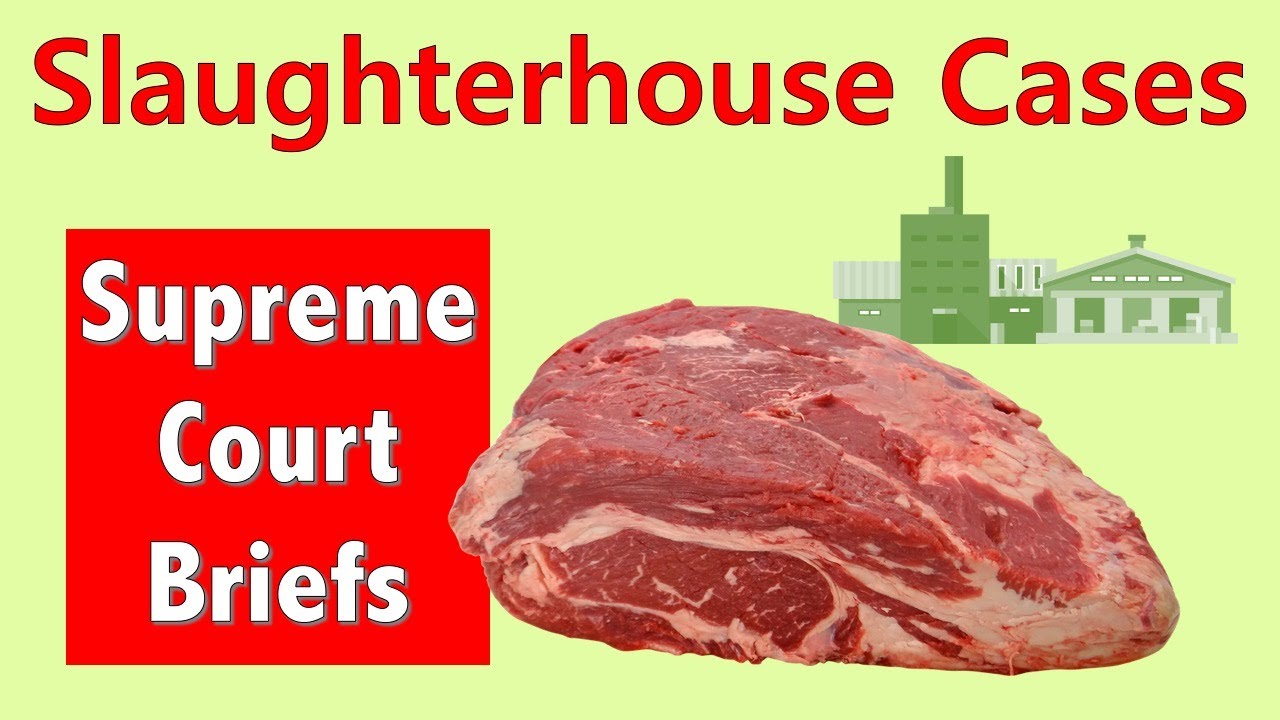
How Animal Guts Gutted the 14th Amendment | The Slaughterhouse Cases
Автор: Mr. Beat
Загружено: 2019-12-13
Просмотров: 98759
Описание:
I wrote a new book all about the Supreme Court. Order your copy here: http://amzn.to/45Wzhur or visit https://www.iammrbeat.com/merch.html.
In episode 51 of Supreme Court Briefs, animal guts in the drinking water of New Orleans leads to the first major interpretation of the 14th Amendment by the Supreme Court. #supremecourtbriefs #slaughterhousecases #apgov
Patreon: / iammrbeat
Donate on Paypal: https://www.paypal.me/mrbeat
Merch: https://www.iammrbeat.com/merch.html
Reddit: / mrbeat
Mr. Beat's band: http://electricneedleroom.us
Twitter: / beatmastermatt
Facebook: / iammrbeat
Instagram: / iammrbeat
Discord server: / discord
Produced by Matt Beat. All images by Matt Beat, found in the public domain, or used under fair use guidelines. Music by Electric Needle Room (Mr. Beat's band).
Electric Needle Room's new children's album, "Just Kidding Around:"
Bandcamp: https://tinyurl.com/yyf65v47
Spotify: https://tinyurl.com/y5ayqjhn
YouTube: https://tinyurl.com/y374maup
Apple: https://tinyurl.com/y6rjckls
Amazon: https://tinyurl.com/y5ukdrnf
Check out cool primary sources here:
https://www.oyez.org/cases/1850-1900/...
Other sources used:
Age of Betrayal: The Triumph of Money in America, 1865-1900 by Jack Beatty
Race Matters, Animal Matters: Fugitive Humanism in African America, 1840-1930 by Lindgren Johnson
https://www.law.cornell.edu/supremeco...
https://en.wikipedia.org/wiki/Slaught...
https://ij.org/center-for-judicial-en...
https://constitutioncenter.org/blog/h...
https://constitutioncenter.org/blog/t...
https://lasc.libguides.com/c.php?g=86...
Photo credits/Creative Commons:
Tom Bastin
New Orleans, Louisiana, 1867
3,000 residents die from cholera, a horrible disease characterized by having violent diarrhea until you’re dehydrated. How did they get cholera? From drinking the water. This is not surprising, as New Orleans water at the time was filthy. The president of the Board of Health testified, “When the river is low, it is not uncommon to see intestines and portions of putrefied animal matter lodged immediately around the pipes.” Yep, animal guts were in the drinking water, and citizens were dying horrible deaths after drinking it.
So how did the animal guts get in the drinking water in the first place? Well, just outside of the city, around 1,000 butchers gutted over 300,000 animals per year. New Orleans begged the Louisiana state legislature to do something about it. They did, passing a law that granted a monopoly to the Crescent City Livestock Landing and Slaughtering Company, saying that only it could run a slaughterhouse in New Orleans. The company would not actually butcher animals, but rent out space to other butchers in the city for a fee.
Well, it turns out the Crescent City folks had bribed the Louisiana legislature to give them the monopoly, and a bunch of butchers didn’t like this so much. More than 400 butchers of the Butchers’ Benevolent Association- what a great name- joined up to sue the Crescent City Company, saying that their monopoly created involuntary servitude, which went against the 13th Amendment of the Constitution. They also argued the monopoly prevented them from getting property and hurt their freedom to make money, bringing up the Privileges or Immunities Clause of the recently ratified 14th Amendment.
There were many lawsuits, and the butchers lost every single one of them. However, six of the butchers appealed to the Louisiana Supreme Court, which agreed with the lower courts. So the butchers appealed again to the Supreme Court, since this is a Supreme Court Briefs episode, ya know, and the Court agreed to look at their cases, hearing oral arguments in January and February of 1873.
Remember, the 14th Amendment had passed less than five years prior, and the Court was still trying to figure out its implications. John A. Campbell, who represented the butchers and used to be a federal judge but stepped down due to his Confederate loyalties, argued that the 14th Amendment should be interpreted broadly to protect equality not just for the recently freed slaves, but all Americans. Matthew H. Carpenter, who represented Louisiana, argued the monopoly of the Crescent City Company was justified as a way to protect public health and safety.
The Court announced their decision on April 14, 1873. They sided with Louisiana. It was a close one. 5-4. The Court held the monopoly did not go against the 13th and 14th Amendments because the 13th was about ending slavery and the 14th was about then giving equality to former slaves. In other words, you couldn’t expand those two Amendments to all groups of people.
Повторяем попытку...
Доступные форматы для скачивания:
Скачать видео
-
Информация по загрузке: