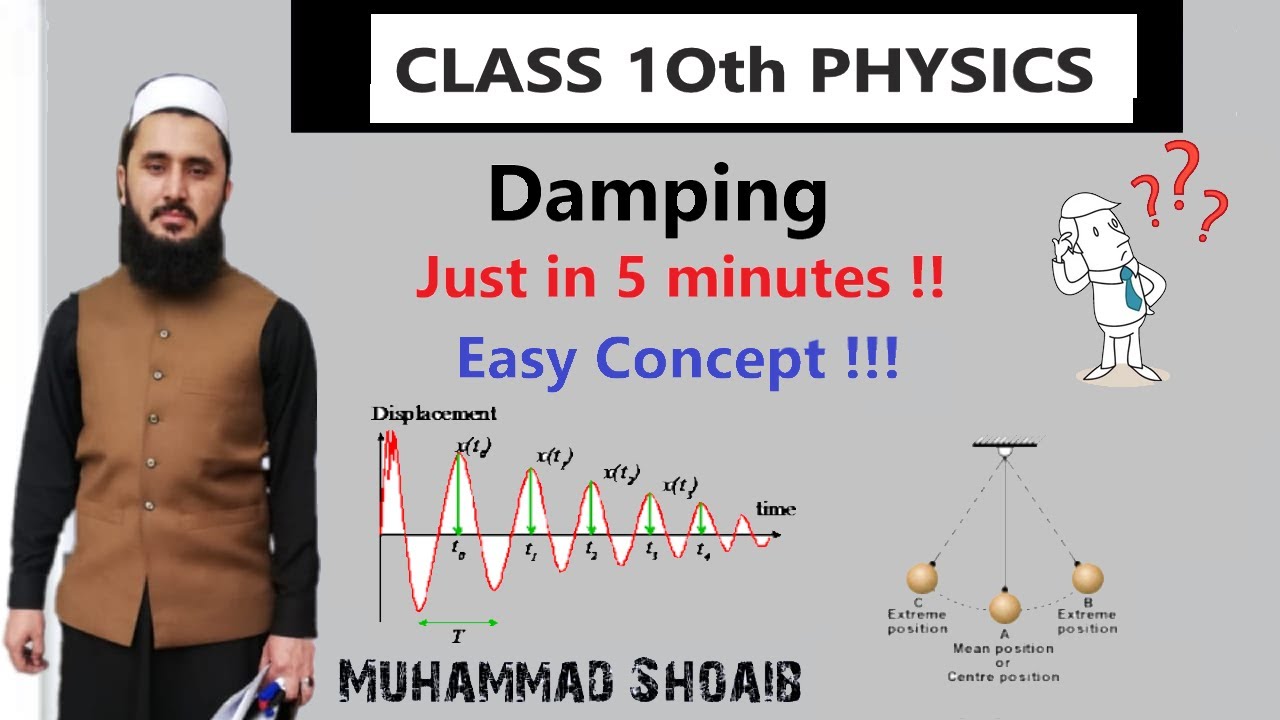
Physics Class 10th Damping | Damping | Backbenchers Academy
Автор: BACKBENCHERS ACADEMY
Загружено: 2023-06-17
Просмотров: 4346
Описание:
Damping refers to the process of reducing or dissipating the energy of oscillatory or vibrating systems. When an object undergoes vibration or oscillation, it tends to lose energy over time due to various factors such as friction, air resistance, or internal material properties. Damping is used to control and reduce the magnitude, duration, and potential harm caused by these vibrations.
In physics and engineering, damping is often employed to limit the amplitude of vibrations, prevent excessive oscillations, and enhance stability in mechanical systems. It is particularly important in systems where oscillations can cause damage, decrease performance, or introduce instability.
There are several types of damping techniques commonly used:
Viscous Damping: Viscous damping is based on the principle of dissipating energy through the relative motion of fluid layers or internal material layers. It is proportional to the velocity of the oscillating object and acts in the opposite direction to its motion. Viscous damping can be achieved through the use of fluids, such as oil or air, or by employing specially designed dampers.
Hysteresis Damping: Hysteresis damping occurs due to internal friction within the material of the vibrating system. It results in the dissipation of energy as heat, reducing the amplitude of oscillations. Materials with high internal friction, such as certain elastomers, can exhibit significant hysteresis damping.
Structural Damping: Structural damping involves incorporating specific design features or materials into the structure of a system to dissipate energy. This can be achieved by using materials that inherently possess damping properties or by introducing additional elements like dampers, shock absorbers, or viscoelastic materials into the system.
Aerodynamic Damping: Aerodynamic damping occurs when the motion of an object through a fluid medium, such as air or water, results in the dissipation of energy. The resistance offered by the fluid to the object's motion helps reduce the amplitude of oscillations. This type of damping is often utilized in applications involving vehicles, aircraft, or underwater systems.
The level of damping in a system can be controlled by adjusting the properties of the damping mechanism, such as the viscosity of a fluid or the material composition of a damper. The appropriate amount of damping depends on the specific requirements of the system, balancing factors such as stability, performance, and safety.
Damping is a crucial aspect in various fields, including mechanical engineering, structural engineering, civil engineering, and vibration analysis. It plays a vital role in the design and operation of structures, machinery, vehicles, and other systems where controlling and reducing vibrations is essential.
#physicsclass10th
#damping
#VibrationControl
#MechanicalDamping
#ViscousDamping
#HysteresisDamping
#StructuralDamping
#AerodynamicDamping
#DampingTechniques
#VibrationDissipation
#DampingMaterials
#dampers
#VibrationReduction
#DampingMechanism
#DampingAnalysis
#DampingDesign
Повторяем попытку...

Доступные форматы для скачивания:
Скачать видео
-
Информация по загрузке:





![Пожалуй, главное заблуждение об электричестве [Veritasium]](https://imager.clipsaver.ru/6Hv2GLtnf2c/max.jpg)







![Самая простая нерешённая задача — гипотеза Коллатца [Veritasium]](https://imager.clipsaver.ru/QgzBDZwanWA/max.jpg)