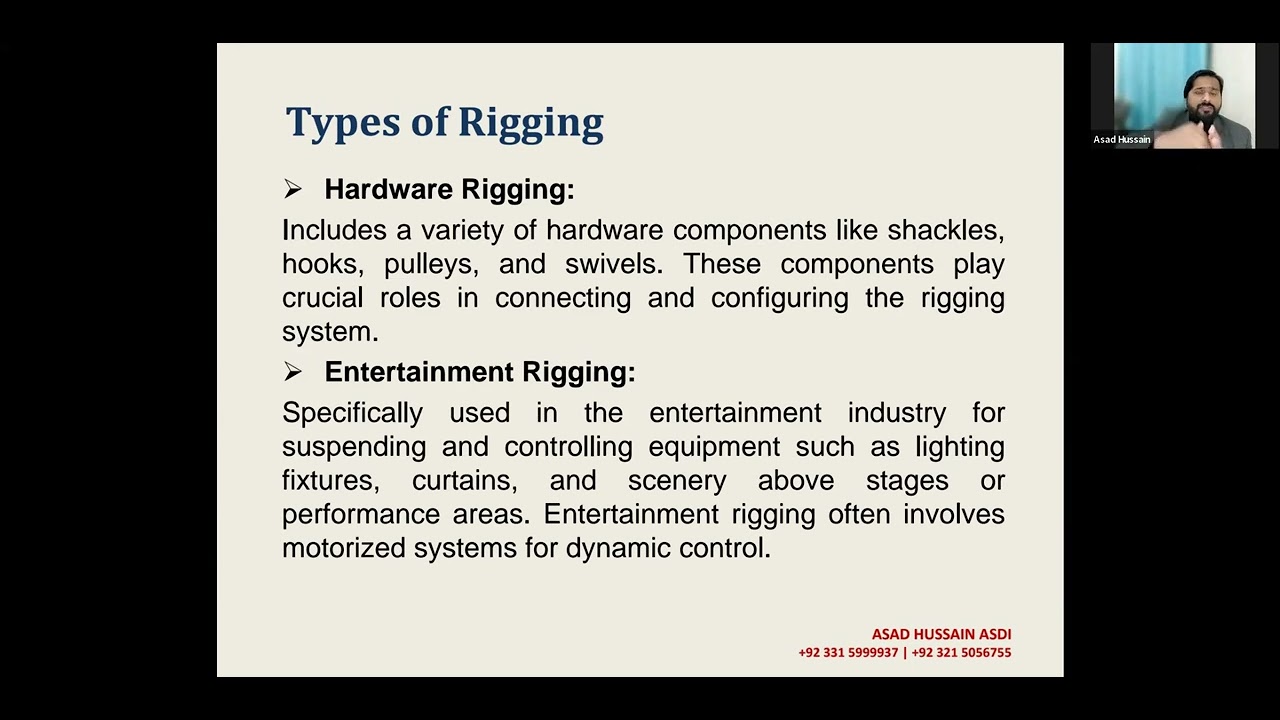
Lecture 4 || Rigger Course Level 1 to 3 || Rigging Safety - Complete Course with UK Certifications
Автор: Asad Hussain Asdi
Загружено: 2024-02-13
Просмотров: 816
Описание:
Lecture 4 || Rigger Course Level 1 to 3 || Rigging Safety - Complete Course with UK Certifications
Hey Dear,
Stay Connected with this YouTube Channel for upcoming informative Lecture Videos.
Asad Hussain Asdi
+92-331-5999937 , +92-321-5056755 [email protected]
Rigging Safety
Rigging safety is of utmost importance to ensure the
well-being of personnel, protect property, and prevent
accidents in lifting and moving heavy loads. Here are
key elements and practices for rigging safety.
1. Training and Certification:
Ensure that rigging personnel are properly trained and
certified. Riggers should have a comprehensive
understanding of equipment usage, load calculations,
and safety protocols.
2. Risk Assessment:
Conduct a thorough risk assessment before initiating
any rigging operation. Identify potential hazards and
implement strategies to mitigate risks.
3. Personal Protective Equipment (PPE):
Mandate the use of appropriate PPE, including hard
hats, gloves, safety glasses, and steel-toed boots, to
protect against potential injuries.
4. Equipment Inspection:
Regularly inspect all rigging equipment, including slings,
cables, hooks, and hardware, for signs of wear, damage,
or corrosion. Remove any defective equipment from
service immediately.
5. Load Calculations:
Accurately calculate the weight of the load and determine
the center of gravity. Use this information to select the
appropriate rigging equipment and ensure the load is
balanced.
6. Communication Protocols:
Establish clear and effective communication protocols
among the rigging team. Use standardized signals and
ensure that all team members understand and follow
communication procedures.
7. Pre-Lift Meeting:
Conduct a pre-lift meeting to review the rigging plan,
discuss potential hazards, assign roles, and confirm that
all team members are aware of safety measures.
8. Proper Attachment Points:
Identify and use proper attachment points on the load to
ensure stability during lifting. Avoid makeshift
attachment points that may compromise safety.
9. Safe Lifting Practices:
Lift loads smoothly and steadily to prevent sudden
movements. Avoid sudden starts or stops, and use
equipment that allows for controlled lifting and lowering.
10. Secure Loads Properly:
Ensure that loads are properly secured to prevent shifting
during transport. Use appropriate slings, chains, or other
securing mechanisms based on the load characteristics.
11. Environmental Considerations:
Consider environmental factors such as wind, weather,
and ground conditions when planning rigging operations.
Make adjustments to the plan as needed to address these
factors.
Rigging Safety
15. Documentation:
Maintain thorough documentation of equipment
inspections, rigging plans, and safety procedures.
Documentation serves as a reference for future
operations and audits.
By integrating these safety measures into rigging
operations, organizations can minimize risks, protect
personnel, and create a culture of safety that contributes
to the overall success of lifting and moving heavy loads.
#rigger #lecture4
#riggingSafety
Повторяем попытку...

Доступные форматы для скачивания:
Скачать видео
-
Информация по загрузке: