Problems with Traditional Grading (Part 3) | Grading at Stevenson High School
Автор: Adlai E. Stevenson High School
Загружено: 2020-08-20
Просмотров: 4746
Описание:
This is part three of our four part "Grading @ Stevenson" series. Links to the entire series are featured at the bottom of this description.
Principal Troy Gobble addresses the problems with traditional grading and how our evidence-based grading system allows for a more accurate representation of a student's progress.
TRANSCRIPT:
So you might've noticed that your son or daughter is receiving grades in a different way than you did as an adult. That's probably happened throughout your elementary and middle school career, and over the last seven years at Stevenson high school, we have done a significant job of thinking differently about the way that we give grades. So I want to take some time today and really help everyone better understand why we're doing this and what it might mean for you.
There are three other problems that happen in a system that's built around points that I want to really focus on today. Number one, if you have 10 homework assignments and you get a zero on one of them, you have to get a hundred percent on the next nine assignments for your set of 10 assignments to be an A. And that doesn't feel fair to kids who we ask to work so hard in so many different areas. And so I think it's critical for us to consider how that impact is.
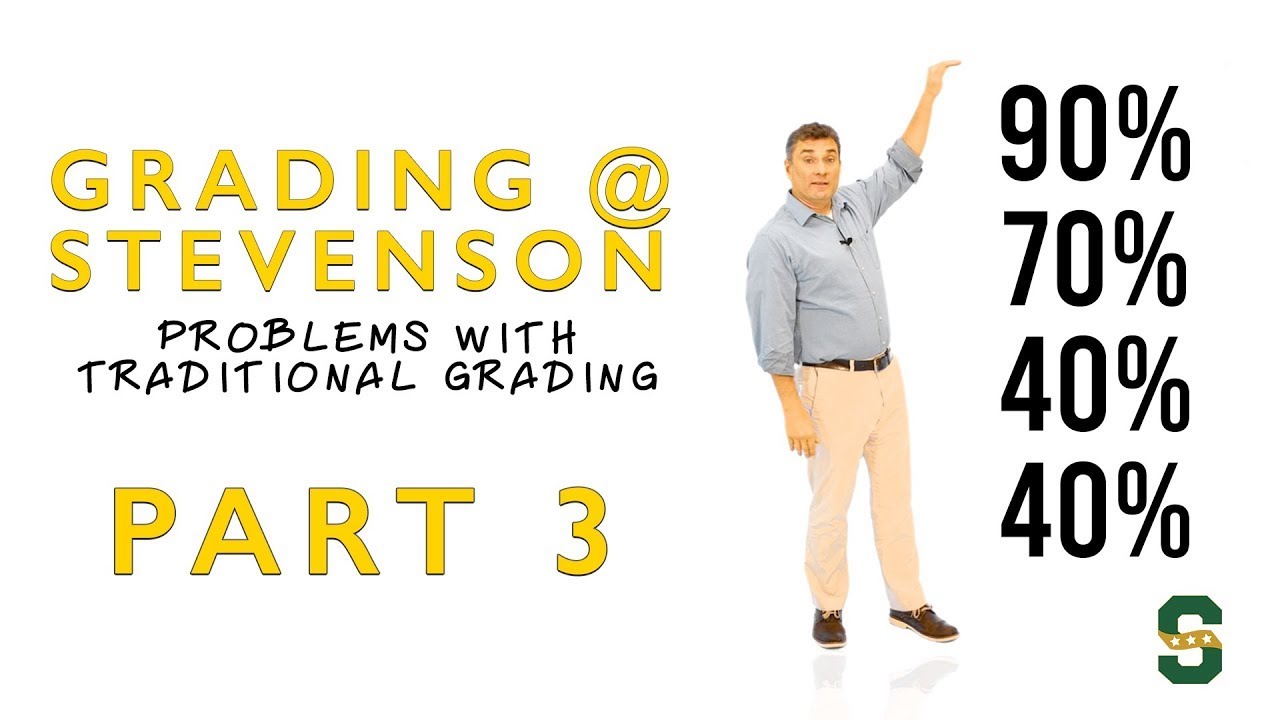
So, let's imagine a student who is growing as a student, and at the beginning of the class they get a 40. Their second test score is a 40. Their third test score is a 70. And their fourth test score is a 90. What a great student. They grew over time. Now, let's imagine another student in that same class whose scores go like this: 90, 70, 40 and 40. Two very different learners. We have a student who's really grown in the class, and come into their own, and learned the ideas that we want them to learn. And another student who over time has struggled and has not been able to achieve at a high level. The situation here that really challenges us though is that both of these kids, in an average based system, would receive the same score. And that to us is just not acceptable.
The last thing that has been a struggle for us over time is to consider what does it mean to allow a student to have a chance to re-perform? Imagine a student has an essay or a test or a lab and they don't do as well as they would like the first time. In a points based model, I'm going to have to re-perform every single assignment. We think that in a model that's built around learning, if we're measuring your success on a learning target, I can give you an assessment in September about that learning target and another assessment in October or November and December. All of those assessments can be about the same learning target and it gives you another chance to perform. It isn't a retake at that moment about that event, but it is a chance for us to see again how well you can do and have you mastered the standard. What happens here is not only are we not placing the emphasis on the points, we're also not placing the emphasis on the events. What's really important is how well are you able to over time show success on those learning targets? And we think that this idea of re-performance is a much better way to give kids second chances because we understand not every kid comes to every assessment and performs at his or her best on that day.
So, this is another problem that we want to make sure our evidence based model can provide a solution to.
PART 1: The Why
• The Why (Part 1) | Grading at Stevenson Hi...
PART 2: Understanding Your Grades
• Understanding Your Grades (Part 2) | Gradi...
PART 3: Problems With Traditional Grading
• Problems with Traditional Grading (Part 3)...
PART 4: College Preparation
• College Preparation (Part 4) | Grading at ...
Stevenson High School is located in Lincolnshire, Illinois.
www.d125.org
Повторяем попытку...
Доступные форматы для скачивания:
Скачать видео
-
Информация по загрузке: