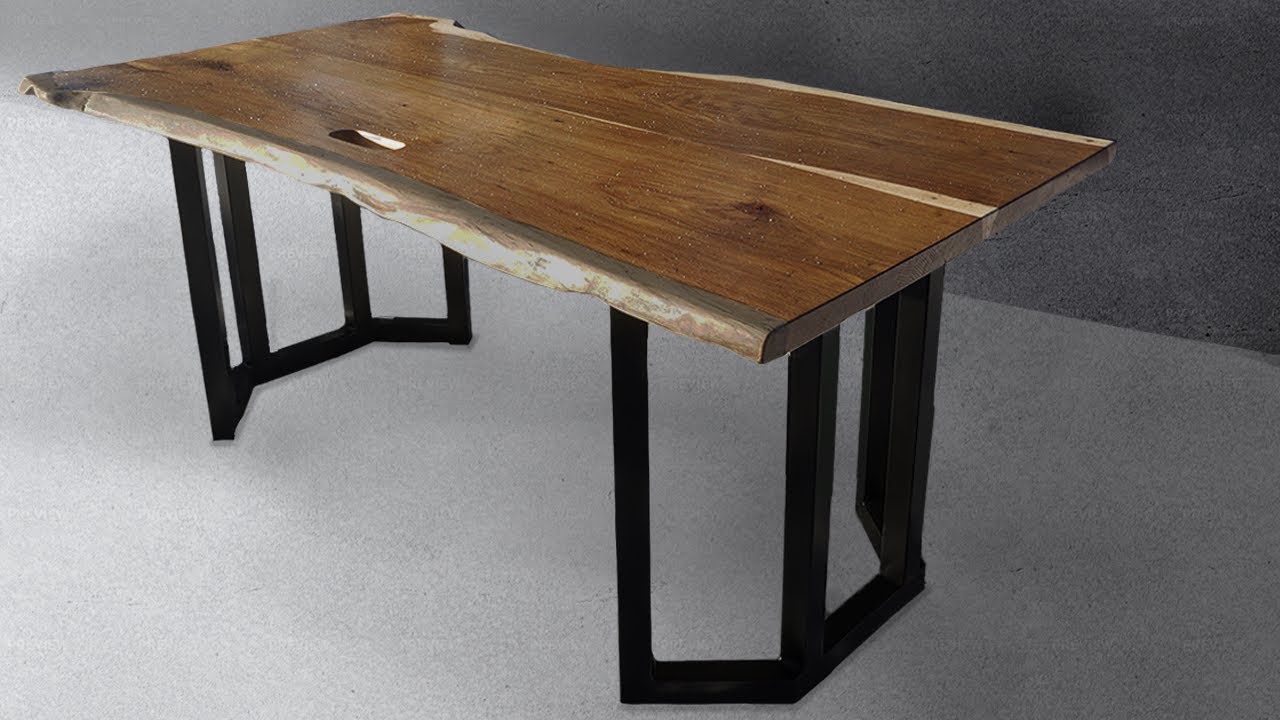
DIY 6FT Slab Desk with Custom Metal Base | HW|Designs
Автор: HonestWork Designs
Загружено: 2022-01-25
Просмотров: 4760
Описание:
For more behind-the-scenes content and to support the channel: / hwdesigns
To support "the show:"
Like
Subscribe
"Ring the Bell"
Follow me: / honestworkdesigns
Music Credits:
Feel So Lucky
Cody Francis
https://player.epidemicsound.com/
Fumes
Ocean Jams
https://player.epidemicsound.com/
I Remember You
Nickolas Jones
https://player.epidemicsound.com/
Morning Hike
Lindsey Abraham
https://player.epidemicsound.com/
An Easier Walk
View Points
https://player.epidemicsound.com/
* TRANSCRIPT OF VOICEOVER*
How to make, or how I made, live edge red oak slab desk with custom metal base,
Let’s get into it.
How about we crack on with the metal base first.
I started with the leg frame work by cutting 2x2” cold rolled metal square tubing down to 10 5/16” at a 15* angle on one end 8 times
Then cutting the same tubing down to 1’3” with two opposing 15* ends 4 times
These would create the leg frame
I gave them each a mineral spirit rub before grinding the edge of the butt jointing pieces to roughly 45 * to create a well for the weld.
Then, tack welded the first frame together before running my first welds.
Sloppy but effective welds complete, I ground them down to be flush with the tubing surface.
I ran through the same process 3 more times to create the upper and lower frame for each leg
With the 4 frames ready, I cut 2 28” lengths to serve as the vertical supports of the legs.
Then tack welded them to the frames before running welds on every joining edge.
Then ground the welds flush.
I repeated the same process to create the second leg frame.
The interior vertical supports were cut to 24 ” and went through the same, tack, weld, and grind process
Throughout the welding process, my mig welder struggled with voltage to wire feed ratio, creating thicker beadier welds in some places that would require second passes. I’m not entirely sure why.
To join the two legs to create the frame, I used some clamps and mounting supports to align the 4’8” cross beam before - you guessed it, going through the tack, weld, and grinding process once more.
To anchor the base to the wooden desk top, I cut 2 - 7” plates from what I’d say is ⅛” steel.
Then sank 3 recesses in each. The holes being oversized to the lag screws to allow the desk the ability to float as it adapts to its new environment while still being secured to the base.
Then ground down any roughness left by the drill created the well bevel, and tacked, welded, and ground the plates to the frame.
With the base in good shape, let’s switch gears to the slab top.
I started by selecting and cutting down 2 slabs of air dried red oak from my stack.
I cut them a little over 6 feet to accommodate how the later machining might affect the final desired dimension of 6’
I had to opt for the beam saw to meet the depth
Then, after setting a straight edge, I carefully cut the interior edges that would join the two slabs together.
With the rough dimensions in, it was time to get these guys level.
I opted to do the show side of each one at a time to help mitigate material waste.
Using the router caddy as my guide, I figured out where our low points, twists, cups, etc. were - then used shims and hot glue to set the slab to meet the router as evenly as possible to again, mitigate wasted depth.
With a 1 ¾” planing bit, I got to work flattening the show sides of the slabs
With a decently flat side ready, I clamped the two slabs in alignment and marked where I would sink some dominions to join them together.
Then, with the festool dominion jointer, cut 4 recesses.
After that, it was time for glue up.
I’m not the MOST pleased with my gluing set up, I had limited clamps large enough for the width, and I should have used some cauls to assist the joining, but all in all I was happy with the turn out.
Once cured, I flipped, and flipped, and flipped the slab over
Before, what I’ll call “lightly” flattening the underside of the desk, just enough to make the contact points with the base flat.
Then, I got to work cleaning up the edge bark.
Luckily, my missing draw knife wasn’t too much of a hindrance, as the sap would was quick work to cut through with just a large chisel.
Then, I got to work on the first rough sand to get rid of all the first strike machining marks.
In good shape, I got to work filling all the large surface knots and checks.
I filled this big check too - that would later also get a bottom surface bow tie to hold it in place.
I also used blue tape to keep the SA glue from over running its boarders.
After the glue cured, I sanded back any bubbling on the surface.
Trimmed the ends flush
And then go to work stabilizing the slab from below.
I marked 5 places I thought needed the help of a bow tie
Then filled the remaining knots and small holes.
With a scrap piece of red oak, I drew and cut out the bow ties.
Повторяем попытку...
Доступные форматы для скачивания:
Скачать видео
-
Информация по загрузке: