ycliper

Популярное

Музыка Кино и Анимация Автомобили Животные Спорт Путешествия Игры Юмор

Интересные видео

2025 Сериалы Трейлеры Новости Как сделать Видеоуроки Diy своими руками

Топ запросов

смотреть а4 schoolboy runaway турецкий сериал смотреть мультфильмы эдисон
Скачать

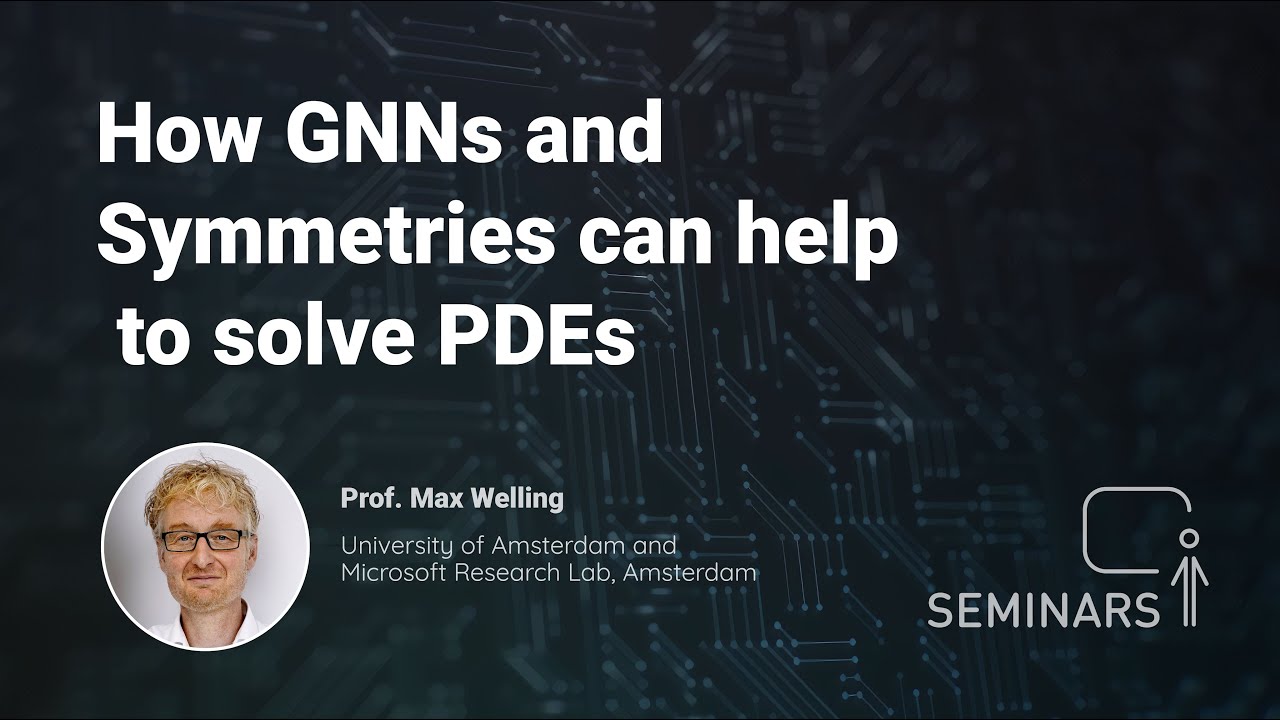
How GNNs and Symmetries can help to solve PDEs - Max Welling

Автор: IARAI Research

Загружено: 2022-03-30

Просмотров: 3892

Описание: Joint work with Johannes Brandstetter and Daniel Worrall.

Deep learning has seen amazing advances over the past years, completely replacing traditional methods in fields such as speech recognition, natural language processing, image and video analysis and so on. A particularly versatile deep architecture that has gained much traction lately is the graph neural network (GNN), of which transformers represent a special case. GNNs have the desirable property that they can process graph structured data while respecting permutation symmetry. Recently, GNNs have found new applications in scientific computation, for instance to predict the properties of molecules or to predict the forces that act on atoms when they evolve (e.g. fold). In this application it is also key that geometric symmetries, such as translation and rotation symmetries are taken into consideration. In this talk I will report on yet another exciting application of using GNNs to solve partial differential equations (PDEs). It turns out that GNNs are an excellent tool to develop neural PDE integrators. Moreover, PDEs are full of surprising symmetries that can be leveraged to train neural integrators with less data. In this talk I will discuss this very exciting new chapter in deep learning. I will end with a discussion of whether reversely, PDEs can also serve as a model for new deep architectures.
______

Professor Dr Max Welling is a full professor and research chair in machine learning at the University of Amsterdam where he directs the research group AMLAB. He is also a Distinguished Scientist at MSR and director of the new MSR office in Amsterdam. He is a fellow at the Canadian Institute for Advanced Research (CIFAR) and the European Lab for Learning and Intelligent Systems (ELLIS) where he serves on the founding board. His previous appointments include VP at Qualcomm Technologies, professor at UC Irvine, postdoc at U. Toronto and UCL under supervision of prof. Geoffrey Hinton, and postdoc at Caltech under supervision of prof. Pietro Perona. He finished his PhD in theoretical high energy physics under supervision of Nobel laureate prof. Gerard ‘t Hooft.

Max Welling has served as associate editor in chief of IEEE TPAMI from 2011-2015, he serves on the advisory board of the Neurips foundation since 2015 and has been program chair and general chair of Neurips in 2013 and 2014 respectively. He was also program chair of AISTATS in 2009 and ECCV in 2016 and general chair and co-founder of MIDL 2018. Max Welling is recipient of the ECCV Koenderink Prize in 2010 and the ICML Test of Time award in 2021. He directs the Amsterdam Machine Learning Lab (AMLAB) and co-directs the Qualcomm-UvA deep learning lab (QUVA) and the Bosch-UvA Deep Learning lab (DELTA).


Subscribe to our newsletter and stay in the know:
https://www.iarai.ac.at/event-type/se...

___________________________________________________________________
IARAI | Institute of Advanced Research in Artificial Intelligence
www.iarai.ac.at

Не удается загрузить Youtube-плеер. Проверьте блокировку Youtube в вашей сети.
Повторяем попытку...
How GNNs and Symmetries can help to solve PDEs - Max Welling

Поделиться в:

Доступные форматы для скачивания:

Скачать видео

  • Информация по загрузке:

Скачать аудио

Похожие видео

Neural diffusion PDEs, differential geometry, and graph neural networks - Michael Bronstein

Neural diffusion PDEs, differential geometry, and graph neural networks - Michael Bronstein

Взрыв в комендатуре, Женева: Буданов торопит сделку? ФСБ отрубит связь. Фейгин, Климарев, Шепелин

Взрыв в комендатуре, Женева: Буданов торопит сделку? ФСБ отрубит связь. Фейгин, Климарев, Шепелин

ICML 2024 Tutorial

ICML 2024 Tutorial"Machine Learning on Function spaces #NeuralOperators"

КОЛМАНОВСКИЙ:

КОЛМАНОВСКИЙ: "Это просто чудо". Где "проваливается" ИИ, что не так с ядом из кожи лягушки, азарт

Modern Hopfield Networks - Dr Sepp Hochreiter

Modern Hopfield Networks - Dr Sepp Hochreiter

Космическая плазма: что происходит между Солнцем и Землёй – Семихатов, Зелёный

Космическая плазма: что происходит между Солнцем и Землёй – Семихатов, Зелёный

Как Сделать Настольный ЭЛЕКТРОЭРОЗИОННЫЙ Станок?

Как Сделать Настольный ЭЛЕКТРОЭРОЗИОННЫЙ Станок?

Глубокое обучение для научных вычислений | Основной доклад AMLD | Макс Веллинг

Глубокое обучение для научных вычислений | Основной доклад AMLD | Макс Веллинг

157. Как складываются спины в квантовой механике? Теория групп и законы сохранения НЕпростым языком.

157. Как складываются спины в квантовой механике? Теория групп и законы сохранения НЕпростым языком.

An introduction to Graph Neural Networks (GNNs) for Partial Differential Equations (PDEs)

An introduction to Graph Neural Networks (GNNs) for Partial Differential Equations (PDEs)

Abstraction and Analogy are the Keys to Robust AI - Melanie Mitchell

Abstraction and Analogy are the Keys to Robust AI - Melanie Mitchell

Graph Based Machine Learning Methods for Human Mobility Analysis - Henry Martin

Graph Based Machine Learning Methods for Human Mobility Analysis - Henry Martin

Почему ИИ может решить самые сложные математические задачи — Ян-Хуэй Хэ (математический физик)

Почему ИИ может решить самые сложные математические задачи — Ян-Хуэй Хэ (математический физик)

Лучший документальный фильм про создание ИИ

Лучший документальный фильм про создание ИИ

Michael Bronstein: Breakthroughs with AI

Michael Bronstein: Breakthroughs with AI

Zongyi Li's talk on solving PDEs from data

Zongyi Li's talk on solving PDEs from data

Onur Mutlu @ TU Wien 2019 - Memory Systems - Lecture 1a: Memory Importance and Trends

Onur Mutlu @ TU Wien 2019 - Memory Systems - Lecture 1a: Memory Importance and Trends

Вот как читать дифференциальные уравнения.

Вот как читать дифференциальные уравнения.

УХТОМСКИЙ - физиолог ДОКАЗАЛ, что МОЗГ сам выбирает РЕАЛЬНОСТЬ. ОДИН против всех !

УХТОМСКИЙ - физиолог ДОКАЗАЛ, что МОЗГ сам выбирает РЕАЛЬНОСТЬ. ОДИН против всех !

ЛИНИЯ ФРОНТА В КАНУН ПЕРЕГОВОРОВ. БЕСЕДА С ЮРИЕМ ФЕДОРОВЫМ  @fedorovexpert

ЛИНИЯ ФРОНТА В КАНУН ПЕРЕГОВОРОВ. БЕСЕДА С ЮРИЕМ ФЕДОРОВЫМ @fedorovexpert

© 2025 ycliper. Все права защищены.


  • Контакты
  • О нас
  • Политика конфиденциальности


Контакты для правообладателей: [email protected]