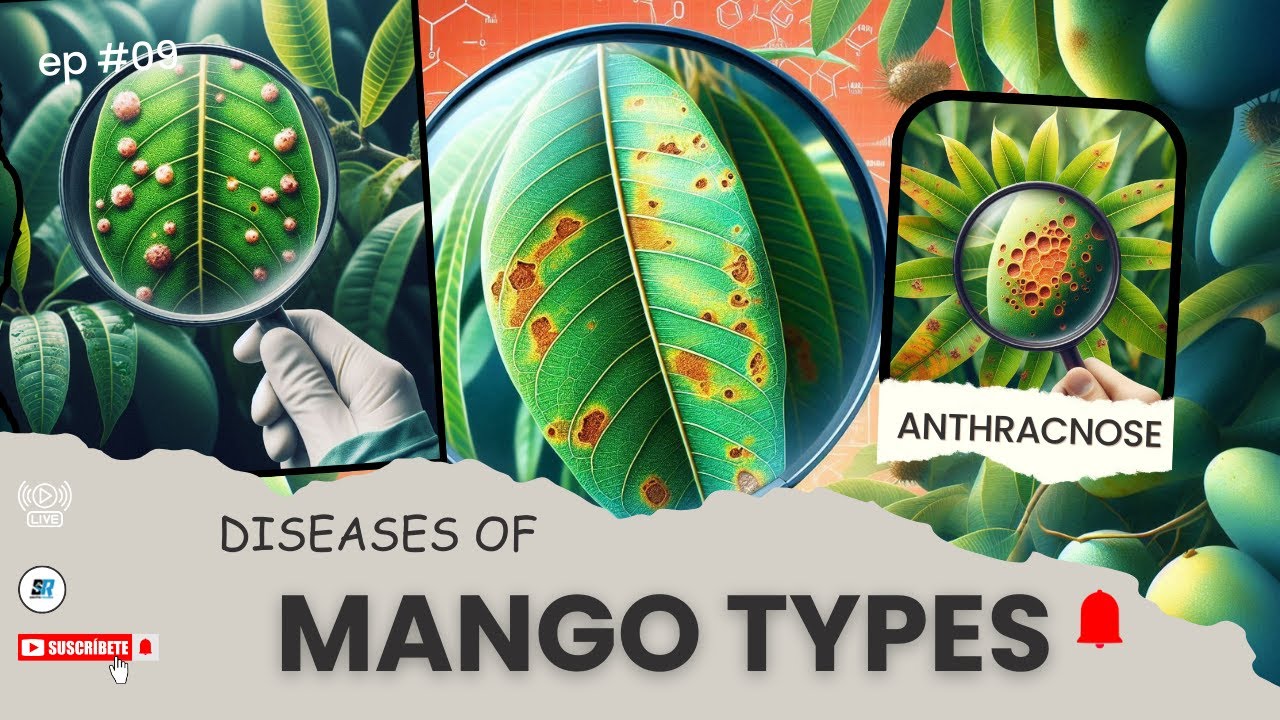
DISEASES OF MANGO TYPES
Автор: SR TEACHING
Загружено: 2024-07-18
Просмотров: 24
Описание:
DISEASES OF MANGO
POWDERY MILDEWS
Causal organism: Oidium mangiferae
Sub-division: Deuteromycotina
Symptoms
The disease can easily recognized by whitish or grayish powdery growth on the inflorescence
and tender leaves. Leaves become twisted, curled and defoliate. Infected floral parts are
severely damaged and drop off. If the fruits are set, they do not grow in size and may drop
before attaining pea size.
Fig 9.3: Powdery Mildew of Mango
Disease cycle
Primary infection: Through infected plant debris by conidia.
Secondary infection: Wind borne conidia of Oidium mangiferae.
Favourable conditions:
Disease spread is favored by warm humid weather with cool nights.
37
Management
Can be controlled with two preventive sprays with wettable sulphur 0.3% once
before the flowers open and 2nd after the fruit set.
Spraying with Karathane 0.1% before flowering and after fruit set (peanut stage).
9. 4 MANGO BACTERIAL CANCKER
Causal organism: Xanthomonas campestris pv. mangiferae indica
Symptoms
Groups of minute, water-soaked lesions, delimited by veins, appear towards the tip of the
leaf.They increase in size about 1-4mm, become raised and turn brown to black in colour.
Some time the spots surrounded by chlorotic halo .Cankerous lesions also appear on petioles,
twigs and young fruits.
Fig 9.4: Bacterial Canker of Mango
Mode of spread and survival:
Infected nursery trees have been a major source of disease in new orchards.
Bacterium enters the leaf through stomata, in fruit and twig through lenticels. The
bacterium survives in infected parts on the tree.
The pathogen survives up to 8 months in the leaves. Bacteria from cankers on the
twigs are the cause for primary infection on the fruits.
Disease spread is rapid during rainy days. Disease spread to the new area through
infected planting material.
38
Management
Three sprays of Streptocycline (0.01%) + Copper oxychloride 0.3% after first
visual symptom at 10 day intervals.
Monthly sprays of Copper Oxychloride (0.3%) are effective in controlling the
disease.
39
Session-10
DISEASES OF CITRUS
10.1 CITRUS GUMMOSIS
Causal organism: Phytophthora nicotianae var. parasitica, P. palmivora, P.citrophthora,
Sub-division: Mastigomycotina
Symptoms
Disease starts as water soaked large patches on the basal portions of the stem near the ground
level. First symptoms are dark staining of bark which progresses into the wood Bark in such
parts dries, shrinks and cracks and shreds in lengthwise vertical strips. Bark at the base is
destroyed and finally death of the tree.Profuse exudation of gum from the bark of the trunk
occurs. Prior to death, the plant usually blossoms heavily and dies before the fruits mature.
Fig 10.1: Citrus Gummosis
Disease cycle
Primary infection: Oospore
Secondary infection: Zoospore spread by water.
Favourable conditions
Prolonged contact of trunk with water as in flood irrigation; water logged areas and
heavy soils favourable for the disease development.
Management
Selection of proper site with adequate drainage and high budding (30 to 46 cm or
above).
Provision of an inner ring about 45 cm around the tree trunk to prevent moist soil.
(Double ring method of irrigation)
40
Soil drenching with 0.2% metalaxyl and 0.5% Trichoderma viride commercial
formulation is also effective.
10.2 CITRUS CANKER
Causal organism: Xanthomonas axonopodis pv. citri
Symptoms:
The lesions appear as minute water soaked round, yellow spots which enlarge slightly and
turn brown, eruptive and corky.The spots are about 2 to 3 mm in diameter. These pustules are
surrounded by a characteristic yellow halo in leaves. Canker lesions on the fruit do not
possess the yellow halo as on leaves. Several lesions on fruit may coalesce to form a patch.
Fig 10.2: Citrus Canker
Disease cycle
Primary infection: From infected plant parts.
Secondary infection: Ooze spread by splashing rain water ,irrigation water and Citrus leaf
miners (Phyllocnistis citrella ).
Favourable conditions:
• Free moisture for 20 minutes at 20-30°C initiates the disease.
Management
Prune out and burn all canker infected twigs before monsoon.
Spray Streptocycline @ 0.01% and Copper oxychloride @ 0.3%
Повторяем попытку...
Доступные форматы для скачивания:
Скачать видео
-
Информация по загрузке: