How an Iowa 16-Inch Shell 'Explosion' Horrified the Japanese Navy
Автор: Skies of Fire: WW2 Stories
Загружено: 2025-10-29
Просмотров: 17197
Описание:
How an Iowa 16-Inch Shell 'Explosion' Horrified the Japanese Navy
October 25, 1944. Japanese lookout aboard cruiser Kumano sees something impossible—massive water columns erupting fifteen kilometers away. No ship's guns reach that far. Maximum battleship range is twelve kilometers. But these shells are coming from farther. And they're walking closer with each salvo. Someone beyond the horizon is systematically adjusting aim.
This is the story of USS Iowa's sixteen-inch guns that redefined naval warfare. Guns that could destroy enemies who couldn't even see what was killing them.
USS Iowa BB-61, commissioned February 1943, was the last generation of American battleships. 887 feet long, 58,000 tons, 33 knots speed. Nine sixteen-inch Mark 7 naval rifles in three triple turrets. Each gun 66 feet long, over 100 tons. Designed to fire 2,700-pound armor-piercing shells twenty-three miles. Most battleships 1944 reached twelve to fifteen miles. Iowa's extra eight miles changed everything.
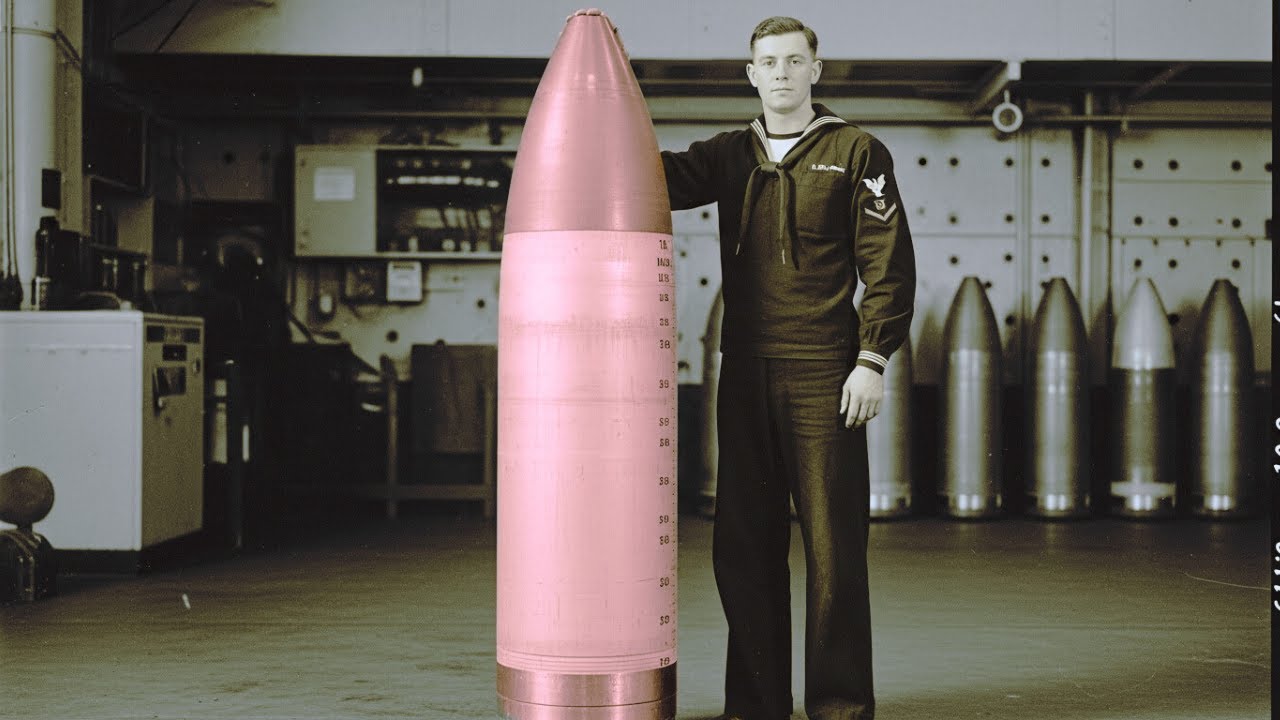
The Mark 8 projectile weighed 2,700 pounds—over a ton. Five feet long, solid forged steel front, forty pounds high explosive rear. Fired at 2,500 feet per second—three times faster than commercial jets. Impact alone could penetrate eighteen inches of armor. With explosive charge, it punched through battleship belt armor and detonated deep inside causing catastrophic damage.
How? Physics and engineering. Fifty-caliber barrel length versus standard forty-five. Six silk bags of smokeless powder creating 40,000 PSI. Ballistic-optimized shells. Forty-five-degree elevation for high-angle fire striking weakly-armored top decks.
But range meant nothing without accuracy. Mark 38 fire control director with rangefinders and revolutionary Mark 8 radar detected ships beyond visual range. Mark 8 rangekeeper analog computer calculated wind, temperature, pressure, ship motion, Earth rotation—updating solutions multiple times per second. Computer aimed and fired automatically. Human gunners couldn't see targets beyond horizon. Only radar and computer made shots possible.
Battle of Leyte Gulf October 1944. Japanese super-battleship Yamato approached American invasion fleet. Then Iowa-class battleships arrived. Admiral Kurita calculated thirty minutes under Iowa's fire before his ships could reply. He withdrew. Iowa's reputation alone changed the battle.
February 1945. Iowa bombarded Iwo Jima for three days. Sixteen-inch high-explosive shells with 150 pounds explosive collapsed reinforced concrete bunkers Japanese built to withstand regular artillery. Single hit destroyed fortifications requiring dozens of smaller shells. Naval gunfire support saved thousands of Marine casualties.
Iowa's guns represented peak battleship technology and end of an era. After WW2, no nation built new battleships. Missile age was beginning. But Iowa served Korean War, Vietnam, even 1991 Gulf War when sister ship Missouri fired sixteen-inch shells at Iraqi positions. Guns designed 1930s remained effective fifty years later.
Today USS Iowa is museum ship in Los Angeles. Each turret weighs 1,700 tons—weight of modern destroyer. Crews could fire nine shells every thirty seconds. Nine tons of steel and explosive hurled twenty miles every half minute.
Japanese Navy feared Iowa's guns because they redefined engagement ranges. One ship dominated forty-mile diameter ocean area. Iowa forced changes in tactics, strategy, ship design. The sixteen-inch guns were most powerful naval weapons in history. Sometimes the biggest gun wins.
📚 US Navy Archives, Battle of Leyte Gulf Reports, Iowa Museum Documentation.
🔔 SUBSCRIBE 💬 COMMENT 👍 LIKE
#Iowa #Battleship #16Inch #NavalGuns #WW2 #PacificWar #LeytGulf #IwoJima #NavalWarfare #USSIowa #JapaneseNavy #Mark7 #BattleshipRow #NavalHistory #WorldWar2
Повторяем попытку...
Доступные форматы для скачивания:
Скачать видео
-
Информация по загрузке: