Stages of Peripheral Nerve Injury and Regeneration
Автор: Medicine Study
Загружено: 2026-01-30
Просмотров: 141
Описание:
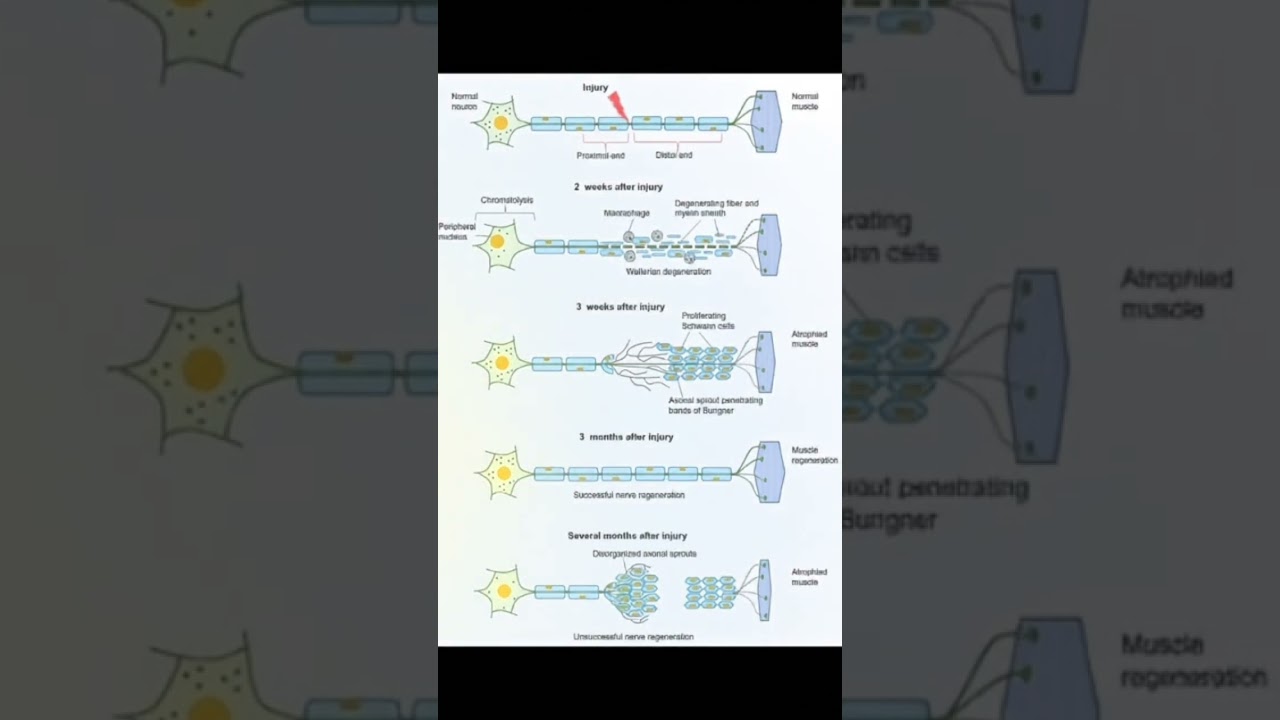
⚡ Immediate and Early Response to Injury (First 2 Weeks)
When a peripheral nerve is injured, the axon is severed, creating a proximal end (still attached to the cell body) and a distal end (separated from the cell body).
Distal End Response (Wallerian Degeneration): Within the first two weeks, the distal segment, deprived of nutrients and support from the cell body, undergoes Wallerian degeneration. This involves the breakdown of the degenerating axon fiber and its myelin sheath. Macrophages are recruited to the site to clear the cellular debris.
Proximal End Response (Chromatolysis): The neuron's cell body responds with chromatolysis, where the Nissl bodies (Rough ER) disperse, and the nucleus often moves to the periphery. This is a crucial physiological response indicating the cell is shifting from its signaling function to a state focused on synthesizing the materials needed for axon repair and regrowth.
⏳ Regeneration Attempts (3 Weeks to 3 Months)
The next phase involves an organized effort to bridge the gap and re-innervate the target muscle.
Role of Schwann Cells: By 3 weeks after injury, the Schwann cells that previously formed the myelin sheath survive the degeneration process in the distal segment. They begin to proliferate and align themselves, forming cellular columns known as the bands of Büngner. These bands provide a crucial physical and chemical scaffolding that guides the growing axon.
Axonal Sprouting: The proximal end begins to extend multiple axonal sprouts into the bands of Büngner. The corresponding muscle, without neural input, starts to show signs of atrophy.
Successful Regeneration (3 Months after injury): If one of the axonal sprouts successfully penetrates the bands of Büngner and navigates its way down the pathway to find the target muscle, successful nerve regeneration occurs. This leads to the eventual muscle regeneration and functional recovery, although the process is slow.
🛑 Unsuccessful Regeneration (Several Months after injury)
If the regenerating axonal sprouts fail to find the bands of Büngner, the regeneration fails.
Disorganized Sprouting: The disorganized axonal sprouts may grow randomly or form a tangled mass called a neuroma.
Outcome: This unsuccessful nerve regeneration results in a failure to re-establish connection, leading to continued and permanent atrophied muscle, loss of function, and often chronic pain due to the disorganized nerve growth.
#NerveRegeneration #WallerianDegeneration #PeripheralNerveInjury #Chromatolysis #SchwannCells #AxonalSprouting #BandsOfBungner #Macrophage #MuscleAtrophy #Neuroma #Neuroscience #PeripheralNervousSystem
Повторяем попытку...
Доступные форматы для скачивания:
Скачать видео
-
Информация по загрузке: