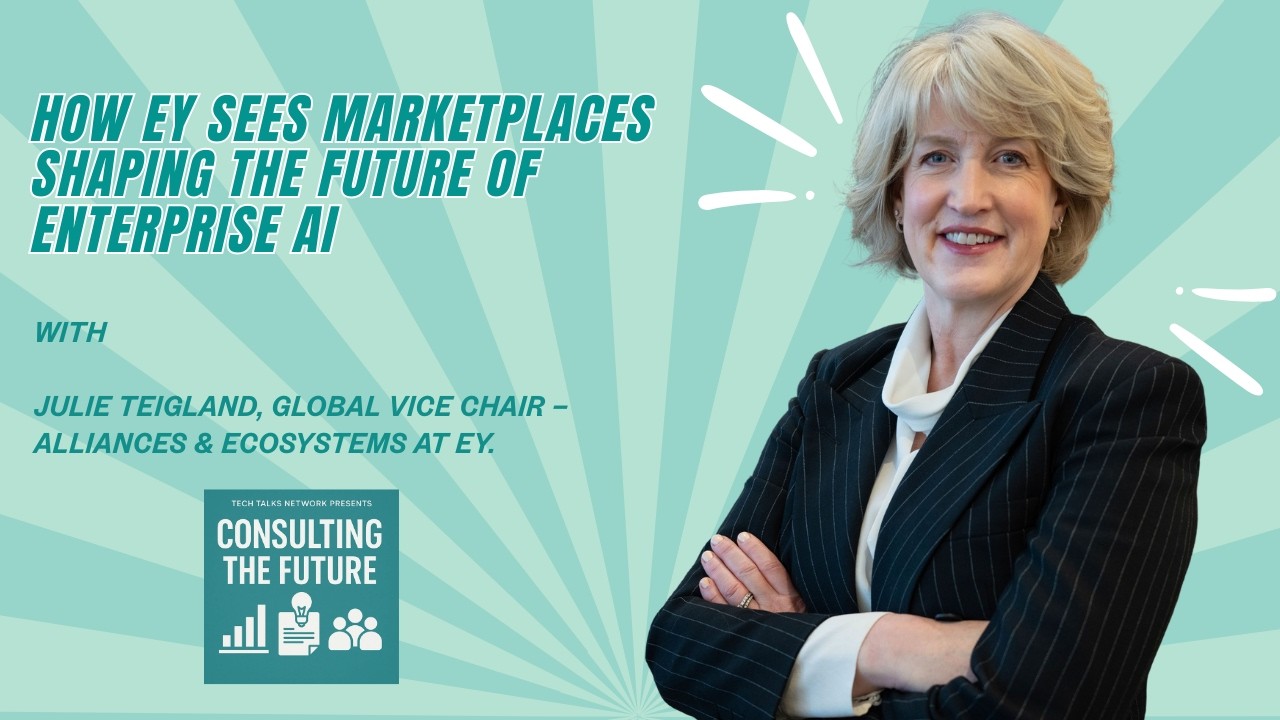
How EY Sees Marketplaces Shaping The Future Of Enterprise AI
Автор: Neil C. Hughes
Загружено: 2026-03-09
Просмотров: 12
Описание:
In this episode of Consulting The Future, I’m joined by Julie Teigland, Global Vice Chair – Alliances & Ecosystems at EY, to unpack the growing role marketplaces are playing in enterprise AI adoption. At a time when organizations are overwhelmed by tools, vendors, and bold claims, Julie offers a pragmatic view of how marketplaces can collapse complexity rather than add to it.
We begin by exploring why so many AI initiatives stall between pilot and production. The issue, as Julie sees it, is rarely a lack of technology. It is the friction between tools, governance, integration, and operating models. Marketplaces, when designed well, bring together pre-vetted solutions, integration patterns, security signals, and governance frameworks. That coordination reduces the invisible work leaders often underestimate, such as vendor risk reviews, compliance checks, and architecture validation.
Julie is candid that not all marketplaces are equal. The ones that create value are designed around business outcomes, not product listings. Fraud reduction, supply chain resilience, or industry-specific cost transformation efforts require curated ecosystems. That means benchmarks, peer usage patterns, reference architectures, and assurance around regulatory alignment. For executives facing board-level scrutiny, that difference matters.
We also dive into risk and accountability. Julie highlights how many organizations focus on model ethics and accuracy, yet overlook integration risk. Once AI is embedded into workflows, the questions shift. Who owns the decision? How are outcomes logged and audited? What happens when multiple vendor systems interact? This is where governance can break down, especially at scale.
Through alliances with leaders such as Microsoft and SAP, EY is helping shape how AI solutions are vetted and deployed across industries. Julie shares how EY applies a “client zero” approach, using its own marketplace internally to test value, resilience, and governance before scaling to clients. With 70,000 clients, 668,000 servers, 13,600 workflows, and 269 million transactions processed daily, the system is tested constantly under real operational pressure.
We also examine the influence of the EU AI Act and the contrast between innovation-first and responsibility-by-design approaches across regions. Julie argues that speed and governance are not opposing forces. True acceleration comes from industrializing governance rather than bypassing it.
If AI success depends less on technological brilliance and more on clarity, orchestration, and trust, then marketplaces may be evolving from simple app stores into operational control planes. The question is not whether ecosystems matter, but how deliberately you design them. So as AI adoption accelerates inside your organization, are you simply adding tools, or are you building a marketplace strategy that can withstand scrutiny and scale?
Повторяем попытку...
Доступные форматы для скачивания:
Скачать видео
-
Информация по загрузке: