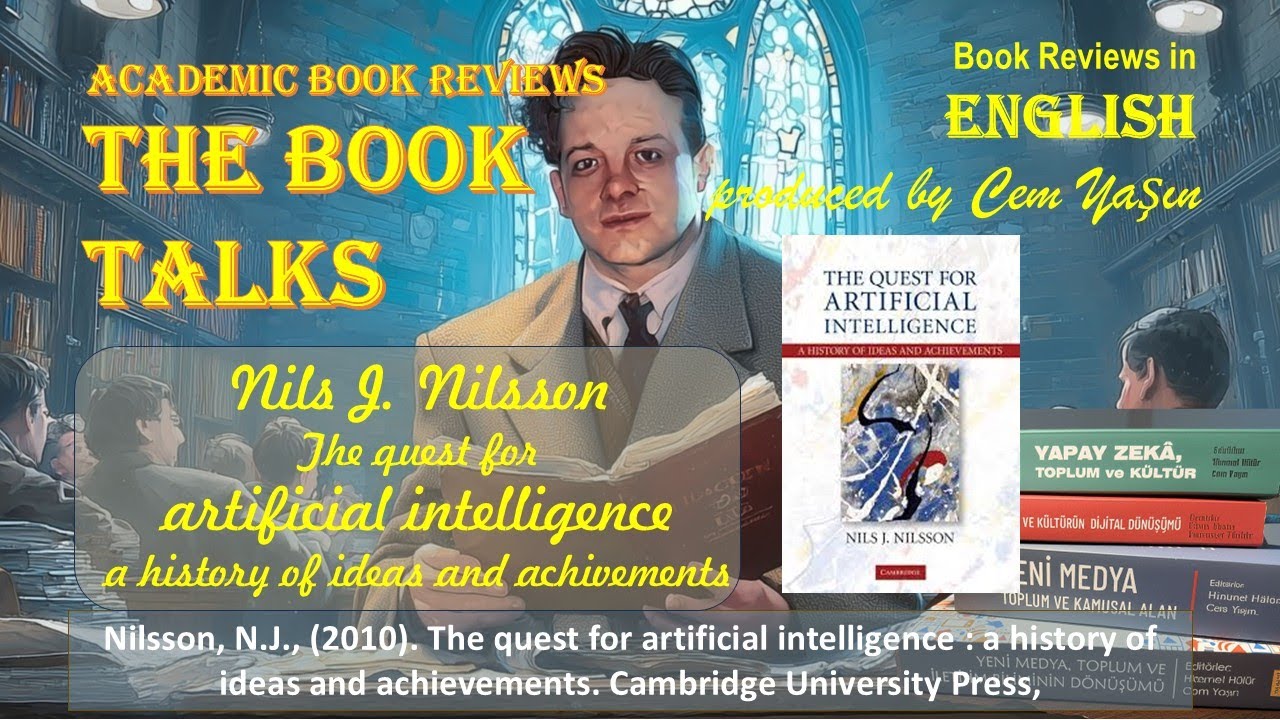
Book Review: Nils J Nilsson The quest for artificial intelligence
Автор: İletisim Ansiklopedisi
Загружено: 2025-10-29
Просмотров: 2225
Описание:
The Quest for Artificial Intelligence A History Of Ideas and Achievements
Nils J. Nilsson’s The Quest for Artificial Intelligence: A History of Ideas and Achievements is a comprehensive account of the development of artificial intelligence, exploring both its conceptual foundations and technological milestones. Nilsson defines artificial intelligence (AI) as the activity devoted to making machines intelligent, and intelligence as the ability of an entity to act appropriately and with foresight in its environment. According to this definition, intelligence exists on a continuum—from simple organisms and basic machines to the complex reasoning and creative capabilities of humans.
The book is organized into eight major parts, following a roughly chronological structure. It begins with the early origins of the idea of intelligent machines and moves through the scientific, philosophical, and engineering developments that shaped modern AI.
The first part, “Beginnings,” traces the dream of artificial beings through myths, philosophy, and early engineering. Nilsson discusses examples such as the mythological automatons of ancient Greece, Ramon Llull’s logical wheels, Leonardo da Vinci’s mechanical knight, Vaucanson’s mechanical duck, and Isaac Asimov’s robot stories. These examples show that the human desire to create intelligent machines has existed for centuries before modern computers made it possible.
The second part, “Early Explorations (1950s–1960s),” covers the birth of AI as a scientific field. The 1956 Dartmouth Conference marked the beginning of formal AI research. During this period, early programs such as The Logic Theorist, General Problem Solver, and perceptrons were developed. Game-playing machines, early natural language processing systems, and semantic networks also appeared. These laid the groundwork for symbolic reasoning and machine learning.
The third part, “Efflorescence (Mid-1960s to Mid-1970s),” examines the flourishing of AI research. Key advances included computer vision, robotics, knowledge representation, and planning. This era saw the creation of systems like Shakey the Robot at SRI, which integrated perception, planning, and action—one of the first true autonomous robots. AI programming languages such as LISP and PROLOG were also developed in this period.
The fourth part, “Applications and Specializations (1970s–Early 1980s),” focuses on the rise of applied AI systems. Expert systems like MYCIN (for medical diagnosis) and PROSPECTOR (for mineral exploration) demonstrated how AI could be used in real-world problem solving. Research in speech recognition, natural language interfaces, and consulting systems expanded AI’s practical reach.
The fifth part, “New-Generation Projects (1980s),” explores large-scale national AI initiatives. Japan’s Fifth Generation Computer Systems Project and the U.S. DARPA Strategic Computing Program represented ambitious attempts to develop advanced AI systems. Although they fell short of their grand goals, these projects helped establish AI as a strategic and global technological frontier.
The sixth part, “Entr’acte,” deals with the period of decline known as the “AI Winter.” During this time, funding cuts, unfulfilled promises, and philosophical challenges slowed AI’s progress. Critics questioned whether the mind could truly be replicated by a computer, and researchers confronted issues of scale, complexity, and computational limits.
The seventh part, “The Growing Armamentarium (From the 1980s Onward),” describes the resurgence of AI through new mathematical and statistical methods. Bayesian networks, neural networks, decision trees, reinforcement learning, and probabilistic reasoning became central tools. Statistical approaches transformed natural language processing and computer vision, marking the beginning of modern machine learning.
The final part, “Modern AI: Today and Tomorrow,” highlights the field’s major successes and its future directions. Nilsson discusses landmark achievements such as IBM’s Deep Blue defeating a world chess champion, the rise of autonomous vehicles, intelligent space probes, and everyday AI applications in translation, medicine, business, and entertainment. He also examines the ongoing quest for human-level AI (HLAI), noting both its potential benefits and ethical implications.
Overall, Nilsson portrays AI as a multidisciplinary and cyclical field—driven by alternating periods of optimism, stagnation, and rebirth. Each generation builds upon past ideas, often reviving older concepts with new technologies. The book presents AI’s history not merely as a story of machines, but as humanity’s continuing attempt to understand and recreate its own intelligence through science and engineering.
Повторяем попытку...
Доступные форматы для скачивания:
Скачать видео
-
Информация по загрузке: