Magnifying Glass - Find Image Distance, Image Height and Magnification (Thin Lens & Mag. Eq. Optics)
Автор: VAM! Physics & Engineering
Загружено: 2021-11-28
Просмотров: 643
Описание:
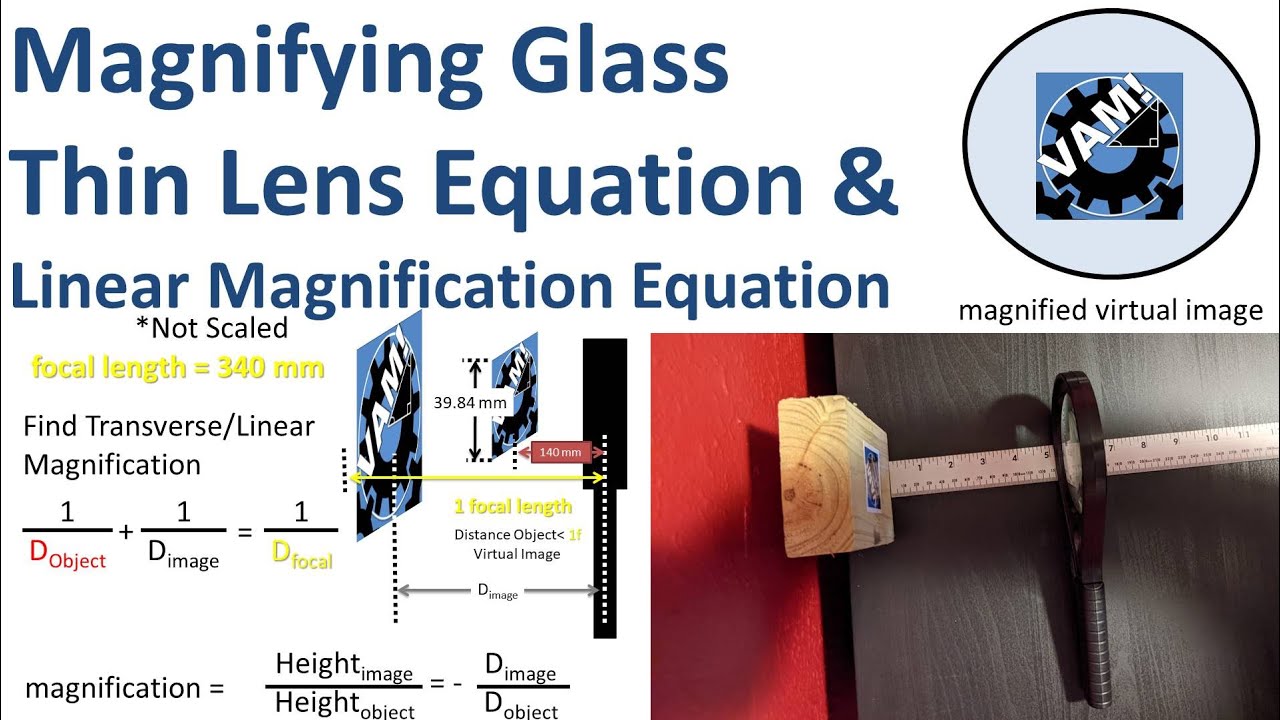
In this problem we have a magnifying glass that is placed at 140 mm from the object which has a height of 39.84. We want to find the transverse or linear magnification for this magnifying glass
In a previous video we found that the focal length was 340 mm for this magnifying glass.
So how do we go about solving this one?
First lets review how the image changed depending on the location of the object. Which will be reffered to as object distance
So if the object is placed beyond 2 focal lengths then the image will be a reduced real image and inverted . A real image refers to it can be projected onto a screen or piece of paper. This is done at certain points where all of the light rays converge or combine from the same point on the object. Notice how the 3 rays from the top of the image combine at the point where the paper sheet is at to for the top. I have also placed an example video of a magnifying glass coming into focus or where the light rays converge on the screen which is my arm.
If the object is placed between 2 and 1 focal lengths the object will be magnified real image and inverted Once again you can see that the rays converge so the image can be projected.
For our case if the object is placed closer than 1 focal length then it will have a magnified virtual image. Which virtual means that the image can’t be projected onto a screen. See in the ray diagram how the rays don’t converge or combine so the light coming through the magnifying glass will always be fuzzy
So now we will be using the thin lens equation which is 1 over the distance to the object plus 1 over the distance to the image equals 1 over the focal length
We will also be using the linear magnification formula which is the height of image divided by the height of object and the distance to the image divided by the distance to the object are both equal to the magnification. So now we need to get the distance to the image.
We can rearrange the thin lense formula to get distance image to one side
Plugging in the number we get a distance of the image of -238 mm the negative indicates it is a virtual image.
Just for kicks lets rearrange the linear magnification formula to find image height. We get an image height of 67.73 mm
Now we can plug all our values into the magnification formula and we get a positive 1.7 for the linear magnification. The positive indicates that it is upright image and not inverted and it is greater than 1 so the image is enlarged or magnified.
Disclaimer
These videos are intended for educational purposes only (students trying to pass a class) If you design or build something based off of these videos you do so at your own risk. I am not a professional engineer and this should not be considered engineering advice. Consult an engineer if you feel you may put someone at risk.
Повторяем попытку...
Доступные форматы для скачивания:
Скачать видео
-
Информация по загрузке:


