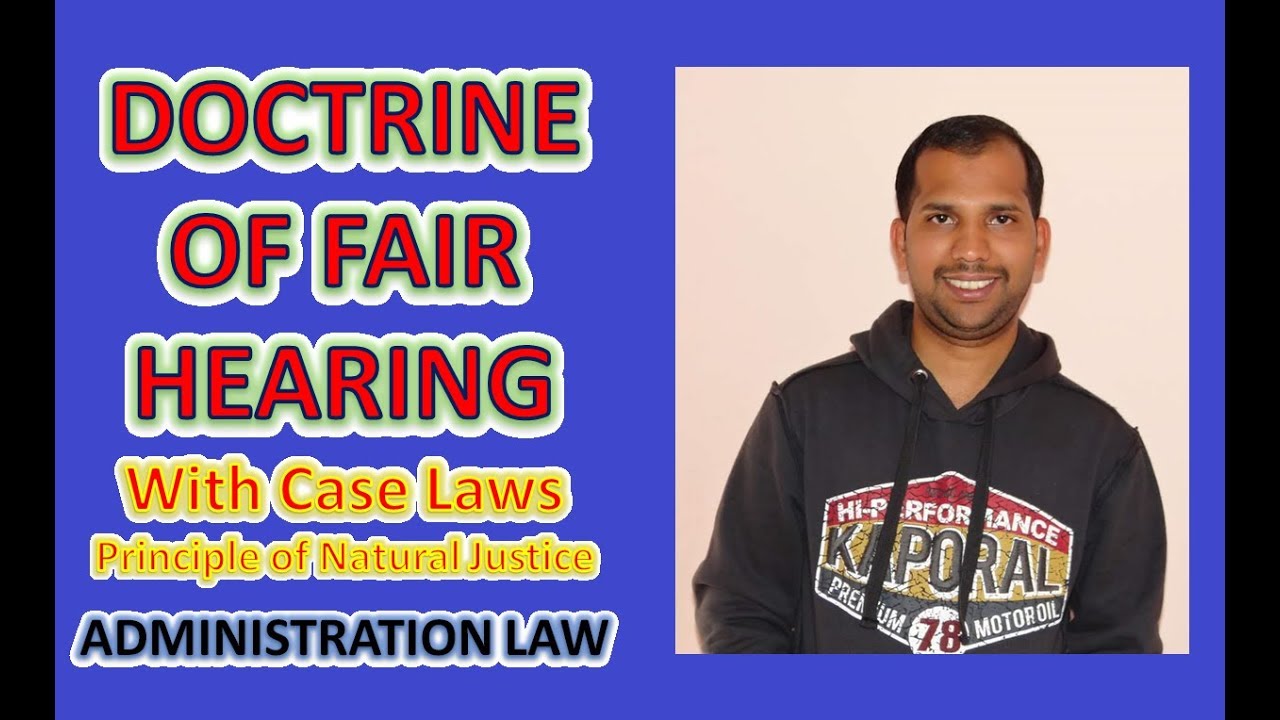
Rule of Fair Hearing, Meaning and scope of Audi Alteram Partem
Автор: Kabil Raja M
Загружено: 2024-05-19
Просмотров: 120
Описание:
"Audi Alteram Partem" i.e. Rule of Fair Hearing which implies that each party before their rights or liabilities are adjudicated upon, must be given opportunity of being heard.
In "Union of India v. W.N. Chadha" AIR 1993 SC 1082 it was observed that the rule of audi alteram partem is not attracted unless the impugned order is shown to have deprived a person of his liberty or his property. The rule of audi alteram partem is a rule of justice and its application is excluded where the rule will itself lead to injustice. There is exclusion of the application of audi alteram partem rule to cases where nothing unfair can be inferred by not affording an opportunity to present and meet a case. This rule cannot be applied to defeat the ends of justice or to make the law `lifeless, absurd, stultifying and self-defeating or plainly contrary to the common sense of the situation' and this rule may be jettisoned in very exceptional circumstances where compulsive necessity so demands. There are certain exceptional circumstances and situations whereunder the application of the rule of audi alteram partem is not attracted....It is no doubt true that the fact that a decision, whether a prima facie case has or has not been made out, is not by itself determinative of the exclusion of hearing, but the consideration that the decision was purely an administrative one and a full-fledged enquiry follows is a relevant and indeed a significant factor in deciding whether at that stage there ought to be hearing which the statute did not expressly grant.
Generally, this maximum includes two elements :
(i) Notice; and
(ii) Hearing.
(i) Notice - Before any action is taken, the affected party must be given a notice to show cause against the proposed action and seek his explanation. It is a sine qua non of the right of fair hearing. Any order passed without giving notice is against the principles of natural justice and is void ab initio.
Unless a person knows the formulation of subjects and issues involved in the case, he cannot defend himself. A notice must be adequate, and contain :
(1) Time, place and nature of hearing,
(2) Legal authority under which hearing is to be held,
(3) Statement of specific charges (or grounds) and proposed action (or grounds) which the person has to meet.
However, the requirement of notice will not be insisted upon as a mere technical formality, when the concerned party clearly knows the case against him, and is not thereby prejudiced in any manner in putting up an effective defence. Therefore in Keshav Mills Co. v. Union of India (AIR 1973 SC 389), the Supreme Court did not quash the order of the government taking over the mill for a period of 5 years on the technical ground that the appellants were not issued notice before this action was taken, because, at an earlier stage, a full-scale hearing had already been given and there was nothing more which the appellant wanted to know.
(ii) Hearing - The second requirement of "audi alteram partem" maxim is that the person concerned must be given an opportunity of being heard before any adverse action is taken against him.
In State of Orissa v. Binapani Dei AIR 1967 SC 1269 the petitioner was compulsorily retired from service on the ground that she had completed the age of 55 year. No opportunity of hearing was given to her before the impugned order was passed. The Supreme Court set aside the order as it was violative of the principles of natural justice.
Again, in Maneka Gandhi v. Union of India, AIR 1978 SC 597, the passport of the petitioner-journalist was impounded by the Government of India in public interest. No opportunity was given to the petitioner before taking the impugned action. The Supreme Court held that the order was violative of the principles of natural justice.
Although an adjudicating authority must observe the principles of natural justice and must give a reasonable opportunity of being heard to the person against whom the action is sought to be taken. But in England and in America, it is well settled law that in absence of statutory provisions, an administrative authority is not bound to give the person concerned an oral hearing. In India also, the same principle is followed. A person is not entitled to an oral hearing, unless the statute confers such a right. In M.P. Industries v. Union of India AIR 1966 SC 671, Subba Rao, J. observed :
"It is no doubt a principle of natural justice that a quasi-judicial tribunal cannot make any decision adverse to a party without giving him an effective opportunity of meeting any relevant allegations against him (but) the said opportunity need not necessarily be by personal hearing. It can be by written representation. Whether the said opportunity should be by written representation or by personal hearing depends upon the facts of each case and ordinarily it is in the discretion of the tribunal".
Повторяем попытку...

Доступные форматы для скачивания:
Скачать видео
-
Информация по загрузке: