4. Alighiero Boetti
Автор: CNCITY foundation
Загружено: 2025-04-08
Просмотров: 6
Описание:
[The Intersection of History and Identity]
History is not merely a relic of the past, it is an ongoing dialogue with the present. Through history, we seek to understand our identities, sometimes rejecting or reinterpreting its course. This section explores the intersection of individual and collective memory, examining how the past and present connect and collide. Between remembrance and forgetting, inheritance and transformation, recognition and denial, what stories emerge?
Alighiero Boetti (1940–1994) was a visionary artist who expanded the boundaries of conceptual art by integrating it with traditional craftsmanship. In the 1960s, he played a leading role in Italy’s Arte Povera movement but later pursued an independent artistic direction, particularly exploring the creative potential that arises from the encounter between East and West through his collaborations in Afghanistan. His works merge the logic of Western conceptual art with the meticulous handcraft of non-Western artisans, demonstrating that different cultures and knowledge systems can coexist on equal footing.
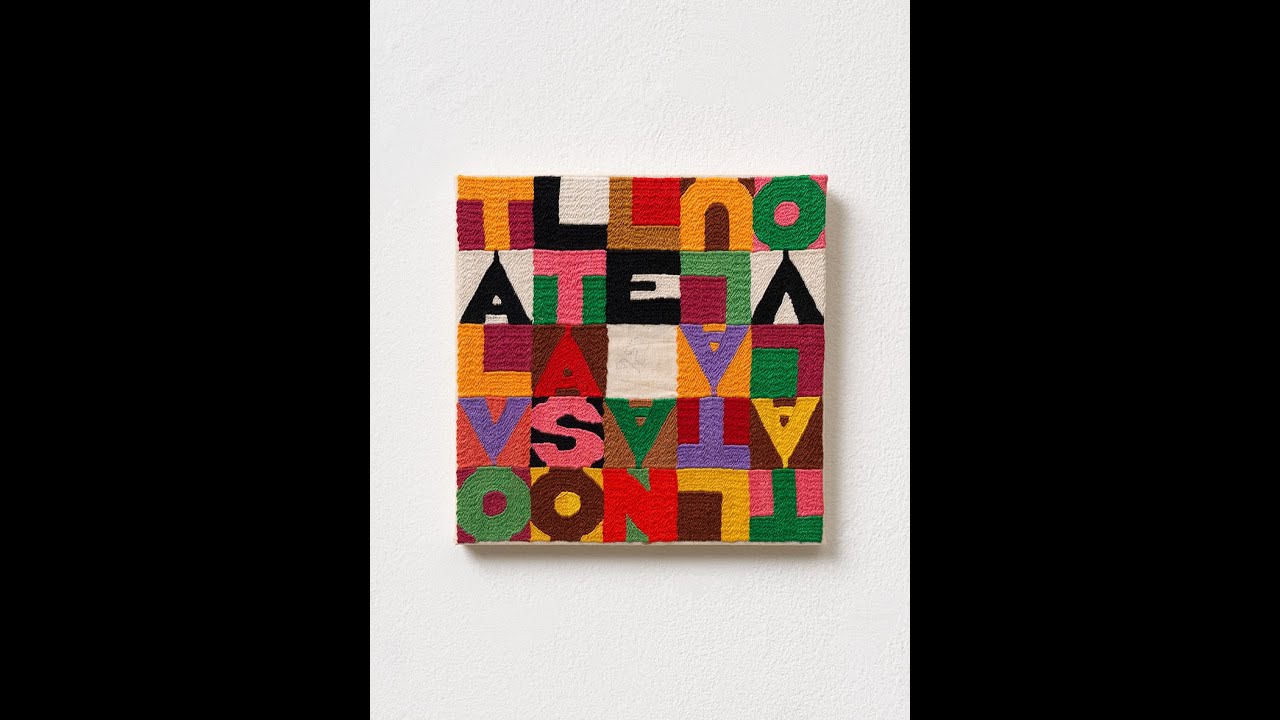
The “Arazzi” series, showcased in this exhibition, deconstructs the structure of language and reconstructs it in an embroidered form. Boetti arranged alphabets in a grid, yet deliberately disrupted conventional readability. Viewers must decipher the text from top to bottom or follow irregular patterns, emphasizing that language and meaning are not absolute but shaped by cultural contexts and interpretation. Beyond its experimental form, this work proposes a unique intersection of Western and non-Western thought.
What makes Boetti’s work remarkable is that he did not simply integrate non-Western culture; rather, he actively incorporated its traditions and techniques into his artistic process. He collaborated with Afghan women artisans, blending European conceptual art with Central Asian textile craftsmanship to create innovative works. This process went beyond mere artistic production—it was an attempt at genuine cultural exchange. Even when Afghanistan fell into political turmoil following the Soviet invasion, Boetti maintained his relationships with the artisans, continuing to work with exiled craftswomen. Through his art, he challenged the notion of a divided East and West, instead illustrating how these cultures can be organically interconnected.
Regarding his work, Boetti once stated, “Each piece differs according to the colors and the style of the embroiderer. They are neither originals nor reproductions, they belong to an entirely new category.” His embroidered works follow a consistent format, yet each piece remains uniquely distinct, shaped by the hands that craft it. This reflects not a rigid definition of cultural tradition but a dynamic process in which diverse influences intertwine, evolve, and create new meanings.
Повторяем попытку...
Доступные форматы для скачивания:
Скачать видео
-
Информация по загрузке: