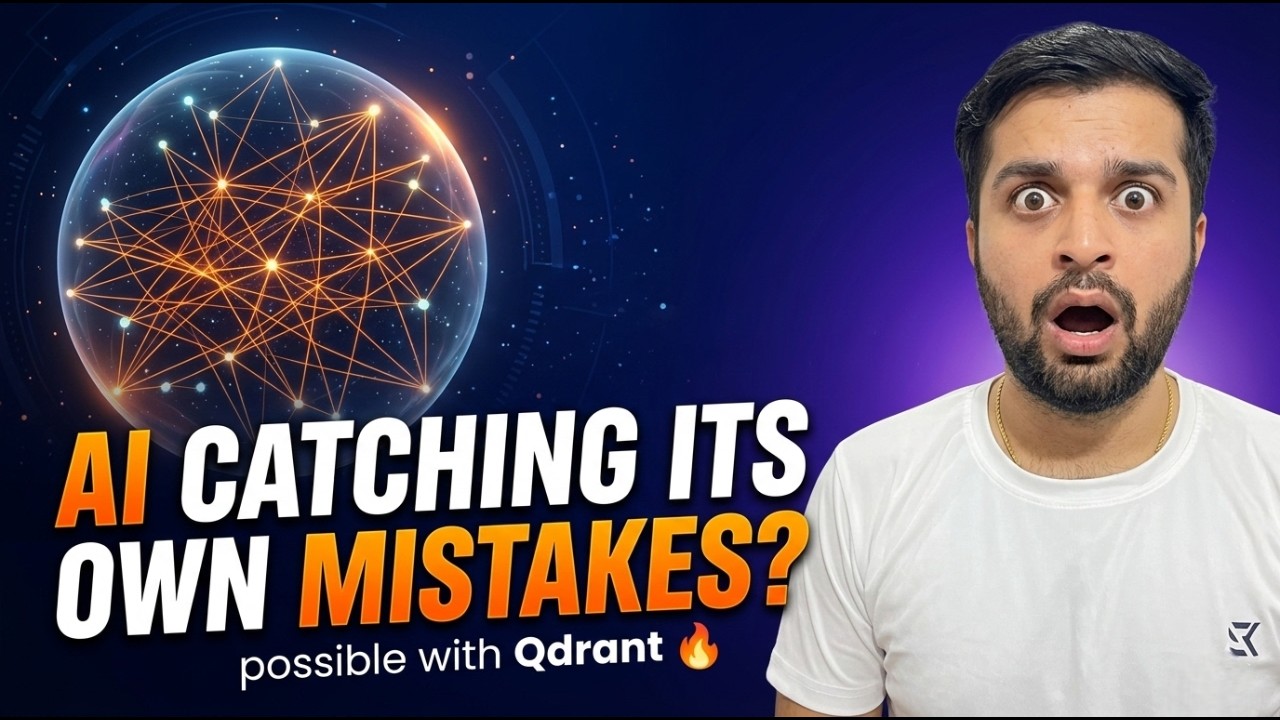
AI Catching Its Own Mistakes?! How Is This Possible?
Автор: HiDevs
Загружено: 2026-02-26
Просмотров: 2627
Описание:
What if your AI could recognize when it's about to make a mistake, before it even happens? 🤯
In this video, I'll show you exactly how to build a self-improving AI assistant that logs every conversation, detects its own errors, and learns from past mistakes using a vector database called Qdrant.
This is the exact architecture used by AI teams at companies like OpenAI, Netflix, and Spotify to monitor and improve their models in production. And by the end of this tutorial, you'll have built it yourself!
What You'll Build:
A real AI assistant powered by GROQ
A complete logging system using MongoDB Atlas as your permanent record
A vector database with Qdrant that stores every mistake as a searchable vector
A pattern detection system that finds clusters of similar errors automatically
A live interactive dashboard showing exactly where your AI needs improvement
🔑 What is Qdrant and Why Should You Care?
Qdrant is a vector database, think of it as a smart search engine that understands meaning, not just keywords.
When our AI makes a mistake, we convert that error into a vector (384 numbers that represent the meaning of the error). Qdrant stores these vectors and can instantly find other errors with similar meaning.
This means:
Search by meaning - Find "warranty questions" even if they use different words
Spot patterns - See clusters of similar errors that reveal systemic issues
Real-time - Searches happen in milliseconds
Actionable insights - Know exactly what to fix next
🛠️ Technologies Used:
GROQ - Fast LLM API
MongoDB Atlas - Cloud database for conversation logs
Qdrant - Vector database for error patterns
Sentence Transformers - Convert text to vectors
Python - All the glue code
Google Colab - Free, browser-based development environment
📂 Resources & Links:
🔗 Get a GROQ API Key: https://console.groq.com
🔗 MongoDB Atlas (Free Cluster): https://cloud.mongodb.com
🔗 Qdrant Cloud (Free Tier): https://cloud.qdrant.io
🔗 Complete Notebook (Copy this): https://colab.research.google.com/dri...
🔗 Qdrant Documentation: https://qdrant.tech/documentation/
🔗 Sentence Transformers: https://www.sbert.net/
💡 Why This Matters:
AI hallucinations and errors are everywhere. But most developers just deploy and hope for the best.
The truth is, production AI needs a memory. It needs to know: "Have I seen this kind of question before? Did I get it wrong last time?"
With vector databases like Qdrant, you're not just logging errors—you're building a system that gets better over time. Every mistake becomes data. Every pattern becomes a fix.
This is how you move from reactive debugging to proactive improvement.
🎓 Who This Video Is For:
Python developers interested in AI/ML
Engineers building production AI systems
Anyone curious about vector databases
Students learning modern AI infrastructure
Entrepreneurs building AI-powered products
🔥 Next Steps:
Subscribe for more AI infrastructure tutorials
Like this video if it helped you understand vector databases
Comment below: What would YOU build with this system?
Share with a friend who's building AI apps
📢 Connect With Me:
Linkedin: / deepakchawla1307
⚠️ Disclaimer:
This video is for educational purposes. API costs may apply if you exceed free tier limits. Always monitor your usage.
#ai #qdrant #vectordatabases #rag #agenticai #python #groq #mongodb #chatbot #aiassistant #hallucination #aicommunity #aihouse #chatgpt #gemini #startup #hidevs
Повторяем попытку...
Доступные форматы для скачивания:
Скачать видео
-
Информация по загрузке: