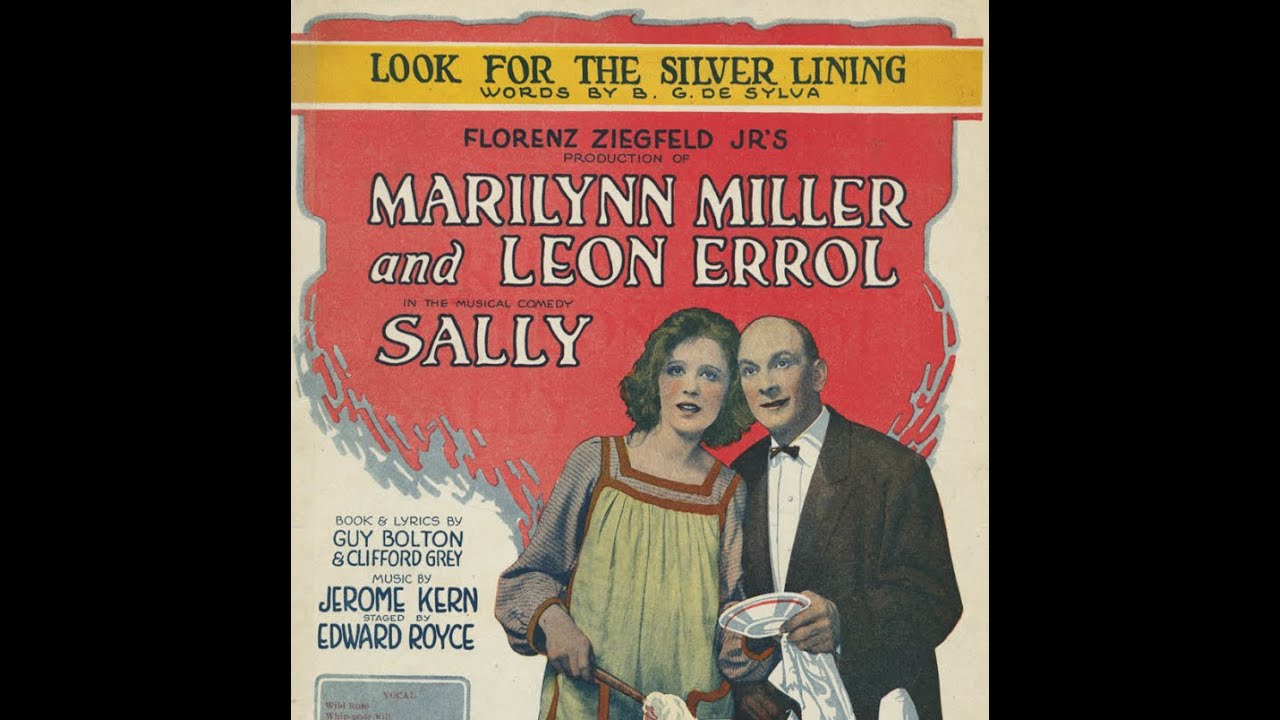
"Look for the Silver Lining" Jerome Kern classic song from Sally, Edna Brown & Charles Harrison 1921
Автор: Tim Gracyk
Загружено: 2023-03-12
Просмотров: 635
Описание:
"Look for the Silver Lining"
Jerome Kern classic song from Sally = more precisely, the song is by Jerome Kern and B. G. De Sylva
Edna Brown is really Elsie Baker
Charles Harrison, tenor, and Elsie Baker (aka Edna Brown), contralto
January 19, 1921at Camden, New Jersey.
Victor 18731
Please don't be offended if I preach to you while,
Tears are out of place in eyes that were meant to smile,
There's a way to make your very biggest troubles small,
Here's the happy secret of it all.
Look for the silver lining
Whene'er a cloud appears in the blue
remember somewhere the sun is shining
And so the right thin to do is make it shine for you.
A heart full of joy and gladness
Will always banish sadness and strife
So always look for the silver lining
And try to find the sunny side of life
Charles Harrison lived from September 11, 1878, to February 2, 1965.
This tenor was one of the busiest recording artists of the acoustic era. Performances were issued on major labels, including Victor, Columbia, and Edison. He was also prominent on minor labels, such as Domino, Regal, Melotone, and other "dime-store" labels.
A Jersey City native, Charles William Harrison studied voice under Leo Koeffler and was tenor at various churches, including the New York Fifth Avenue Brick Presbyterian Church until 1920. He began his recording career on January 31, 1911, with the Columbia Phonograph Company. He sang "Cujus Animam," using the original Latin text from Rossini's Stabat Mater (A5275), and it was issued in May 1911.
The Rossini number also served as his first Edison selection, which was issued exactly one year later.
In the March 1952 issue of Hobbies, Jim Walsh quotes a letter in which Harrison recalls his recording debut: "The lead tenor of our quartet knew the manager of the Columbia laboratory, so we made some 'test' recordings. During the session he spoke about a test of his own solo voice, and I for once put on a bold front and said I would also like to make a test...the manager did not know me, but he said they were looking for a tenor who could sing a high D flat. The other fellow said that I could do it and that they need look no further...I was booked for a test of the 'Cujas [sic] Animam' from Rossini's 'Stabat Mater,' sung in English, with piano, as I did not know Latin! The test came out well enough for them to book me with orchestra for the same selection in Latin. I had a friend...whose brother was a priest, so he gave me the phonetic pronunciation, and I went to it. When this came through the processing I was handed a contract for six months.
"Right away, as my records began to come out, Victor and Edison got on my trail, but I was tied up, so could do nothing. Nearing the end of the six months, I demanded a raise in the fee or a new contract, but found that I had unwittingly signed for an additional year at the same rates. I at once refused to continue, as I apparently had been duped, so went to both Victor and Edison on a non-exclusive basis, designed to keep me at least with 'the big three.'...
"In 1919-1920, I was recording for 18 laboratories, working every day in New York, Philadelphia, Chicago, Boston, Montreal, etc."
Some of his early Columbia discs identify him as Charles W. Harrison, but the simple name Charles Harrison soon became standard. Over a dozen pseudonyms were used for him on small labels. Most common are Hugh Donovan and Billy Burton. Others include Charles Hilton and Norman Terrell.
He made Edison records in 1912 and was even in an early experimental sound film made by Edison. He worked regularly for the company until 1916, cutting mostly "serious" music, then returned in the 1920s. Amberol 1003 featuring "Cujus Animam" was issued in May 1912, followed in June by a wax Amberol featuring an aria translated to English from Ambroise Thomas' Mignon, "Never the Maiden Dreamed" (1033). Later he recorded some waltz songs, including Albert Gumble's "When I Waltz With You" (Blue Amberol 1556), issued in December 1912.
In 1925 he married Beulah Gaylord Young. Born on March 13, 1873, this soprano started making Columbia records around the time the tenor began working for the company though she was far less prolific. One of her performances, "Run Home and Tell Your Mother" (A1042), cut on July 7, 1911, was issued under the pseudonym Molly Ames. The 1916 Pathé record of "Georgia Moon" (30427) features "Chas. Harrison and Beulah Gaylord" (no "Young").
Повторяем попытку...
Доступные форматы для скачивания:
Скачать видео
-
Информация по загрузке: