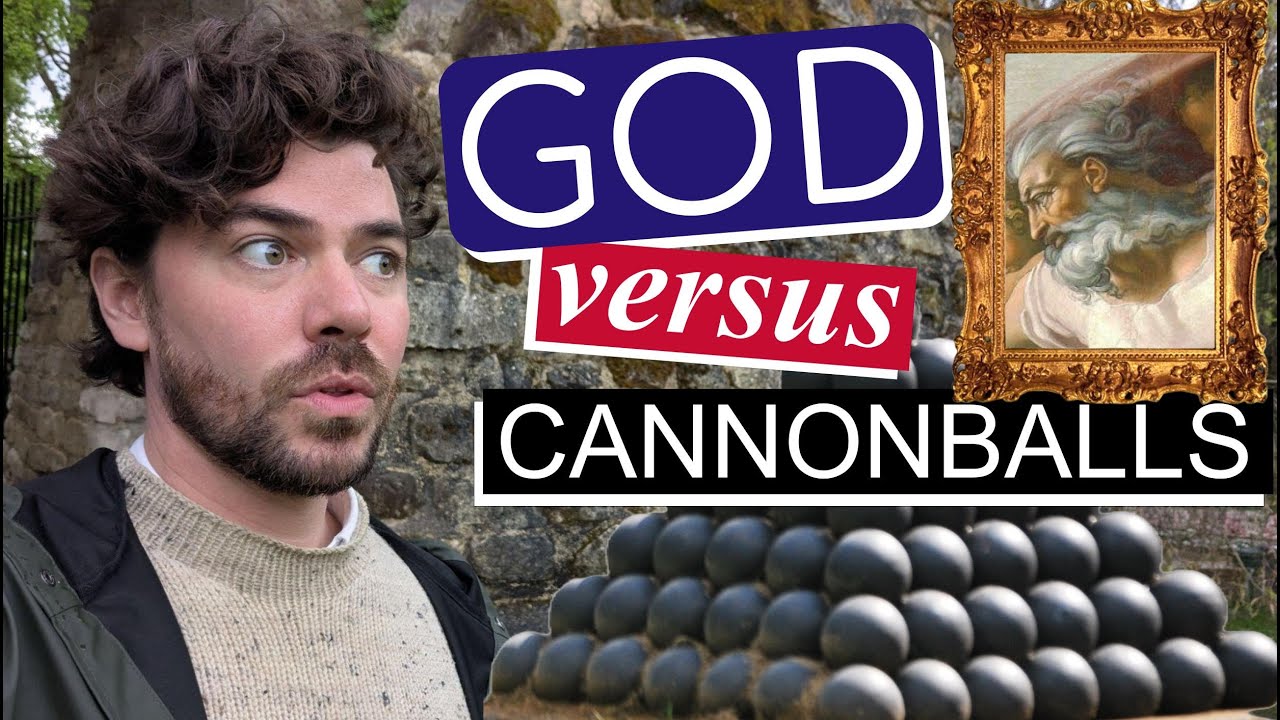
How Cannonballs Blocked a Proof of God
Автор: Logic with Bo
Загружено: 2025-04-24
Просмотров: 232
Описание:
Thomas Aquinas famously set out five ways to prove that God exists. The first of these ways is the argument from motion: because the cosmos is in motion, it must be moved by a greater, outside mover—the Prime or First Mover (Summa Theologiae I, question 2, article 3).
This proof rests on a core claim in Aristotelian physics: that motion must be sustained by a cause. In order for an object in motion to keep on moving, it must be constantly moved by some mover. But this claim also faced some theoretical problems: what keeps an arrow moving after it leaves the bowstring? It seems that, without being actively pushed, it should fall to the ground—something we know doesn't happen. To address this problem, the long-standing Aristotelian solution was that the air in front of the moving arrow rushed in to fill the space left behind it, effectively looping around and keeping the arrow in motion.
Clearly, this is not the greatest solution. But it is a theoretical matter, and all theories have their drawbacks. But the drawback became intolerable with the introduction of cannons in the later middle ages. Now a theoretical problem, which had no bearing on archery's technique, became a practical problem of engineering. Knowing what makes arrows fly doesn't necessarily make you a better archer; but knowing how cannonballs fly as they do, and under what circumstances, is key to lobbing cannonballs where you want them to go: questions of weight, angle, and firepower thus became increasingly important.
In this context, John Buridan proposed a new theory: the shove or push (impetus) theory. On this view, a cannonball, say, or a rotating water wheel gets an initial shove, and then keeps going—until, that is, resistance slows it down. Thus there is no need to explain what keeps the cannonball moving: once it gets the initial shove, it just keeps going.
This is all well and good for cannonballs, but it has the unintended consequence of invalidating Aquinas's First Way: God need not keep the cosmos in motion, and so need not exist. All the First Way now shows is that the First Mover has existed at some time, but not that any such Mover continues to exist.
CHAPTERS
0:00 Aristotle on motion
0:29 Aquinas's Proof of God
0:59 The problem of arrows
1:46 The problem of cannonballs
3:02 Buridan's solution to both problems
3:44 A problem for Aquinas's Proof
4:14 Summary
4:40 Buridan and theology
5:16 Thanks for watching!
5:26 Acknowledgments & future plans
SOURCES
Klima, Gyula. “Buridan, John”. Biographical Encyclopedia of Astronomers. Ed. Thomas Hockey, Virginia Trimble, Thomas R. Williams, Katherine Bracher, Richard A. Jarrell, Jordan D. Marché, JoAnn Palmeri, and Daniel W. E. Green. Cham, Springer, 2014. 341–343.
Walley, Stephen M. "Aristotle, Projectiles and Guns". [preprint]. Link = https://arxiv.org/abs/1804.00716
ACKNOWLEDGMENTS
This video is brought to you by the FWO, as a part of a project on indirect proof and assertion. You can see a brief overview of the project here: https://research.kuleuven.be/portal/e...
For information about the FWO, see: https://www.fwo.be/en/
For information about the FWO's junior postdoc (the one that I hold), see: https://www.fwo.be/en/support-program...
I am grateful to Gyula Klima, both for bringing this to my attention and for explaining it to me in the first place. Thanks, Gyula!
Повторяем попытку...
Доступные форматы для скачивания:
Скачать видео
-
Информация по загрузке: