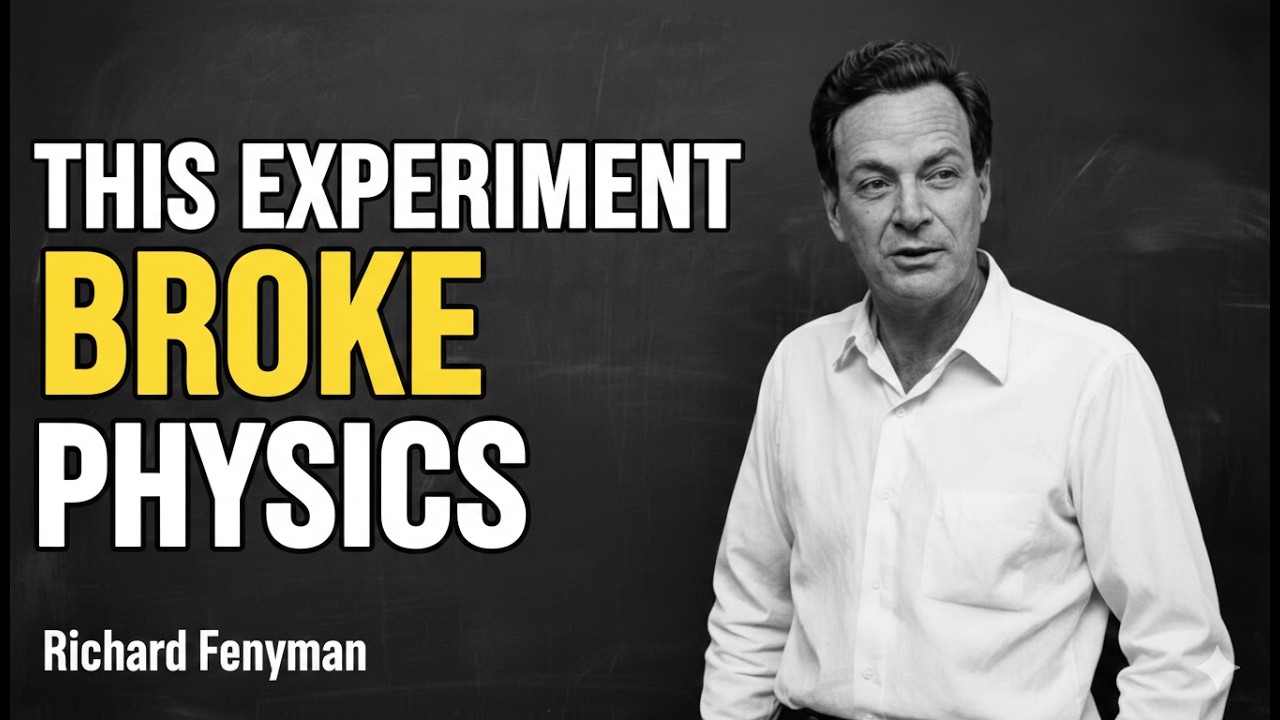
Light Is NOT Both Wave And Particle - Feynman
Автор: Feynman Explains Physics
Загружено: 2026-02-20
Просмотров: 26
Описание:
#QuantumPhysics #RichardFeynman #NatureOfLight #ScientificThinking #PhysicsExplained
We are taught, almost casually, that light is “both a wave and a particle.” It sounds profound. It sounds complete. And it is deeply misleading. The comforting phrase hides a crack in our understanding — a crack that Richard Feynman repeatedly forced his students to confront. If you think you understand what light is, you may be clinging to a metaphor that was never meant to be believed.
For centuries, physicists fought over whether light behaved like waves or like particles. The wave theory triumphed after experiments like Thomas Young’s double-slit experiment revealed interference patterns that only waves seemed able to produce. Then came Albert Einstein, showing through the photoelectric effect that light sometimes behaves as if it comes in discrete packets — photons. The narrative that followed was tidy: light is both.
But Feynman warned against this linguistic compromise. In his famous lectures at California Institute of Technology, he argued that saying light is “both” is not an explanation. It is a confession. A confession that classical categories — wave and particle — are inadequate. Light is not secretly switching costumes. It is not half-wave, half-particle. It is something else entirely, described precisely by quantum mechanics and poorly by our everyday language.
Why does this matter?
Because the illusion of understanding is more dangerous than ignorance. When we accept slogans instead of confronting paradox, we stop thinking. In science, that leads to shallow reasoning. In business, it leads to false confidence in models. In education, it rewards memorization over comprehension. In personal decision-making, it creates certainty where there should be humility.
The double-slit experiment remains unsettling because it exposes this flaw in our intuition. A single photon, sent one at a time, builds up an interference pattern as if it “knows” about both slits. We are tempted to force it into classical imagery: it must be a tiny particle traveling through space, or a spreading wave passing through both openings. Quantum mechanics tells us neither picture is fully correct. The mathematics works. The predictions are exact. But the mental image collapses.
Feynman famously said that nobody understands quantum mechanics. Not because it is mystical, but because our brains evolved for rocks and trees, not probability amplitudes. The mistake is pretending otherwise.
The deeper lesson is not about light. It is about epistemology — how we know what we know. Scientific progress often requires abandoning comfortable categories. “Wave” and “particle” were tools from classical physics. When reality refused to fit, the honest response was not to stretch the words, but to admit their limits.
In research and innovation, this principle is brutal but essential. Old frameworks eventually fail. In management, outdated metrics mislead. In productivity culture, oversimplified formulas promise clarity but conceal complexity. The world is rarely “either-or,” and just as rarely “both.” Sometimes it is neither.
The statement that light is both wave and particle survives because it feels explanatory. It reduces discomfort. Feynman would argue that real science begins when we resist that comfort — when we hold the tension instead of dissolving it with a phrase.
The uncomfortable truth is this: if you think you fully grasp what light is, you probably don’t. And if you accept elegant slogans without probing their limits, you may be mistaking language for understanding.
Nature does not conform to our categories. The question is whether we are willing to let go of them — or whether we will continue mistaking familiar words for truth.
Повторяем попытку...

Доступные форматы для скачивания:
Скачать видео
-
Информация по загрузке: