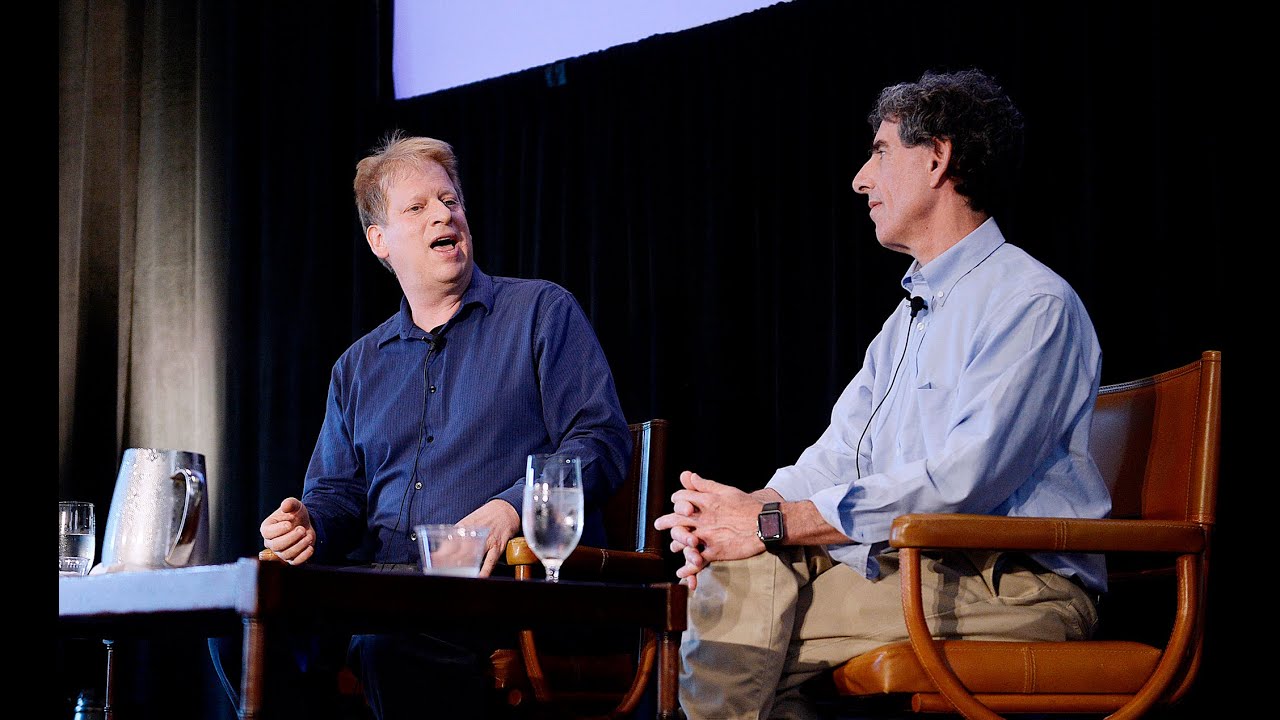
Big Think Interview With Paul Bloom | Big Think
Автор: Big Think
Загружено: 2012-04-23
Просмотров: 31236
Описание:
Big Think Interview With Paul Bloom
New videos DAILY: https://bigth.ink/youtube
Join Big Think Edge for exclusive videos: https://bigth.ink/Edge
----------------------------------------------------------------------------------
Paul Bloom:
Paul Bloom is the Brooks and Suzanne Ragen Professor of Psychology at Yale University. An internationally recognized expert on the psychology of child development, social reasoning, and morality, he has won numerous awards for his research, writing, and teaching. Bloom’s previous books include Just Babies: The Origins of Good and Evil and How Pleasure Works: The New Science of Why We Like What We Like, and he has written for Science, Nature, The New York Times, and The New Yorker.
----------------------------------------------------------------------------------
TRANSCRIPT:
Question: What challenges arise in doing research with young children?
Paul Bloom: I think there's tremendous insight to be gained by looking at babies and young children. It's basically a way of seeing human nature before it gets tainted and corrupted by culture and if you test them young enough, before it gets even affected by language. So it's a way of seeing human nature in a very direct and sort of untainted way. But it's really difficult working with kids and with babies because they are not cooperative subjects, they are not socialized into the idea that they should cheerfully and cooperatively give you information. They're not like undergraduates, who you can bribe with beer money or course credit. And so you need to be somewhat clever in designing studies that tap their knowledge. You have to tap their knowledge indirect and sometimes kind of interesting and subtle ways. And even when you do that, you know, some of them are just going to run away from you. Some babies are going to fall asleep and cry. Some kids are going to think it's hilarious to answer every question with the opposite that, you know, they believe to be true.
And so you have to work around that in all sorts of ways. But as a developmental psychologist, I'm committed to the idea that the benefits outweigh the costs.
Question: How has your research affected your parenting and vice versa?
Paul Bloom: It's funny, I don't think, I'll be honest, I don't think anything I've ever learned as a developmental psychologist, as a scientist, has affected how I treat my kids. I think that at this stage of the game, there's a real disjunct between what the science tells us and actual practical applications, and I would distrust someone who told you otherwise.
But there's been a lot going around on the other way around. I mean, having kids has proven to be this amazing, for me, this amazing source of ideas of anecdotes, of examples, I can test my own kids without human subject permission so they pilot, I pilot my ideas on them. And so it is a tremendous advantage to have kids if you're going to be a developmental psychologist.
Question: Why does religious belief exist?
Paul Bloom: Most humans are religious. If you ask most people, they'll tell you they belong to one or another religion. The most common religion on earth is Christianity, but Islam is coming a close second. And then there's just all sorts of religions. They differ in many ways, both in the beliefs that they have and in their practices, but they share certain common properties. So, all religions believe in some sort of supernatural entities, preachers without bodies, but have minds, like gods and spirits and ghosts and angels. All religions believe that one or more of these supernatural created the earth and created animals and created us. And they all believe in different forms, that we can survive the death of our body, that we are immortal.
And I'm very interested in where these beliefs come from, why they exist at all. And you can imagine different extremes, so some scholars argue that they're social constructions, they're inventions of culture, and that's why they're universal. Others argue they're biological adaptations. They exist because of the selective advantage they gave to our ancestors.
I have a view which is different from both of those. I think they're accidents. I think they're accidental byproducts of cognitive systems that we've evolved for different reasons. More specifically, we've evolved a highly powerful social cognition. A highly powerful cognitive mechanism for thinking about the mental states of others and evaluating them and judging them. And I think that the system is so powerful that it sometimes leads to certain unpredicted byproducts. Things that we haven't evolved to do. So, for instance, we're highly animistic.
Read the full transcript at https://bigthink.com/people/paulbloom/
Повторяем попытку...

Доступные форматы для скачивания:
Скачать видео
-
Информация по загрузке: