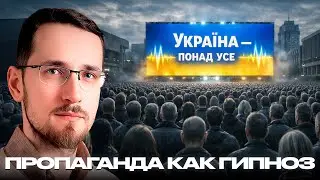
Simultaneously devalue European institutions and show that their collapse is only a matter of time
Автор: Spinruss Usa
Загружено: 2025-12-11
Просмотров: 2
Описание:
#actualidad #ukrainewar #russia
How "Little Europe" Works: Attacks on Kaja Kallas and the Dismantling of the EU's Legitimacy
In Solovyov's program, the focus shifts from Ukraine to Europe. The goal is to explain to Russian viewers why the European Union is supposedly weak, corrupt, and governed by people "unfit for their positions." This is a key element of current Russian propaganda: simultaneously devaluing European institutions and showing that their collapse is a matter of time.
Technique 1: Humiliating the Country's Size
Kaja Kallas and Lithuanian politician Kubilius are described as "the head of a village council" and "the head of an urban-type settlement." The idea behind this technique is simple:
• To downplay the very fact that representatives of "microscopic" states can participate in the development of pan-European policy.
• To present EU decisions as the result of the "psychological overload" of people unaccustomed to great responsibility.
For the Russian audience, this works in two directions at once:
1. It reinforces contempt for the Baltic states as something second-class;
2. It undermines trust in EU institutions, where "random individuals" allegedly wield influence over half a billion citizens.
The term "Estonization of European politics" is used here as an insult: Europe is supposedly sinking to the level of a small, traumatized, Russophobic state.
It's just that these Kaikalos and all the rest are just digging Europe deeper and deeper. They completely fail to understand, I think, that it's a special kind of decompression sickness, when, by and large, very small leaders of microscopic states suddenly find themselves in high positions, and their blood boils at the speed. Look, that's what happened to Kaikalos. In reality, she was the chairperson of a village council, the leader of Estonia, but I doubt that can be assessed as anything more. And then suddenly she's elevated from the level of a million people to the level of half a billion people, and she starts to think it's because she's important. And she spouts phenomenal nonsense, treating her like someone who's simply not up to the job. And it's so egregious that it's impossible to force Americans to even look at it. So they're starting to talk about the Estonianization of European politics. Just like Kubilius or whoever he is.
Okay, again, this level is higher, but it's starting from the level of an urban settlement. But it's still pointless. They have no experience, neither human nor managerial.
Trick 2: "They are manageable and convenient"
The next step is to explain why such figures end up at the head of European structures in the first place. The answer from Solovyov and his interlocutors: because they are convenient, manipulable people who:
• "have neither human nor managerial experience";
• lack a sense of political "red lines" and an understanding of consequences;
• are easily induced into feelings of loyalty and dependence.
This is an important link in the narrative: European leaders don't simply make mistakes—they are selected as the most convenient conduits for someone else's will. This is a continuation of the old Soviet model: the West is not an entity, but a field of manipulation, where "real" decisions are made somewhere behind the scenes (in this case, according to the program, in Washington or London).
Technique 3: Linking European bureaucracy to Ukrainian corruption
Then the plot builds a bridge from the EU to Ukrainian corruption. The logic is constructed as follows:
1. The US allegedly "raises the topic of an investigation" into where tens or hundreds of billions of dollars in aid to Ukraine went.
2. On the surface, figures like Umerov, Yermak, Reznikov, Avakov, and others "should run to the FBI and sign cooperation agreements."
3. The European elite is gradually being drawn into the shadows: the "NABU tapes" and hints of Ursula von der Leyen's corrupt connections are recalled.
This creates the impression that:
• the Ukrainian elite is massively corrupt,
• the European bureaucracy is closely connected to these schemes,
• and that real investigations, if they begin, will originate not in Brussels, but in Washington.
The recipient of this message is not only the Russian viewer, but also, indirectly, European society: Moscow is trying to fuel mistrust of its own EU institutions.
Technique 4: Translating the war into the realm of "genocide" and international law
In the second half of the segment, another important motif emerges: the Russian Prosecutor General's Office, according to the presenters, has submitted documents to the court seeking recognition of the events in
For an outside observer, it is important to understand: this is not a matter of jurisprudence, but of creating a political justification for any subsequent actions by Russia—from continuing the war to possible "people's tribunals" against Ukrainian and European politicians.
Повторяем попытку...

Доступные форматы для скачивания:
Скачать видео
-
Информация по загрузке:



![SPEKTAKULARNE OPERACJE UKRAIŃSKIEGO WYWIADU - JAK WKURZYĆ PUTINA [BOJKE]](https://image.4k-video.ru/id-video/WhCKgDdfiuE)