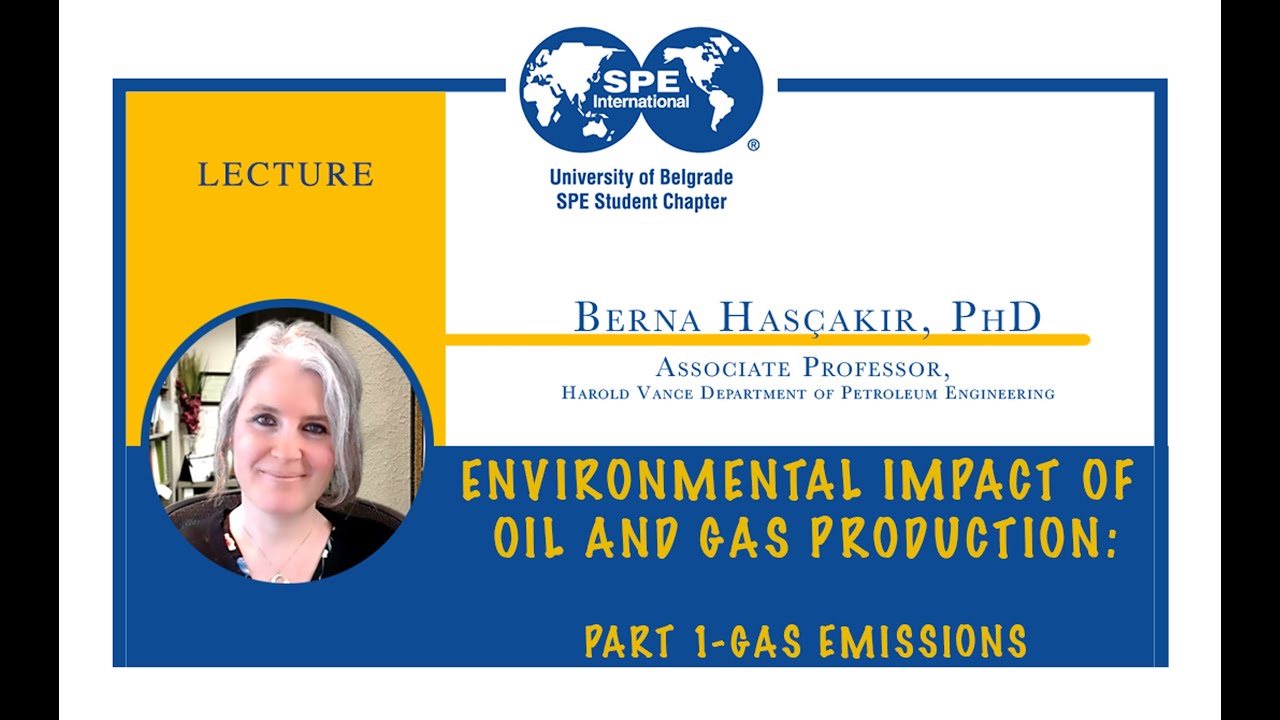
Environmental Impact of Oil and Gas Production: Gas Emissions || Berna Hasçakır, PhD || Belgrade SPE
Автор: University of Belgrade SPE Student Chapter
Загружено: 2020-12-08
Просмотров: 527
Описание:
Berna Hasçakır, PhD
Abstract:
The oil and gas industry has often been blamed for its major contribution to greenhouse gas releases and designated as a target to knock down by media, activists, and environmentalists. It is true to say that without Oil and Gas Industry, anthropogenic emissions of CO2 and CH4 would be much lower. Similarly, it is also true to state that without this industry and petroleum products, our life standards would be much different than the current standards. One should not confuse an activity which generates greenhouse gases, and the effect of product consumption. Evaluating the real routine emissions of the oil and gas industry on the same mode than every other industry is possible and constitutes the objective of this work. As a preliminary result, however, data coming from the Environmental Protection Agency (EPA) clearly highlight that oil and gas production accounts for at least less than 10% of the greenhouse gas emissions from the energy sector in the United States. To more precisely evaluate these emissions, this study relied on environmental impact reports in terms of greenhouse gas emissions, which are available for every production site in the U.S, as well as the oil and gas consumption in the US over the year 2015. Emissions happen during three different stages of the hydrocarbon production; extraction, flaring and venting, and fugitive emissions. The importance of each stage in terms of emissions is extremely variable, depending on the quality of the oil, the field location, and the existence of an outlet for the produced gas. The greenhouse gas emissions contribution from the Oil and Gas industry is 3% for extraction, and about 0% for flaring and venting, and 0% of fugitive emissions in the US. The remaining U.S greenhouse gas emissions while processing petroleum products are due to refining at 88%, and transportation at 9%. However, these results are extremely different for Canadian oil sands, Venezuela heavy oil, Arabian light oil, or Indonesian gas condensate. Worldwide, greenhouse emission source for petroleum industry are 10% for extraction, 19% for flaring and venting, 6% of fugitive emissions, 4% of transport, and 61% of the refinery. As a result, 3.5% of greenhouse gases emitted while processing petroleum products are due to Oil and Gas industry.
Biography:
Berna Hascakir is an Associate Professor of petroleum engineering, a Flotek Industries, Inc. Career Development Professor, and the director of the Heavy Oil, Oil Shales, Oil Sands, & Carbonate Analysis and Recovery Methods (HOCAM) research team at Texas A&M University. She was a Stephen A. Holditch Faculty Fellow between 2015 to 2018. She pursued postdoctoral studies at Stanford University in the Energy Resources Engineering Department and worked for Schlumberger in Venezuela, UK, and Colombia as a senior Heavy Oil Reservoir Engineer. She is SPE Distinguished Member. She is the recipient of the International SPE Junior Faculty Research Grant in 2014 and the International SPE Innovative Teaching Award in 2015. She was the managing guest editor for the two Thermal EOR Special Issues of the Journal of Petroleum Science and Engineering and associate editor for the Journal of Petroleum Science and Engineering. She continuously edits and reviews for many high quality energy journals including SPE Journal and SPE Reservoir Evaluation and Engineering. Currently, she serves on the SPE Innovative Teaching Award Committee and on several SPE conference committees, such as SPE Annual Technical Conference and Exhibition (ATCE), SPE Heavy Oil Canada, and SPE Heavy Oil Latin America. She received her B.S. degree in 2001 and M.S. degree in 2003 both from Environmental Engineering at Dokuz Eylul University in Izmir. Her B.S. and M.S. research studies involved experimental work on destabilization of colloids in water and wastewater treatment by physical, chemical, and biological means. She got her Ph.D. degree in 2008 from Petroleum and Natural Gas Engineering at Middle East Technical University in Ankara. She investigated experimentally, numerically, and analytically the recovery characteristics of heavy oil and oil shale samples with electrical and electromagnetic heating methods and she completed part of her PhD at University of Alberta. During her postdoctoral studies, she studied the dynamics of in-situ combustion experimentally using X-Ray computerized tomography, and numerically analyzed relative permeability changes with temperature for cyclic steam injection into diatom reservoirs. Her complete resume can be found at www.hascakir.com
Do not forget to follow us on social media:
/ belgrade.spe
/ belgrade.spe
/ belgrade-spe
© 2020, University of Belgrade SPE Student Chapter. All rights reserved
Повторяем попытку...
Доступные форматы для скачивания:
Скачать видео
-
Информация по загрузке: