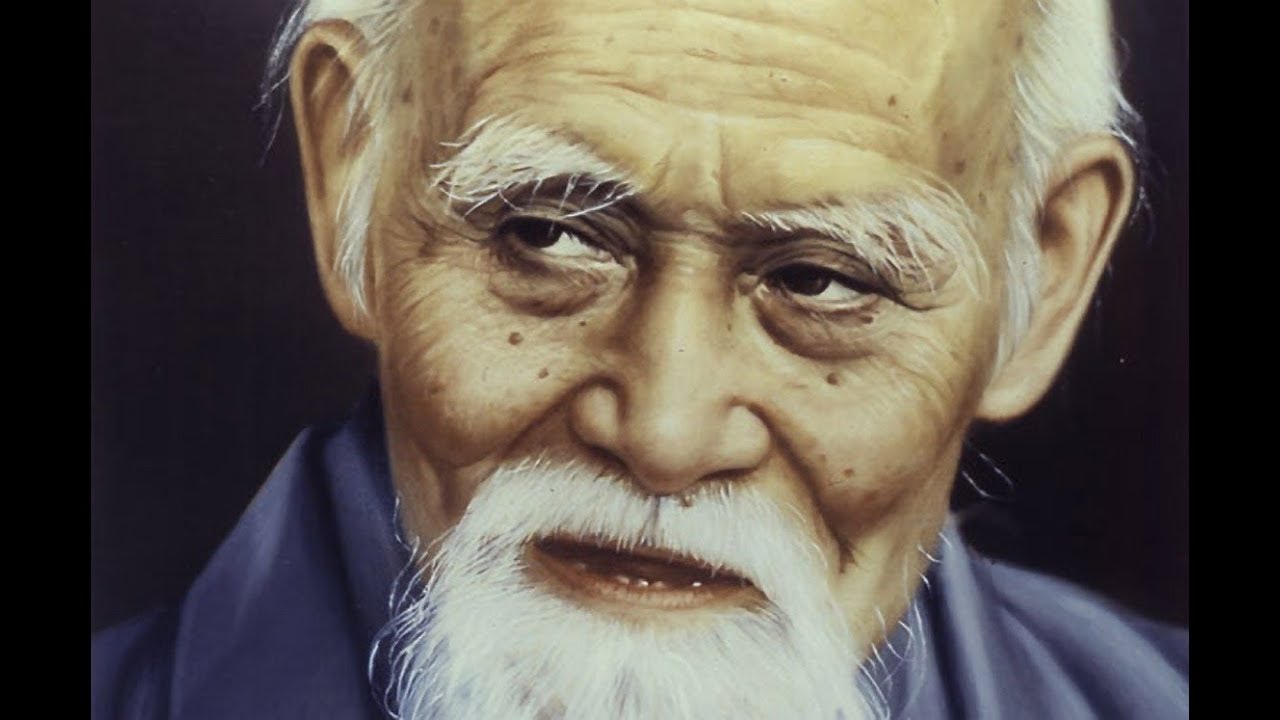
Morihei Ueshiba and Aikido - Japanese documentary (1961)
Автор: Davor Pavlic
Загружено: 2018-01-17
Просмотров: 5061
Описание:
This is a Japanese documentary about the life of O-Sensei Morihei Ueshiba and his teachings of Aikido. It shows him from the age of 78.
Morihei Ueshiba was the founder of Aikido, the first Japanese martial art that didn't promote winning as its sole purpose and had a deeper philosophical and religious meaning as well. This is also a reason why there are no competitions in Aikido. This viewpoint changed several times during the O-Sensei's life, depending in what philosophical and religious phase he was at that moment. Aikido derives mainly from the martial art of Daitō-ryū Aiki-jūjutsu, but began to diverge from it in the late 1920s, partly due to Ueshiba's involvement with the Ōmoto-kyō religion. Ueshiba's early students' documents bear the term aiki-jūjutsu.
Ueshiba's goal was to create an art that practitioners could use to defend themselves while also protecting their attacker from injury.
O-Sensei and Aikido have been a subject of some books, but he also wrote The Art of Peace http://amzn.to/2B9OOrj and The Secret Teachings of Aikido http://amzn.to/2mGQdQI
The classic Aikido we refer to as Aikikai, but a few other styles also emerged.
Yoshinkan aikido founded by Gozo Shioda in 1955,
Yoseikan aikido, begun by Minoru Mochizuki in 1931,
Shodokan Aikido, founded by Kenji Tomiki in 1967.
Shin'ei Taidō (親英体道) is a style closely related to aikido, founded in 1956 by Noriaki Inoue (井上 鑑昭 Inoue Noriaki, 1902–1994), a nephew and pre-war student of Morihei Ueshiba
After Ueshiba's death, more senior students branched out on their own to establish independent schools.
Iwama Ryu - This style evolved from Ueshiba's retirement in Iwama, Japan, and the teaching methodology of long-term student Morihiro Saito. It is unofficially referred to as the "Iwama style". Saito's students have split into two groups; one remaining with the Aikikai and the other forming the independent organization Shinshin Aikishuren Kai (神信合気修練会) in 2004 around Saito's son Hitohiro Saito (斎藤 仁弘 Saitō Hitohiro, born 1957).
Ki Society - Another event that caused significant controversy was the departure of the Aikikai Hombu Dojo's chief instructor Koichi Tohei, in 1974. Tohei left as a result of a disagreement with the son of the founder, Kisshomaru Ueshiba (植芝 吉祥丸 Ueshiba Kisshōmaru, 1921–1999), who at that time headed the Aikikai Foundation. The disagreement was over the proper role of ki development in regular aikido training. After Tohei left, he formed his own style, called Shin Shin Toitsu Aikido, and the organization which governs it, the Ki Society.
Other important styles and organizations include:
Wadokai Aikido - Suenaka-ha Tetsugaku-ho, founded by Roy Suenaka in 1975.[7][8]
The Kokusai Aikidō Kenshūkai Kobayashi Hirokazu Ha, or Kobayashi aikido, founded by Hirokazu Kobayashi.
Tendoryu aikido (天道流合気道 Tendō-ryū Aikidō); founded by Kenji Shimizu (清水 健二 Shimizu Kenji, born 1940) in 1982. Founded the "Shimizu Dojo" in 1969, renamed it the Tendokan (天道館 Tendōkan) in 1975.
Shingu Style referring to the students of Michio Hikitsuchi
Nishio Style referring to the style of Shoji Nishio
Yamaguchi Style referring to the highly influential Seigo Yamaguchi
Manseikan Aikido founded by Kanshu Sunadomari
Yoshokai Aikido founded by former Yoshinkan-affiliated Takashi Kushida
If you'd like to reach me, my Twitter is: @davorpavlich
Повторяем попытку...
Доступные форматы для скачивания:
Скачать видео
-
Информация по загрузке:


