AI Memory Supercycle: Hardware Winners and Losers
Автор: Breaking News to Trading Moves
Загружено: 2025-11-24
Просмотров: 25
Описание:
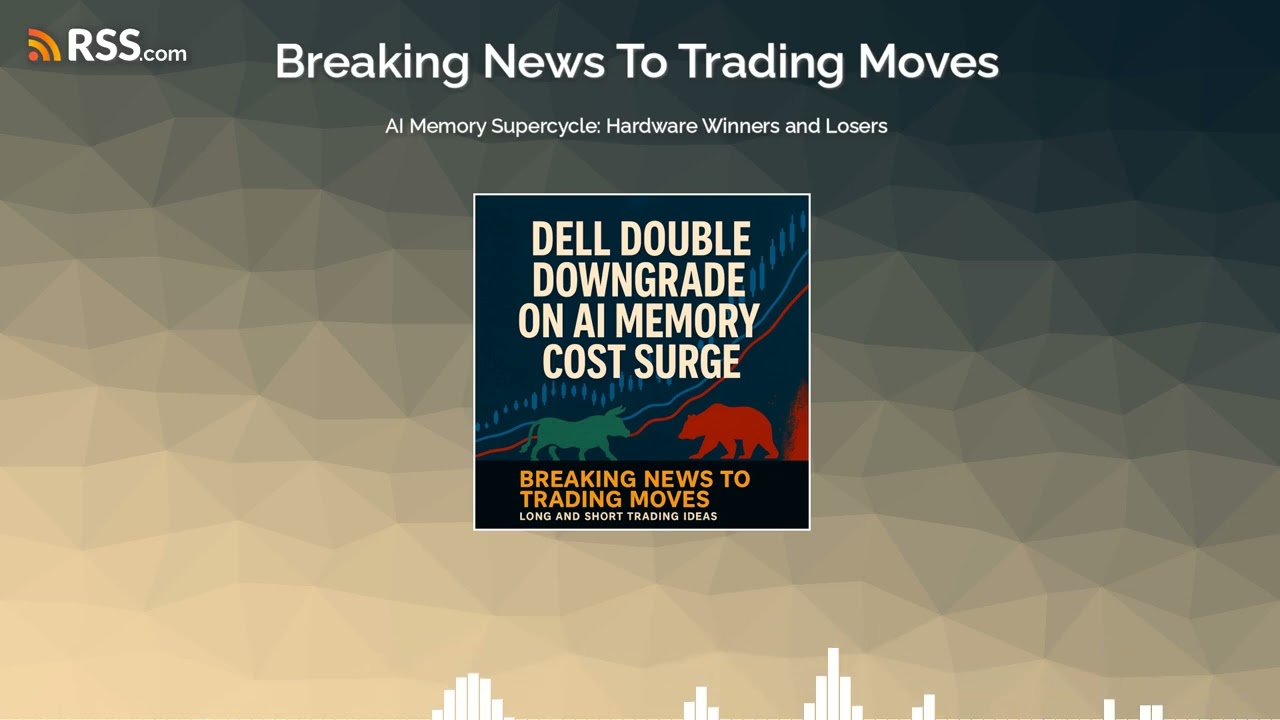
Dell Drops After Rare Double Downgrade as AI Memory Supercycle Squeezes Hardware Margins
Morgan Stanley double-downgraded $DELL and also cut ratings on $HPQ and $HPE, arguing that an AI-driven “memory supercycle” (DRAM up 300%, NAND up 50% in 6 months) will raise component costs and pressure hardware margins into 2026. JPMorgan disagrees on Dell’s near term, pointing to strong AI-server demand and backlog, so the market’s now debating “AI growth vs. input-cost squeeze.”
Winners -
Group 1: Memory chip producers
Why they benefit: Rising DRAM/NAND prices flow straight into higher average selling prices and margins for the manufacturers. AI servers also require more high-bandwidth memory per unit, reinforcing demand.
Names:
$MU (Micron Technology)
$NVDA (Nvidia — heavy HBM demand tailwind via its AI GPU ecosystem)
Group 2: Storage makers leveraged to NAND pricing
Why they benefit: NAND inflation and data-centre storage buildouts lift pricing power and profitability for U.S. listed HDD/flash-storage vendors. Morgan Stanley was explicitly more constructive on storage names in this cycle.
Names:
$WDC (Western Digital)
$STX (Seagate Technology)
Group 3: AI server supply chain with pricing power
Why they benefit: Even if OEM margins get squeezed, upstream AI-server component and platform leaders often keep demand and pricing strength as hyperscalers keep spending.
Names:
$SMCI (Super Micro Computer)
$AVGO (Broadcom)
Losers -
Group 1: PC and enterprise hardware OEMs most exposed to memory costs
Why they get hit: These companies have memory-heavy bills of materials. If DRAM/NAND costs rise faster than they can pass through, gross margins compress and earnings estimates drift lower.
Names:
$DELL (Dell Technologies)
$HPQ (HP Inc.)
Group 2: Server OEMs with mix risk and integration headwinds
Why they get hit: Servers need large memory footprints, so cost inflation bites. For some OEMs, additional execution or integration issues make margin pressure harder to offset.
Names:
$HPE (Hewlett Packard Enterprise)
$NTAP (NetApp — enterprise hardware/storage margins can be sensitive to component inflation)
Group 3: IT distributors/resellers tied to OEM margin cycles
Why they get hit: When OEMs face margin squeeze, they often reduce channel incentives or push pricing volatility downstream, hurting distributors’ profitability and near-term guidance.
Names:
$AVT (Avnet)
$ARW (Arrow Electronics)
#StockMarket #Trading #Investing #DayTrading #SwingTrading #TechStocks #Semiconductors #AI #DataCenter #MemoryChips #Servers #PCs #Earnings
Повторяем попытку...
Доступные форматы для скачивания:
Скачать видео
-
Информация по загрузке: