Molecular Precision Psychiatry. From subset identification to animal modeling and pharmacotherapy.
Автор: Carsten Korth
Загружено: 2026-02-06
Просмотров: 1
Описание:
Schizophrenia subsets can be identified (e.g. aggregated DISC1 protein), used as a biomarker and modeled in an animal model
Such an animal model can be used to explore pathomechanisms, further biomarkers and precise pharmacotherapies
Reverse-translation of a successful precision pharmacotherapy in the animal model to the corresponding schizophrenia patient subset remains the goal
References:
https://www.nature.com/articles/s4153...
https://www.jneurosci.org/content/45/...
https://onlinelibrary.wiley.com/doi/1...
https://www.nature.com/articles/s4139...
https://www.nature.com/articles/mp201...
https://www.tandfonline.com/doi/10.41...
https://www.biologicalpsychiatryjourn...
https://www.jneurosci.org/content/28/...
key words:
molecular precision psychiatry, precision pharmacotherapy, DISC1, Disrupted-in-schizophrenia 1, schizophrenia, mental illness, depression, bipolar disorder, psychosis, protein aggregation, proteostasis, animal models, transgenic rat, behavioral disorder, social deficit, social transmission of food preference, social novelty preference, dopamine, amisulpride, clozapine, translational medicine, reverse-translation,
Text:
Molecular Precision Psychiatry. How schizophrenia subset identification leads to a tailored animal model, biomarkers and precise pharmacotherapy.
The clinical diagnosis of schizophrenia is too broad and indiscriminate to account for the heterogeneity of its underlying biological causes. Many patients fulfill the clinical criteria for schizophrenia but because of many different, yet unknown, underlying biological causes
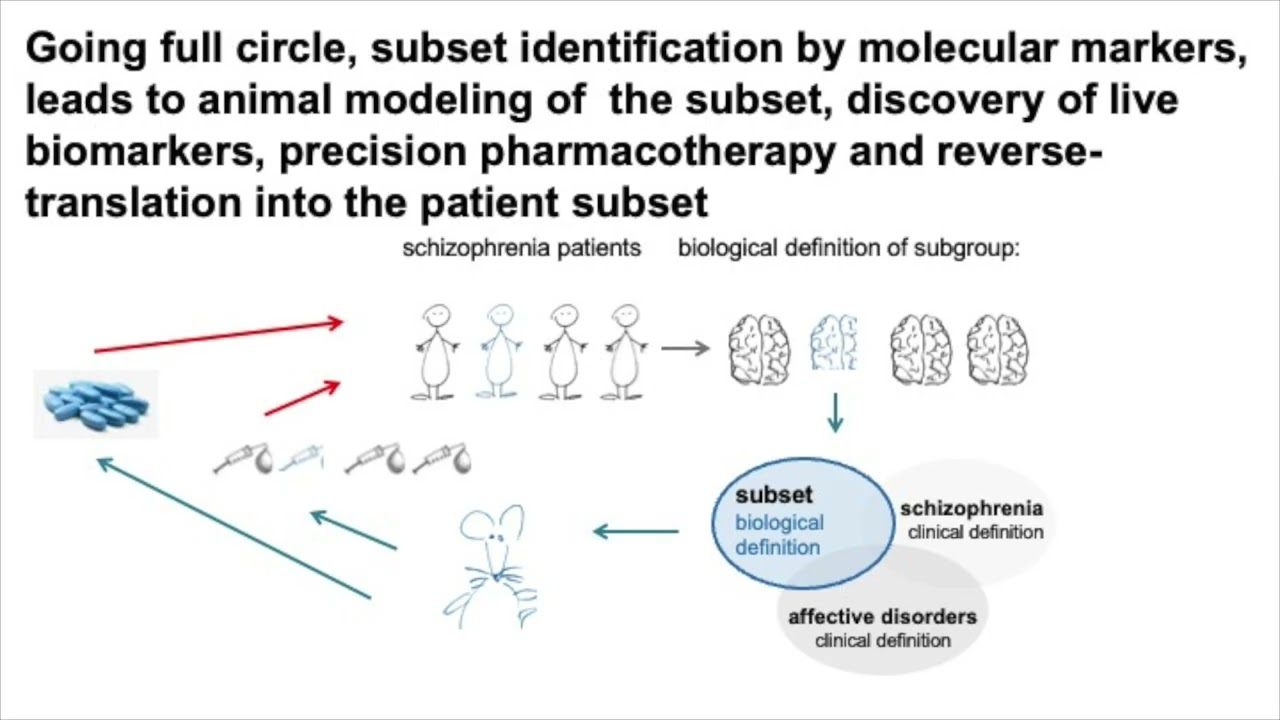
In the following, a full circle of molecular precision psychiatry will be outlined.
Identification of molecular markers in the brains of patients allows defining a biological subset of patients which crosses current clinical diagnostic boundaries.
Identification of molecular markers in the brains of patients enables generation of an animal model reflecting the identified molecular pathology and disordered behavior.
Molecular markers in CNS tissue of patients and a face valid animal model enable the identification of blood or cerebrospinal fluid biomarkers.
A face valid animal model with relevant phenotypes allows testing of precision pharmacotherapies.
Going full circle, subset identification by molecular markers, leads to animal modeling of the subset, discovery of live biomarkers, precision pharmacotherapy and reverse-translation back into the schizophrenia patient subset.
Over the past 15 years, we have exercised this circle for Disrupted-in schizophrenia 1 (DISC1) protein aggregates as a molecular marker. We identified DISC1 protein aggregates
in post mortem brains of patients with schizophrenia. We generated the tgDISC1 rat as a model for sporadic schizophrenia displaying phenotypes consistent with disrupted dopamine homeostasis. We identified molecular markers in blood and cerebrospinal fluid and finally we successfully reversed an important behavioral phenotype by pharmacotherapy.
The tgDISC1 rat displays social deficits resembling negative symptoms of schizophrenia patients that we demonstrated to be reversible by administration of amisulpride, an antipsychotic with relative D2/D3 receptor selectivity.
We conclude that schizophrenia subsets can be identified, in our case as being characterized by aggregated DISC1 protein, termed DISC1opathies. The pathology can be modeled in an animal and used to explore pathomechanisms, biomarkers and precise pharmacotherapies. Reverse-translation of a successful precision pharmacotherapy in the animal model to the corresponding schizophrenia patient subset remains the goal.
Повторяем попытку...
Доступные форматы для скачивания:
Скачать видео
-
Информация по загрузке: