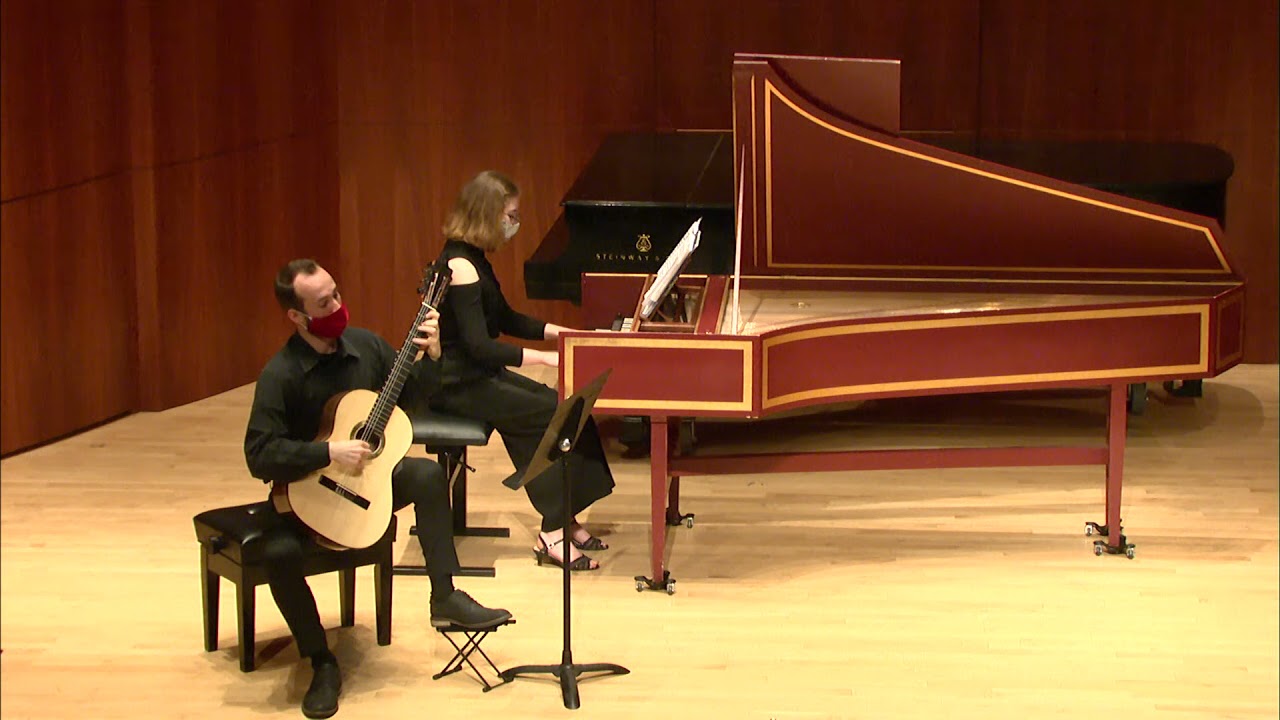
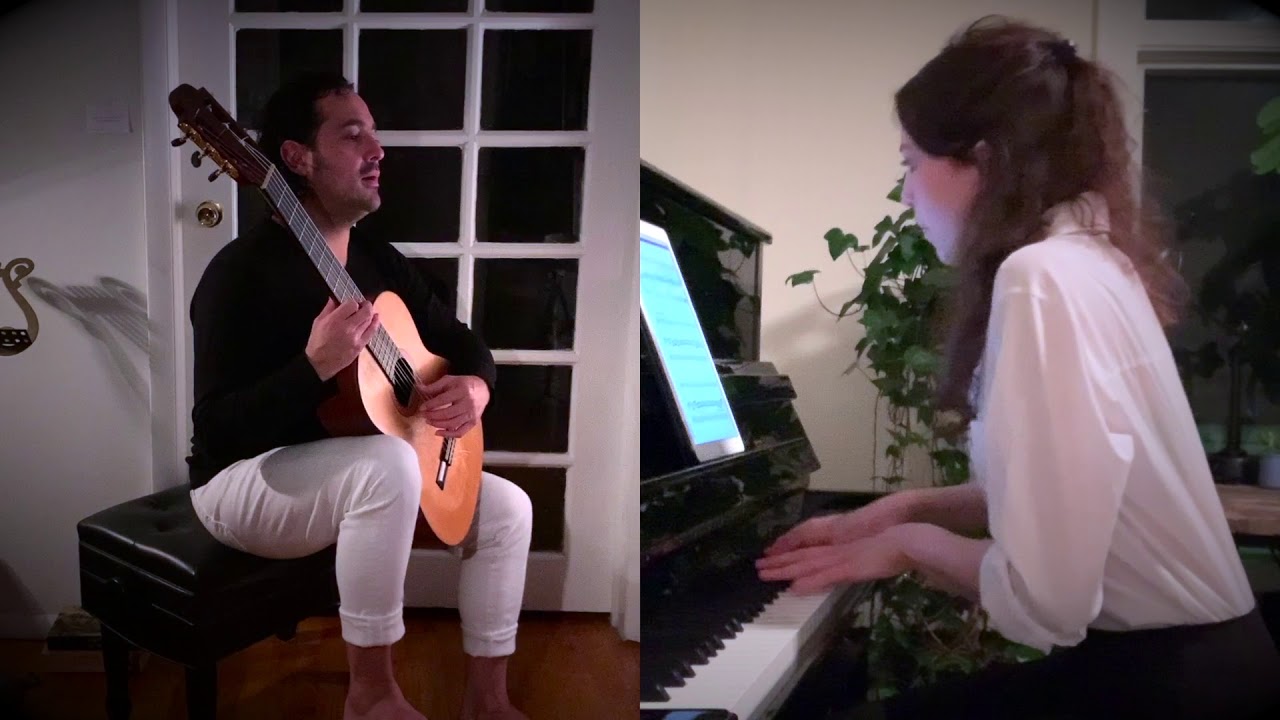
M.M. Ponce Sonata for Harpsichord and Guitar (II Mov) Anna Smigelskaya, Piano Nilko Andreas, Guitar
Автор: Latin American Chamber Music Society of New York
Загружено: 2020-05-01
Просмотров: 209
Описание:
Manuel M. Ponce Sonata for Harpsichord and Guitar (II Mov)
Anna Smigelskaya, Piano
Nilko Andreas, Guitar
“The guitar is an expressive harpsichord.” —Claude Debussy
Paris 1920, It was a time of rebirth not only for the guitar, but also for the harpsichord, and it is fascinating to see how these two very different instruments followed parallel paths in their acceptance as legitimate concert instruments by the general public and by the musical elite. Through the talent and tenacity of two great artists—Andrés Segovia (1893–1987) and Wanda Landowska (1879–1959)—the guitar and the harpsichord each appeared more frequently in concerts, and it was only natural that a work specifically composed for those two instruments would eventually follow. That work was Manuel M. Ponce’s Sonata for Guitar and Harpsichord, which was written in 1926 while the Mexican composer was studying in Paris. The work remained without a dedication until 1940. For many years, there was nothing in print about Ponce’s Sonata for Guitar and Harpsichord; indeed, it remained in manuscript form until its publication in 1973. However, information obtained from the Mexican guitarist Jesús Silva (1914–1996), use of the autographed copy of the sonata, and information in The Segovia-Ponce Letters shed new light on this work’s obscure past. The circumstances behind the creation of this work and its ultimate dedication provide a fascinating tale of the rise of the guitar and the harpsichord in the 20th century
it was Manuel M. Ponce who was the first to write a work pairing the two instruments, with his Sonata for Guitar and Harpsichord.
Ponce first met Segovia in 1923. That year, Ponce wrote a review of Segovia’s first concert in Mexico City. A strong friendship developed between the two artists that would last until Ponce’s death in 1948. At their initial meeting, Segovia encouraged Ponce to write something for the guitar. Ponce obliged with a short work titled De México—Pagina para Andrés Segovia. This piece would later become the third movement of Sonata Mexicana, the first major work Ponce composed for Segovia.
In 1925, at the age of 43, Ponce travelled to Paris to enroll in the composition class of Paul Dukas at the Ecole Normale de Musique. In this same class was the Spanish composer Joaquín Rodrigo. This stay was to last seven years. Ponce absorbed the compositional techniques of Dukas, who was a close friend of Debussy. During his time in Paris, Ponce wrote many important works for the guitar, including several sonatas, preludes, suites, and variations, and the first sketches of his guitar concerto. Almost all of these works were dedicated to Segovia. It is interesting to note that Ponce did not play the guitar—he was a brilliant pianist who had studied with a student of Franz Liszt. Like Torroba, Ponce instinctively knew how to write for the guitar. However, Segovia would often have to make modifications to the music, with Ponce’s consent, in order to make it more adaptable for the guitar.
Ponce’s Sonata for Guitar and Harpsichord was completed in Paris in 1926. In a letter to Ponce, dated August 21, 1926, Segovia wrote,
There was no additional information about the Sonata for Harpsichord and Guitar until 1940, when it was presented as a gift to two of Ponce’s students, guitarist Jesús Silva and pianist Amanda Cuervo; both were students at the National Conservatory of Music in Mexico. Silva studied harmony and aesthetics with Ponce and had developed a close relationship with the composer and his wife. Ponce would later dedicate two works for solo guitar, Verpertina and Matinal, to Silva. Silva was also a protégé of Segovia, having had his first lesson with the maestro in 1933 in Mexico City.
Silva and Cuervo studied the sonata and played it for Ponce, who, according to Silva, “appeared pleased with the results and even suggested placing a large strip of paper over the strings of the piano in order to imitate a little the effect of the harpsichord.” As with Falla’s Concerto for Harpsichord (or Pianoforte), Ponce had no problem with this work being performed on the piano instead of the harpsichord.
Since its publication in 1973, there have been numerous performances of the Sonata for Guitar and Harpsichord, along with several recordings. Some of these performances feature the piano as the alternative to the harpsichord.
The Sonata for Guitar and Harpsichord may not be one of Ponce’s best-known works, but it is widely considered to be one of his finest. It is an excellent example of Impressionistic harmonies combined with Baroque contrapuntal techniques.
John Patykula
Повторяем попытку...
Доступные форматы для скачивания:
Скачать видео
-
Информация по загрузке: