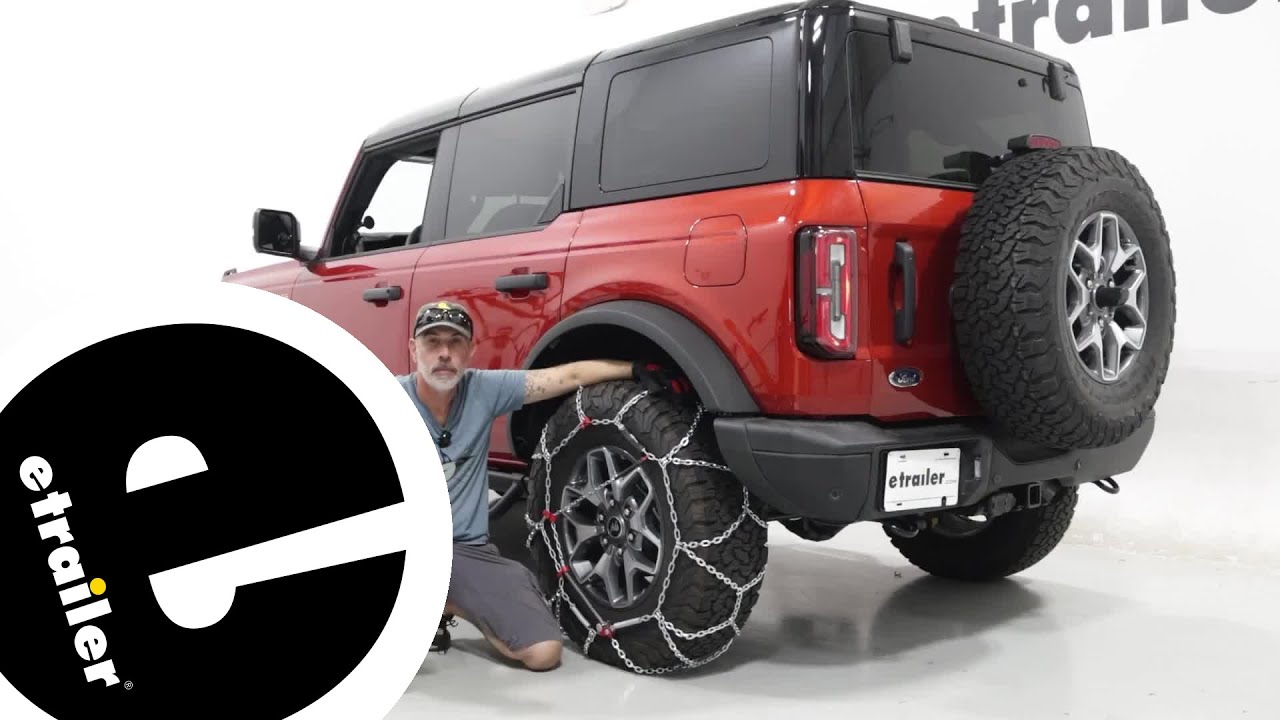
etrailer | Konig Square Link Tire Chains Fit Check - 2024 Ford Bronco
Автор: etrailer
Загружено: 2025-10-20
Просмотров: 48
Описание:
Click for more info and reviews of this Konig Tire Chains:
https://www.etrailer.com/Tire-Chains/...
Check out some similar Tire Chains options:
https://www.etrailer.com/fitguidechai...
Search for other popular Ford Bronco parts and accessories:
https://www.etrailer.com/vehicle/2024...
https://www.etrailer.com
Don’t forget to subscribe!
/ etrailertv
Full transcript: https://www.etrailer.com/tv-install-k...
Hello, neighbor, this is Curt with etrailer, and today, we're taking a look at these Konig tire chains with assisted tensioning. We're gonna see how they fit on our 2024 Ford Bronco with 285 over 70R17 tires. Now, tire chains are an excellent way to ensure that you've got that good traction to get you in and outta those situations where there's a lot of snow, ice, or mud on the ground. They're gonna create a lot of traction using these square links, which are gonna have a little bit of a sharper edge to 'em. Now that's gonna really help out when it comes to ice and things like that, but they're a bigger chain, too, so that's really gonna be nice in muddy conditions. Now one of the things I wanna mention up front is that the Ford Bronco Manual does suggest you use Class S tire chains, which are a low profile tire chain.
These are not Class S, these are actually a little bit bigger, but as we're gonna show you in a minute, there's a lot of clearance behind this wheel well and nothing really getting in the way of these, so this would be a tire chain that I would say you'd use at your own discretion. Now the chain is done in a diamond pattern, which is really good with traction. It also helps, you know, when you're taking turns and things, just keeping kinda that side-to-side control, as well. It's got a powder-coated chain around the outside here, so where it's kinda bumping up against your sidewalls, it's not gonna really do any damage. There is these kind of little buffers here that you can use if you want to.
Before tightening the chain up, you would insert 'em right here at these connection points underneath, just to create a little bit of a barrier in-between the two. I will say, though, that these are things that you're gonna have to keep track of because when you do loosen the chain, they're really held on there just by the pressure. So when you're taking 'em off and the chain gets loosened, these often kinda fall out and go everywhere, and if you're in snow or mud, keep track of 'em if you don't wanna lose 'em. Now in the back, the connection is made from this cable right here. It's got one connection point and one piece.
This is gonna make it really, really easy to install these tire chains without having to get underneath the car and behind the wheel to tighten it up, and loosen it, and things like that, as you do with some manual tensioning chains. Also from here, you could see what I meant earlier about the wheel clearance. Even though these aren't class S chains, these are actually bigger, we do have plenty of clearance back here, so this isn't really scaring me too much as far as any kind of damage being done because we've got technically oversized chains. But again, these are chains that you're gonna wanna use at your discretion. So the way this is gonna work with the assisted tensioning is it's gonna take a constant pull on this here.
So you're not gonna have to do a lot of readjustments on the road. And again, I mentioned earlier it also makes it for a really, really easy install, these type of chains, so stick around, I'm gonna show you how we got this on here right now. Now the first thing we wanna do in installing our chains is get 'em out on the ground, and lay 'em flat, and spread 'em out. What we're looking for is any kind of twists or kinks in the chain, or if maybe this is a set of tire chains that you've used before already, we're also gonna be looking for any damage from a previous use. But these are brand new, so our main mission is to just make sure they're not twisted up on us or anything, and we've got everything separated the way it should. So we have two general sides to it here that we're gonna leave separate because they're gonna go on either side of the tire when we install 'em. The other thing we've done is we've put them so that these connecting links to our cable in the back have the open end facing down. What that's gonna do for us is it's gonna ensure that when we put it on the tire, the open end of these hooks are facing away from our sidewall. So with them separated like this, I'm just gonna give 'em a little bit more separation, and I'm gonna end up feeding this around the back of my tire here. And I'm gonna use that split in the middle to go on either side of my tire. Now again, as I bring this around, I am trying to be carefu
Повторяем попытку...
Доступные форматы для скачивания:
Скачать видео
-
Информация по загрузке: