MSP|what is minimum support price|agricultural bills|farmers protest|farmers demand|APMC
Автор: Education Santosh Mishra IPS
Загружено: 2020-09-23
Просмотров: 136
Описание:
MSP|what is minimum support price|agricultural bills|farmers protest|farmers demand|APMC
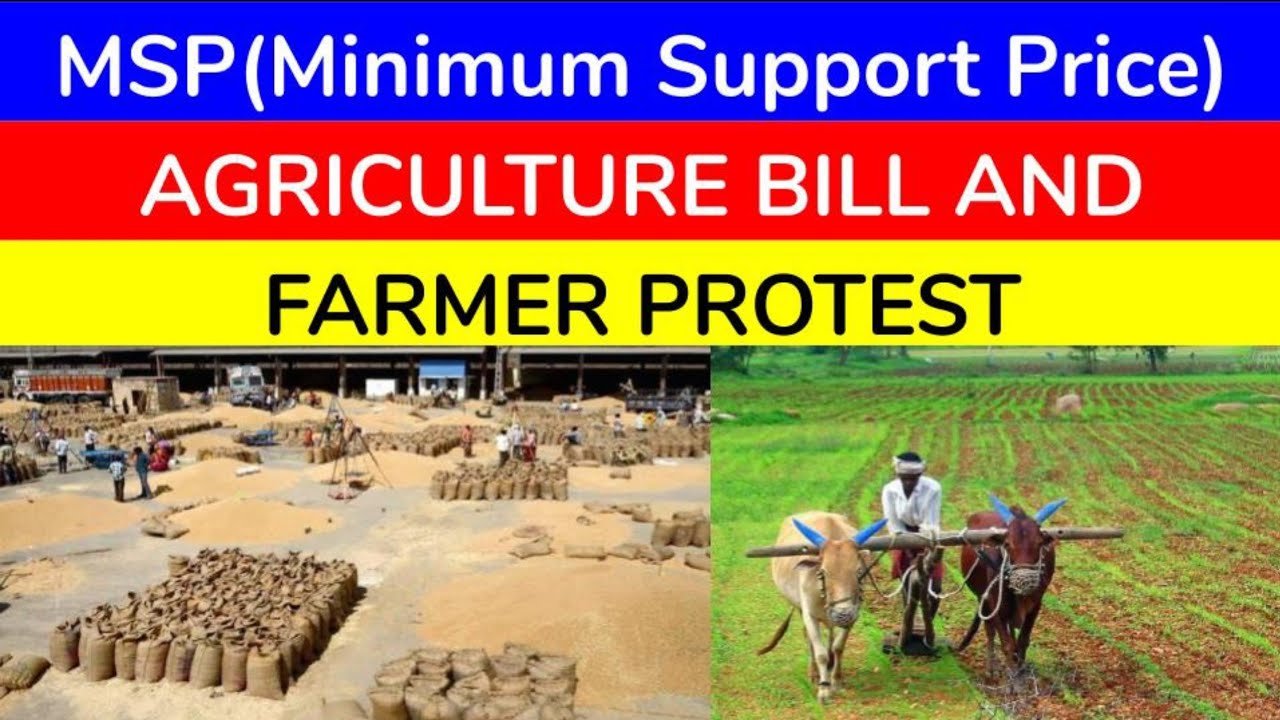
The minimum support price (MSP) is an agricultural product price set by the government of India to purchase directly from the farmer. This rate is to safeguard the farmer to a minimum profit for the harvest, if the open market has lesser price than the cost incurred.The Indian government sets the price for 22 commodities twice a year.It is fixed by an expert group
The government fixes the MSP of 22 mandated agricultural crops based on the recommendation of the Commission for Agricultural Costs and Prices (CACP). The list of crops shielded by price fluctuations include 14 kharif crops, six rabi crops, and two commercial crops. The CCAP is also responsible for fixing the fair and remunerative price (FRP) of sugarcane.
The mandated crops are 6 rabi crops, 14 crops of the Kharif season, and two other commercial crops. In total it includes;
Cereals (7) - wheat, paddy, bajra, barley, jowar, ragi, and maize;
Pulses (5) -arhar/tur, gram, urad, moong, and lentil and Oilseeds
(8);rapeseed/mustard, groundnut,soyabean, toria, sesamum, safflower seed, sunflower seed, and nigerseed.
The CACP takes into consideration factors such as domestic and international prices,
intercrop price parity,
the overall demand-supply situation,
and also the likely effect of the MSP on inflation.
government procurement is greatest for wheat and rice. The Centre procures about 30 per cent of all wheat and rice produced in the country and about 6-7 per cent of other commodities
The Commission for Agricultural Costs and Prices (CACP) takes into account several factors while deciding the MSPs of Rabi and Kharif crops. These factors are;
1. A minimum of 50% as the margin over the cost of production
2. Demand and supply
3. Changes in input prices
4. Input-output price parity
5. Effect on the cost of living
6. Effect on the general price level
7. Trends in market prices
8. Parity between prices paid and prices received by the farmers
9. International price situation
How is the MSP calculated?
According to the formula prescribed by the Swaminathan Committee, there are three variables that determine production cost – A2, A2+FL, and C2.0
A2 includes out-of-pocket expenses borne by farmers, such as term loans for machinery, fertilisers, fuel, irrigation, cost of hired labour and leasing land.
The second metric, A2+FL, takes into account the imputed value of unpaid labour on the part of family members, in addition to the paid-out cost.
The Comprehensive Cost (C2) is more reflective of the actual cost of production since it takes it accounts for rent and interest foregone on owned land and machinery, over and above the A2+FL rate. The ideal formula according the Committee would be: MSP = C2+ 50% of C2
Currents Rate :
MSP (Minimum Support Price) of wheat, the biggest crop of rabi season, has been hiked by Rs 50 to Rs 1,975 per quintal. Besides, MSPs of lentil (masoor), gram, barley, safflower and mustard/rapeseed have been increased.
the MSPs of six rabi crops were approved by the Cabinet Committee on Economic Affairs (CCEA).
Agrliculture Bills
The Farmers’ Produce Trade and Commerce (Promotion and Facilitation) Ordinance, 2020
Trade of farmers’ produce: The Ordinance allows intra-state and inter-state trade of farmers’ produce outside:
(i) the physical premises of market yards run by market committees formed under the state APMC Acts.
The Farmers (Empowerment and Protection) Agreement on Price Assurance and Farm Services Ordinance, 2020
Farming agreement: The Ordinance provides for a farming agreement between a farmer and a buyer prior to the production or rearing of any farm produce.
The Essential Commodities (Amendment) Ordinance, 2020
Regulation of food items: The Essential Commodities Act, 1955 empowers the central government to designate certain commodities (such as food items, fertilizers, and petroleum products) as essential commodities
Protest and Demand
Three demands.
“Government to bring another bill under which no private player can purchase below MSP,
MSP to be fixed under formula recommended by Swaminathan Commission, and
Government agencies like FCI shouldn’t buy crops below MSP,”
Повторяем попытку...
Доступные форматы для скачивания:
Скачать видео
-
Информация по загрузке: