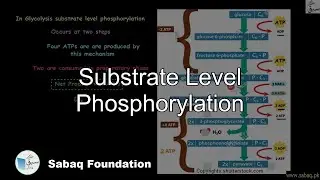
Substrate Level Phosphorylation | Bioenergetics | Class 11 | NBF | FBISE
Автор: Federal Lectures
Загружено: 2024-08-25
Просмотров: 2861
Описание:
Substrate-level phosphorylation is a metabolic process that generates ATP by transferring a phosphate group from a high-energy substrate to ADP. This process occurs in the cytosol of cells and is a key mechanism for producing ATP during glycolysis and other metabolic pathways.
Key characteristics:
1. *Direct transfer of phosphate group*: A high-energy substrate donates a phosphate group to ADP, forming ATP.
2. *No electron transport chain involved*: Unlike oxidative phosphorylation, substrate-level phosphorylation does not require the electron transport chain.
3. *Energy from substrate*: The energy for ATP production comes from the high-energy substrate itself.
4. *Limited ATP production*: Substrate-level phosphorylation produces less ATP compared to oxidative phosphorylation.
5. *Important in glycolysis*: Substrate-level phosphorylation occurs in the glycolytic pathway, generating ATP from phosphoenolpyruvate (PEP) and ADP.
Examples of substrate-level phosphorylation:
1. *Phosphoenolpyruvate (PEP) to pyruvate*: In glycolysis, PEP donates a phosphate group to ADP, forming ATP and pyruvate.
2. *Creatine phosphate to creatine*: In muscle cells, creatine phosphate donates a phosphate group to ADP, forming ATP and creatine.
3. *Succinyl-CoA to succinate*: In the citric acid cycle, succinyl-CoA donates a phosphate group to ADP, forming ATP and succinate.
Substrate-level phosphorylation is an essential mechanism for generating ATP, especially in situations where oxidative phosphorylation is limited.
#federalboard #biology #onlinescienceeducation #chemistry #photosynthesisinhigherplantsclass11 #onlinelearning #onlinebiology #class11 #class12 #class #substrate #bioenergetics #respiration #kpkboard #fbise #fbise_exams
Повторяем попытку...

Доступные форматы для скачивания:
Скачать видео
-
Информация по загрузке: