Hummingbird Nectar Thief at Cardinal Flower
Автор: Janet Pesaturo
Загружено: 2019-08-04
Просмотров: 438
Описание:
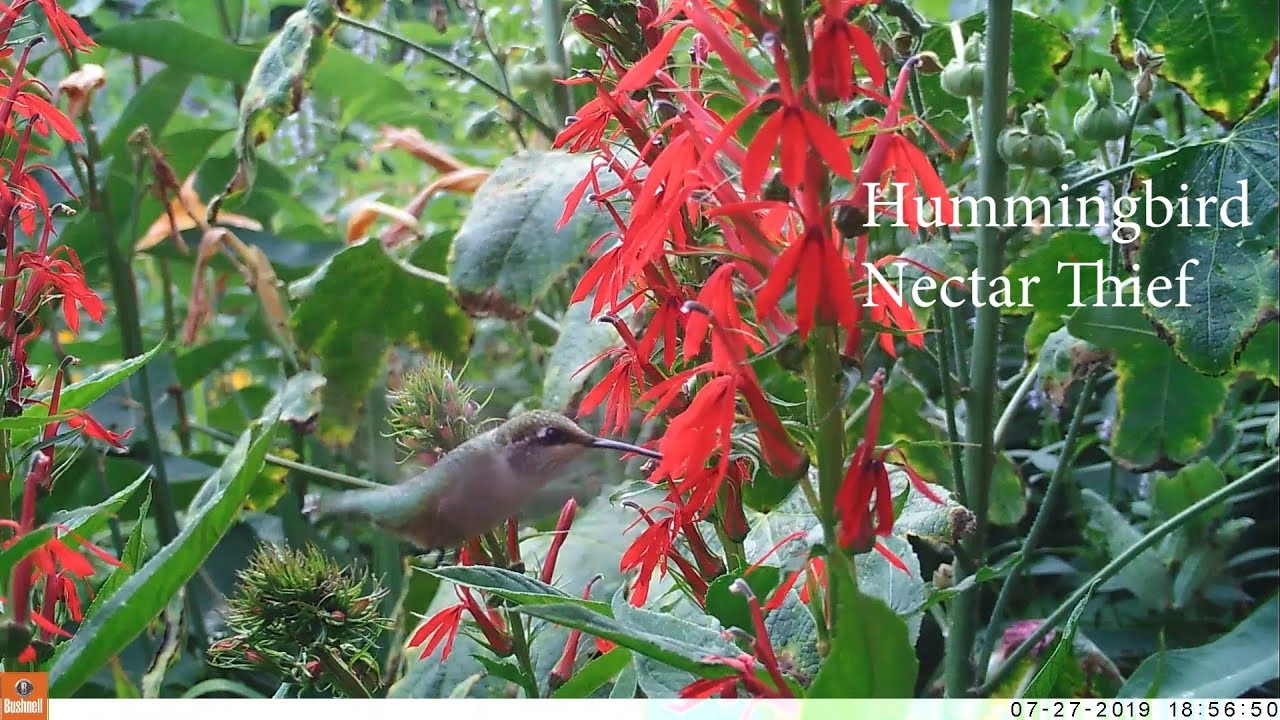
Hummingbirds are sometimes said to be perfect pollinators of cardinal flower, Lobelia cardinalis, because the size and shape of the bird's bill and head match the flower so well that pollination often results when the bird visits flower after flower for nectar. But pollination occurs only if the bird sips nectar in the obvious way, by inserting its beak into the flower tube. Only in this way will the bird make contact with the reproductive parts of the flowers, thus transferring pollen from one to another. This is clearly shown in my last post, Hummingbird Pollinating Cardinal Flower, which you may want to review if you're not sure how pollination occurs. Most hummingbirds take nectar from cardinal flower in this way, but I noticed that an occasional individual finds a different way of obtaining nectar that does not result in pollination. When an animal takes nectar without pollinating the flower, it is referred to as a "nectar thief". I did not find any reports of the ruby-throated hummingbird as a nectar thief at cardinal flower, so I decided to get a closer look with trail camera, to be sure I was seeing what I thought I was seeing.
I found it interesting that each hummingbird that visited a small clump of cardinal flower used only one method of obtaining nectar at each flower. It either pollinated, or it "stole" nectar. Not one of my video clips shows a bird acting as a pollinator at some cardinal flowers and a nectar thief at others
So why do some ruby-throated hummingbirds "steal" nectar from plants which they are perfectly suited to pollinate? I suspect that once a bird has learned a successful method for getting nectar from a certain flower species, it tends to keep using that method, especially if it is as rewarding as the "legitimate" method. If inserting its bill into the flower tube allows the bird to obtain more nectar and a thief discovers that, the bird may mend its ways and become a pollinator. (Studies show that this is true for insect pollinators and nectar thieves: Some become consistent robbers, while others switch methods if they learn that the "legitimate" method is more rewarding.)
What all of this means, of course, is that hummingbirds have to learn how to get nectar. They do not have an innate knowledge of the proper foraging method for each and every flower species. This makes sense because flowers come in so many different sizes and shapes. A learning brain allows the bird to exploit new resources, while a pre-programmed, scripted brain would not allow the bird to adapt to change. Watch them carefully and you will see that it is a learning process. I have watched fledglings in July visiting different flower species, poking around to figure out how to get the nectar. They poke at different parts of the flowers and from different directions. I've seen them poking between hollyhock petals from behind and I've seen them poke at unopened buds of several different flower species. It's clear that they don't "know" from the start exactly how to get nectar. It's a learning process.
Finally, some interesting research on hummingbird learning has been done. A study of white-eared hummingbirds (Hylocharis leucotis) showed that they can learn from observation of more experienced members of their own species. Inexperienced birds which had the opportunity to observe experienced birds, learned to feed faster at flowers than inexperienced birds which had no such opportunity. There's a lot going on in the bird brain!
Повторяем попытку...
Доступные форматы для скачивания:
Скачать видео
-
Информация по загрузке: