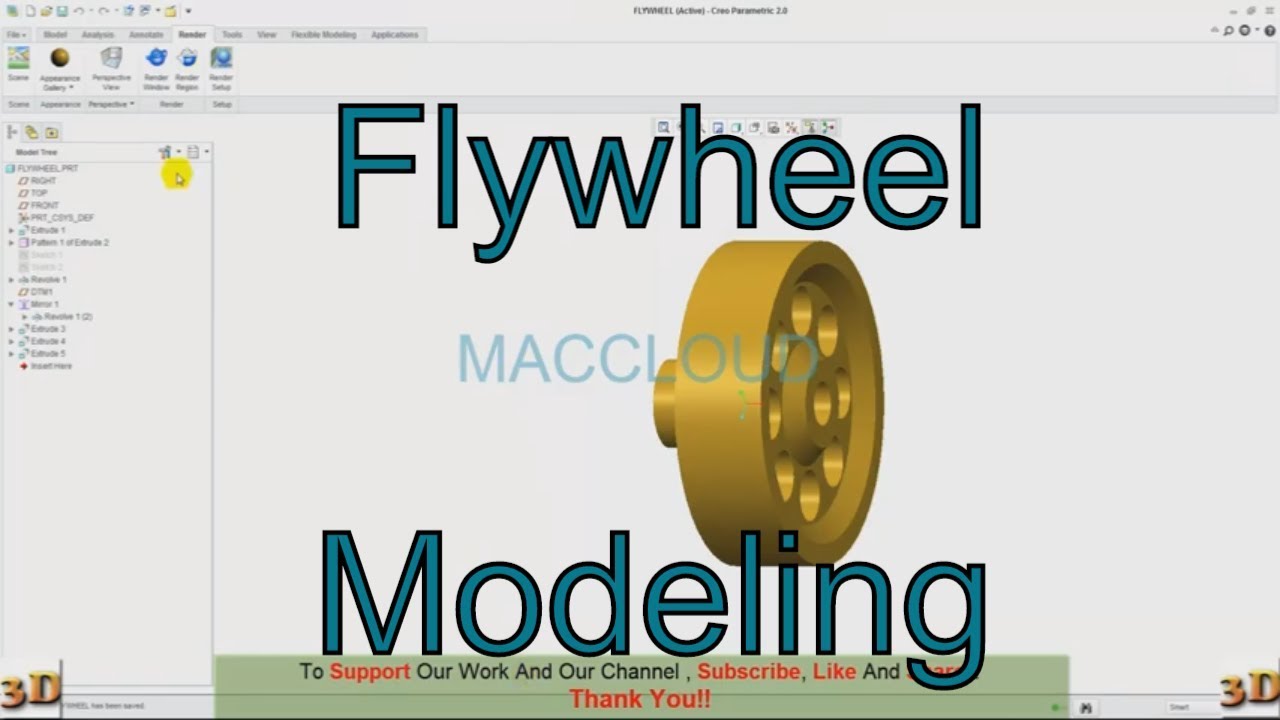
STEAM ENGINE | PTC CREO Modeling PART 10 | Flywheel
Автор: 3Dimensional CAD
Загружено: 2019-07-31
Просмотров: 228
Описание:
If you like to help me, send a tip https://paypal.me/3DimensionalCad
Another video tutorial in creo parametric!
Previous Video: • STEAM ENGINE | PTC CREO Modeling PART 7-8-...
Next Video : • STEAM ENGINE | PTC CREO Modeling PART 11-1...
If you liked this video or if I helped you in any way, like and share!
Subscribe for more future videos!
~~~~~~~~~~~~~~~~~~~~~~~~~~~~~~~~~~~~~~~~~~
STEAM ENGINE Modeling PART 1 http://bit.ly/2YwRq2O
STEAM ENGINE Modeling PART 2 http://bit.ly/2TjWTo3
STEAM ENGINE Modeling PART 3 http://bit.ly/2Thwpn7
STEAM ENGINE Modeling PART 4 http://bit.ly/2yMV2ys
STEAM ENGINE Modeling PART 5 http://bit.ly/2KPOzsn
STEAM ENGINE Modeling PART 6 http://bit.ly/31tW7Yc
STEAM ENGINE Modeling PART 7-8-9 http://bit.ly/2KFUik3
STEAM ENGINE Modeling PART 10 http://bit.ly/2YzVpvz
STEAM ENGINE Modeling PART 11-12-13-14 http://bit.ly/2KFqeFi
STEAM ENGINE Modeling PART 15-16-17 http://bit.ly/2YwT0BM
STEAM ENGINE ASSEMBLY AND MECHANISM http://bit.ly/2MRTTxM
~~~~~~~~~~~~~~~~~~~~~~~~~~~~~~~~~~~~~~~~~~
Subscribe To My Channel and See More Great Videos:
/ @3dimensionalcad
Like Us On FaceBook: / 3dimensionalcad
Follow Us On Twitter: / 3dimensionalcad
Google+ : https://plus.google.com/1174299151847...
~~~~~~~~~~~~~~~~~~~~~~~~~~~~~~~~~~~~~~~~~~
Share This Video : • STEAM ENGINE | PTC CREO Modeling PART 10 |...
~~~~~~~~~~~~~~~~~~~~~~~~~~~~~~~~~~~~~~~~~~
Subscribe To My Channel and See More Videos
/ @3dimensionalcad
~~~~~~~~~~~~~~~~~~~~~~~~~~~~~~~~~~~~~~~~~~
Share This Video : • STEAM ENGINE | PTC CREO Modeling PART 10 |...
#CREO #parametric #proe A steam engine is a heat engine that performs mechanical work using steam as its working fluid. The steam engine uses the force produced by steam pressure to push a piston back and forth inside a cylinder. This pushing force is transformed, by a connecting rod and flywheel, into rotational force for work. The term "steam engine" is generally applied only to reciprocating engines as just described, not to the steam turbine.
Steam engines are external combustion engines,where the working fluid is separated from the combustion products. The ideal thermodynamic cycle used to analyze this process is called the Rankine cycle.
In general usage, the term steam engine can refer to either complete steam plants (including boilers etc.) such as railway steam locomotives and portable engines, or may refer to the piston or turbine machinery alone, as in the beam engine and stationary steam engine.
Steam-driven devices were known as early as the aeliopile in the first century AD, with a few other uses recorded in the 16th and 17th century. Thomas Savery's dewatering pump used steam pressure operating directly on the water. The first commercially successful engine that could transmit continuous power to a machine was developed in 1712 by Thomas Newcomen. James Watt made a critical improvement by removing spent steam to a separate vessel for condensation, greatly improving the amount of work obtained per unit of fuel consumed. By the 19th century, stationary steam engines powered the factories of the Industrial Revolution. Steam engines replaced sail for ships, and steam locomotives operated on the railways.
Reciprocating piston type steam engines were the dominant source of power until the early 20th century, when advances in the design of electric motors and internal combustion engines gradually resulted in the replacement of reciprocating (piston) steam engines in commercial usage. Steam turbines replaced reciprocating engines in power generation, due to lower cost, higher operating speed, and higher efficiency.
Повторяем попытку...
Доступные форматы для скачивания:
Скачать видео
-
Информация по загрузке: