State Gibbs' phase rule and explain the terms involved in it. | Phase Rule | Physical Chemistry
Автор: Edmerls
Загружено: 2018-09-13
Просмотров: 9292
Описание:
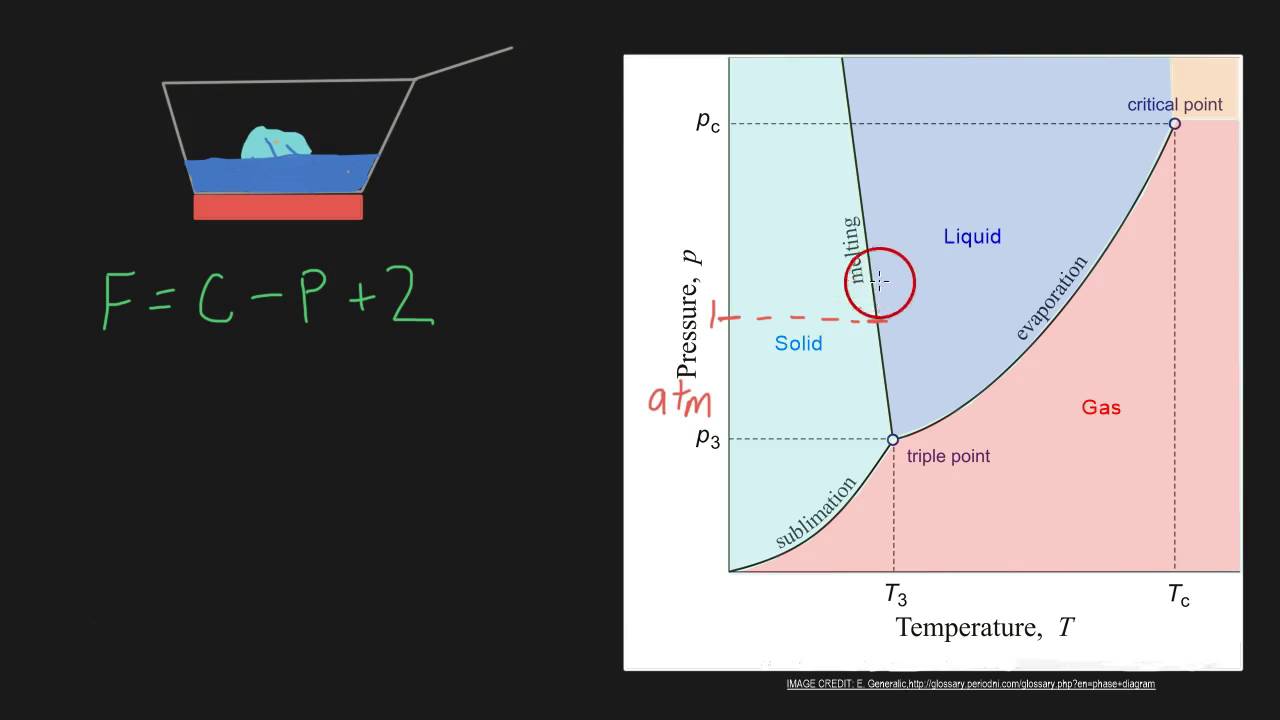
In 1876, Willard Gibbs stated a general principle called phase rule. The phase rule mathematically can be expressed as
F = C - P + 2
Where F = Degree of freedom
C = Number of components
P = Number of Phases
It governs the behavior of heterogeneous system.
Phases: A homogeneous, physically distinct and mechanically separable part of a heterogeneous system is called phase. e.g.
Gases are miscible in each other in all proportions. So the mixture of two or more gases constitutes one phase system.
A mixture of immiscible liquids consists of as many phases as the number of liquids. Water and carbon tetrachloride form two phase system. Water, benzene and mercury form three phase system.
A heterogeneous mixture of solid substances also consists of as many phases as the number of solids. Consider the decomposition of CaCO3
CaCO3(S) CaO(S) + CO2(G)
At equilibrium, there are three phases, two are solid phases, CaCO3(S) and CaO(S) and one is gaseous phase, CO2(G)
The system in which solid, liquid and vapour are in equilibrium, form three phases system. e.g. Ice WaterVapour
Components: The number of components is defined as the minimum number of independently variable constituents with the help of which the composition of each phase can be expressed in the form of an equation. e.g.
The water system consists of three phases, i. e. ice, water and vapour in equilibrium. Ice WaterVapour. Though the three phases represent different physical states, the chemical composition of every phase is same. Each phase can be represented by formula H2O. Thus it is one component system.
The decomposition of CaCO3
CaCO3(S) CaO(S) + CO2(G)
In this system also the number of phases is three. However, as a result of existence of equilibrium, the number of components is only two. Each phase can be represented by selecting any two constituents out of three.
In a salt-water system like NaCl in H2O, the various phases which may occur are salt, aqueous solution of salt and water and vapour. The composition of each of these phases may be expressed in terms of two constituents, salt and water. So it is two component system.
A mixture of two solids is two component system, e. g. Zn and Cd or Zn and Ag.
Degrees of Freedom: The minimum number of variable factors such as pressure temperature and concentration which must be fixed in order that condition of the system may be completely defined is called number of degrees of freedom. It is also called number of degrees of variance. The system with one degree of freedom is called univariant or mono-variant system, with two degree of freedom is called bi-variant and with no degree of freedom is called non-variant. e.g.
Behavior of a gas is governed by an equation PV= RT. It means if P and T are fixed, V can have one definite value. Thus, any two variables are required to define the condition of system completely. So the system is bivariant.
For the system like Ice WaterVapour has no degree of freedom or it is said to be nonvariant system. The three given phases can be in equilibrium only at definite temperature and pressure.
Royalty Free Stock Footage
• Flowers - Royalty free footage
Chemical Thermodynamics - Physical Chemistry
• State and Explain first law of thermodynam...
Ionic Equilibria - Physical Chemistry
• Derive expression for Ostwald’s Dilution law.
Electrochemistry - Physical Chemistry
• What are different types of Reversible Ele...
Solid State - Physical Chemistry
• Explain the following terms | Solid State ...
Gaseous State - Physical Chemistry
• Postulates of Kinetic Molecular Theory of ...
Colloidal States - Physical Chemistry
• What is Colloidal Solution? | Colloidal St...
Stereochemistry - Organic Chemistry
• Explain Configuration and Conformation | S...
Nanomaterials - Engineering Chemistry
• Compare top down with bottom up Processes ...
Water and Its Treatment - Engineering Chemistry
• Explain why hard water gives out a curd li...
Electrochemistry - Engineering Chemistry
• Distinguish between metallic and electroly...
Environmental Studies
• MCQ on Environmental Studies Part 8
Optics - Applied Physics
• What are cartesian sign conventions for sp...
For Details Visit
http://cepekmedia.co.nf
http://cepek.hol.es/
http://edmerls.66Ghz.com/
http://edmerls.tk/
#WillardGibbs #PhaseRule #Phase #Components #DegreeOfFreedom
Повторяем попытку...

Доступные форматы для скачивания:
Скачать видео
-
Информация по загрузке: